

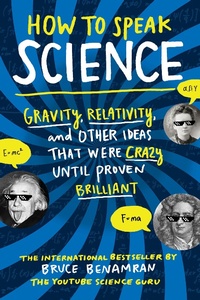
How to Speak Science
Gravity, Relativity, and Other Ideas That Were Crazy Until Proven Brilliant
Published on 30. April 2021
336 pages
978-1-61519-420-9 (ISBN)
Description

A math-free introduction to the greatest scientific ideas of the last 2,000 years: "This is the book for the wannabe science nerd." -
The Toronto Star
As smartphones, supercomputers, supercolliders, and AI propel us into an ever more unfamiliar future, How to Speak Sciencetakes us on a rollicking historical tour of the greatest discoveries and ideas that make today's cutting-edge technologies possible.
Wanting everyone to be able to "speak" science, YouTube science guru Bruce Benamran explains, accessibly and wittily, the fundamental ideas of the physical world: matter, life, the solar system, light, electromagnetism, thermodynamics, special and general relativity, and much more.
Along the way, Benamran guides us through the wildest hypotheses and most ingenious ideas of Galileo, Newton, Curie, Einstein, and science's other great minds, reminding us that while they weren't always exactly right, they were alwayscurious. How to Speak Scienceacquaints us not only with what scientists know, but how they think-so that each of us can reason like a physicist and appreciate the world in all its beautiful chaos.
"The perfect example of a geeky text that is neither condescending nor highfalutin. It has sufficient genuine scientific content to keep the techies interested, while being fast-paced enough (and at times genuinely funny) to keep the neophyte on board." - E&T Magazine
As smartphones, supercomputers, supercolliders, and AI propel us into an ever more unfamiliar future, How to Speak Sciencetakes us on a rollicking historical tour of the greatest discoveries and ideas that make today's cutting-edge technologies possible.
Wanting everyone to be able to "speak" science, YouTube science guru Bruce Benamran explains, accessibly and wittily, the fundamental ideas of the physical world: matter, life, the solar system, light, electromagnetism, thermodynamics, special and general relativity, and much more.
Along the way, Benamran guides us through the wildest hypotheses and most ingenious ideas of Galileo, Newton, Curie, Einstein, and science's other great minds, reminding us that while they weren't always exactly right, they were alwayscurious. How to Speak Scienceacquaints us not only with what scientists know, but how they think-so that each of us can reason like a physicist and appreciate the world in all its beautiful chaos.
"The perfect example of a geeky text that is neither condescending nor highfalutin. It has sufficient genuine scientific content to keep the techies interested, while being fast-paced enough (and at times genuinely funny) to keep the neophyte on board." - E&T Magazine
More details
Other editions
Additional editions
Bruce Benamran
How to Speak Science
Gravity, Relativity, and Other Ideas That Were Crazy Until Proven Brilliant
Book
09/2018
The Experiment LLC
€15.50
Shipment within 3-4 weeks
Person
Bruce Benamran is a YouTube personality whose popular science channels
e-penser (in French) and
Get It (in English) have over a million subscribers. Benamran holds a master's degree in computer science from the University of Strasbourg. Already an international bestseller,
How to Speak Science is his first book. @getitchannel
Content
- Intro
- FOREWORD
- Introduction
- 0. Correlation and Causality
- 1. Models and Reality
- Matter
- 2. Atoms
- 3. Good Old Science Dude: Dmitri Mendeleev
- 4. The Electron
- 5. The Nucleus of the Atom
- Light
- 6. Is Light Made of Particles or Waves?
- 7. The Discovery of the Photoelectric Effect
- 8. First Detour: Heat
- 9. Second Detour: Black Bodies
- 10. Einstein in 1905: The First Article
- 11. Why Do They Turn Off Airplane Cabin Lights for Night Landings?
- 12. Why Is the Sky Blue and the Sun Yellow?
- 13. What Is a Rainbow?
- 14. How Many Senses Do Humans Have?
- 15. You Have Never Touched Anything in Your Life
- Electromagnetism
- 16. Magnetism
- 17. Permanent Magnets
- 18. Electricity?! What Does That Have to Do with Anything?
- 19. Static Electricity
- 20. Electric Fields
- 21. Ampère, Gauss, Faraday, and Others . . . Right up to Maxwell
- 22. Maxwell's Four Equations
- The Solar System
- 23. The Sun
- 24. Stellar Nucleosynthesis
- 25. Formation of the Solar System
- 26. Mercury
- 27. Good Old Science Dude: Guillaume Le Gentil-Gentle Willy
- 28. Earth, the Goldilocks of the Solar System
- 29. The Earth Is Round
- 30. Good Old Science Dude: Eratosthenes
- 31. How Old Is the Earth?
- 32. Mars
- 33. The Missing Planet
- 34. Pallas, Juno, Vesta, and Everyone Else and Their Mother
- 35. Jupiter
- 36. The Jovian System
- 37. Saturn
- 38. Mimas, Enceladus, and Titan
- 39. Uranus and Neptune
- 40. Pluto, the Fallen Planet
- 41. Kuiper Belt and Oort Cloud
- 42. The Dimensions of the Solar System
- Classical Mechanics
- 43. The Great Question of Life, the Universe, and Everything
- 44. Aristotle and Impetus
- 45. Archimedes and the First Mechanics
- 46. Eureka, or the Golden Crown of Hiero II, Tyrant of Syracuse
- 47. Good Old Science Dude: Galileo, Part 1
- 48. Giordano Bruno, Punk Genius and Father of Relativity
- 49. Good Old Science Dude: Galileo, Part 2
- 50. Good Old Science Dude: Isaac Newton
- 51. Force, Couple, Torque, and Work
- 52. Momentum and Collisions
- 53. Angular Momentum
- Life
- 54. You Are Alive
- 55. The Incredible Highways and Byways of the Body
- 56. In a Cell
- 57. The Incredible Things Your Brain Does All by Itself
- 58. Why Is Yawning Contagious?
- 59. Left-Handers
- 60. A Conclusion About Life?
- Thermodynamics
- 61. So, What Is It? Do Tell.
- 62. Is the Cake Pan Hotter Than the Cake?
- 63. The First Steam Engine
- 64. Good Old Science Dude: Francis Bacon
- 65. Sadi Carnot, Father of Thermodynamics
- 66. The Three Laws of Thermodynamics
- 67. And Boltzmann?
- 68. Einstein in 1905: The Second Article
- Special Relativity
- 69. To Move or Not to Move? That Is the Question
- 70. The Problem with Light
- 71. The Ether
- 72. Michelson's Interferometer
- 73. The Electrostatic Problem
- 74. Lorentz and Poincaré
- 75. Einstein in 1905: The Third Article
- 76. A Problem with Clocks
- 77. The Problem with Two Lights
- 78. The Special Theory of Relativity
- General Relativity
- 79. Newtonian Gravity
- 80. If a Roofer Fell Off a Roof
- 81. Equivalence Principle
- 82. Geometrization of Gravity
- 83. Non-Euclidean Space-Time
- 84. Better Together in 1913: Coauthoring an Article
- 85. Einstein in 1905: The Fourth Article
- 86. And Mercury Proves It
- 87. The General Theory of Relativity
- 88. Testing, Testing, 1-2-3
- 89. The Big Problem with Relativity and the Rest
- Chronology of Scientists
- Acknowledgments
- About the Author
