

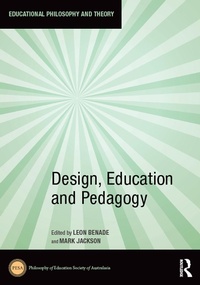
Design, Education and Pedagogy
1st Edition
Published on 9. June 2020
108 pages
978-1-000-05281-7 (ISBN)
Description

This book explores the increasing emergence within educational institutions, such as schools and universities, of large, flexible spaces whose design is underpinned by cutting-edge principles and technologies.
These changes in educational facilities have spawned a range of new terminology. For example, terms such as 'modern learning environments', 'innovative learning environments', 'flexible learning environments' and 'new generation learning spaces' have gained currency in recent years. The development of flexible learning spaces, while suggesting design creativity, also points to the desire by governments to influence educational outcomes. The displacement of traditional classrooms also presupposes varied teaching and learning approaches, calling on teachers to work in teams and to de-privatise their practice into spaces that are transparent and porous.
These developments in the area of educational facilities suggest critical questions regarding the origins and purposes of these changes in educational thinking and practice. Questions must also be raised about the links between conception, design intention and spatial practice. Underlying these questions are competing views on the design of education facilities. This volume gathers a range of international authors who theorise these questions at the intersection of building design, pedagogy and educational policy.
The chapters in this book were originally published in the journal Educational Philosophy and Theory.
These changes in educational facilities have spawned a range of new terminology. For example, terms such as 'modern learning environments', 'innovative learning environments', 'flexible learning environments' and 'new generation learning spaces' have gained currency in recent years. The development of flexible learning spaces, while suggesting design creativity, also points to the desire by governments to influence educational outcomes. The displacement of traditional classrooms also presupposes varied teaching and learning approaches, calling on teachers to work in teams and to de-privatise their practice into spaces that are transparent and porous.
These developments in the area of educational facilities suggest critical questions regarding the origins and purposes of these changes in educational thinking and practice. Questions must also be raised about the links between conception, design intention and spatial practice. Underlying these questions are competing views on the design of education facilities. This volume gathers a range of international authors who theorise these questions at the intersection of building design, pedagogy and educational policy.
The chapters in this book were originally published in the journal Educational Philosophy and Theory.
More details
Edition
1. Auflage
Language
English
Place of publication
London
United Kingdom
Publishing group
Taylor & Francis Ltd
Target group
College/higher education
Product notice
Reflowable
ISBN-13
978-1-000-05281-7 (9781000052817)
Copyright in bibliographic data and cover images is held by Nielsen Book Services Limited or by the publishers or by their respective licensors: all rights reserved.
Schweitzer Classification
Other editions
Additional editions
Leon Benade | Mark Jackson
Design, Education and Pedagogy
Book
06/2024
1st Edition
Routledge
€71.98
Shipment within 10-20 days
Leon Benade | Mark Jackson
Design, Education and Pedagogy
Book
03/2020
1st Edition
Routledge
€179.51
Shipment within 15-20 days
Persons
Leon Benade has an interest in the way 'twenty-first century learning' impacts teachers' work, particularly in relation to the establishment of innovative learning environments (ILE).
Mark Jackson has a research focus on design ethics with respect to spatial practices that extend from education facilities to broader concerns with urban political theory and practice.
Mark Jackson has a research focus on design ethics with respect to spatial practices that extend from education facilities to broader concerns with urban political theory and practice.
Content
Introduction 1. Is the classroom obsolete in the twenty-first century? 2. Re/assembling 'innovative' learning environments: Affective practice and its politics 3. Innovative learning environments and new materialism: A conjunctural analysis of pedagogic spaces 4. Activating built pedagogy: A genealogical exploration of educational space at the university of Auckland's Epsom campus and business school 5. I/MLEs and the uneven return of pastoral power 6. Bodies and affect in non-traditional learning spaces 7. From Low-Lying Roofs to Towering Spires: Toward a Heideggerian understanding of learning environments 8. The scene of the classroom
