

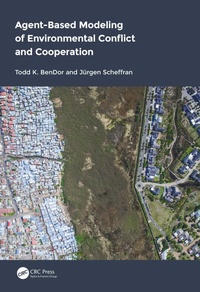
Agent-Based Modeling of Environmental Conflict and Cooperation
1st Edition
Published on 12. October 2018
363 pages
978-1-351-10624-5 (ISBN)
Description

Conflict is a major facet of many environmental challenges of our time. However, growing conflict complexity makes it more difficult to identify win-win strategies for sustainable conflict resolution. Innovative methods are needed to help predict, understand, and resolve conflicts in cooperative ways.
Agent-Based Modeling of Environmental Conflict and Cooperation examines computer modeling techniques as an important set of tools for assessing environmental and resource-based conflicts and, ultimately, for finding pathways to conflict resolution and cooperation. This book has two major goals. First, it argues that complexity science can be a unifying framework for professions engaged in conflict studies and resolution, including anthropology, law, management, peace studies, urban planning, and geography. Second, this book presents an innovative framework for approaching conflicts as complex adaptive systems by using many forms of environmental analysis, including system dynamics modeling, agent-based modeling, evolutionary game theory, viability theory, and network analysis. Known as VIABLE (Values and Investments from Agent-Based interaction and Learning in Environmental systems), this framework allows users to model advanced facets of conflicts-including institution building, coalition formation, adaptive learning, and the potential for future conflict-and conflict resolution based on the long-term viability of the actors' strategies.
Written for scholars, students, practitioners, and policy makers alike, this book offers readers an extensive introduction to environmental conflict research and resolution techniques. As the result of decades of research, the text presents a strong argument for conflict modeling and reviews the most popular and advanced techniques, including system dynamics modeling, agent-based modeling, and participatory modeling methods. This indispensable guide uses NetLogo, a widely used and free modeling software package, to implement the VIABLE modeling approach in three case study applications around the world. Readers are invited to explore, adapt, modify, and expand these models to conflicts they hope to better understand and resolve.
Agent-Based Modeling of Environmental Conflict and Cooperation examines computer modeling techniques as an important set of tools for assessing environmental and resource-based conflicts and, ultimately, for finding pathways to conflict resolution and cooperation. This book has two major goals. First, it argues that complexity science can be a unifying framework for professions engaged in conflict studies and resolution, including anthropology, law, management, peace studies, urban planning, and geography. Second, this book presents an innovative framework for approaching conflicts as complex adaptive systems by using many forms of environmental analysis, including system dynamics modeling, agent-based modeling, evolutionary game theory, viability theory, and network analysis. Known as VIABLE (Values and Investments from Agent-Based interaction and Learning in Environmental systems), this framework allows users to model advanced facets of conflicts-including institution building, coalition formation, adaptive learning, and the potential for future conflict-and conflict resolution based on the long-term viability of the actors' strategies.
Written for scholars, students, practitioners, and policy makers alike, this book offers readers an extensive introduction to environmental conflict research and resolution techniques. As the result of decades of research, the text presents a strong argument for conflict modeling and reviews the most popular and advanced techniques, including system dynamics modeling, agent-based modeling, and participatory modeling methods. This indispensable guide uses NetLogo, a widely used and free modeling software package, to implement the VIABLE modeling approach in three case study applications around the world. Readers are invited to explore, adapt, modify, and expand these models to conflicts they hope to better understand and resolve.
More details
Edition
1. Auflage
Language
English
Place of publication
London
United Kingdom
Publishing group
Taylor & Francis Ltd
Target group
College/higher education
Professional and scholarly
Illustrations
3 Tables, black and white; 52 Illustrations, black and white
File size
15,71 MB
ISBN-13
978-1-351-10624-5 (9781351106245)
Copyright in bibliographic data and cover images is held by Nielsen Book Services Limited or by the publishers or by their respective licensors: all rights reserved.
Schweitzer Classification
Other editions
Additional editions
Todd BenDor | Juergen Scheffran
Agent-Based Modeling of Environmental Conflict and Cooperation
Book
06/2020
1st Edition
CRC Press
€72.70
Shipment within 15-20 days
Todd BenDor | Juergen Scheffran
Agent-Based Modeling of Environmental Conflict and Cooperation
Book
10/2018
1st Edition
CRC Press
€205.10
Shipment within 10-20 days
Persons
Professor Todd BenDor is the head of the land use and environmental planning specialization in the Department of City and Regional Planning University of North Carolina at Chapel Hill. His research and teaching focus on producing better ways to understand the impacts that human activities and development can have on sensitive ecological and environmental systems. His research uses both qualitative and quantitative techniques to explore improvements in environmental policy, better and easier to use models of urban growth and change, and improvements in environmental conflict resolution techniques. Dr. BenDor is also the Director of Carolina Planning's Ph.D. Program.
Juergen Scheffran is professor at the Institute of Geography of Universitaet Hamburg and head of the Research Group Climate Change and Security (CLISEC) in the Excellence Initiative "Integrated Climate Systems Analysis and Prediction" (CliSAP) at KlimaCampus Hamburg. He is Associate Member of the Center for Science and Peace Research (ZNF) and Faculty Affiliate of the Program in Arms Control, Disarmament and International Security (ACDIS) at the University of Illinois. After his physics Ph.D. at the University of Marburg he worked in the Interdisciplinary Research Group IANUS and the Mathematics Department of the Technical University of Darmstadt, at the Potsdam Institute for Climate Impact Research (PIK), and as Visiting Professor at the University of Paris (Sorbonne). Before he came to Hamburg in August 2009, he spent five years at the University of Illinois at Urbana-Champaign (UIUC), where he held positions in the Departments of Political Science and Atmospheric Sciences, at ACDIS and the Center for Advanced BioEnergy Research (CABER).
Juergen Scheffran is professor at the Institute of Geography of Universitaet Hamburg and head of the Research Group Climate Change and Security (CLISEC) in the Excellence Initiative "Integrated Climate Systems Analysis and Prediction" (CliSAP) at KlimaCampus Hamburg. He is Associate Member of the Center for Science and Peace Research (ZNF) and Faculty Affiliate of the Program in Arms Control, Disarmament and International Security (ACDIS) at the University of Illinois. After his physics Ph.D. at the University of Marburg he worked in the Interdisciplinary Research Group IANUS and the Mathematics Department of the Technical University of Darmstadt, at the Potsdam Institute for Climate Impact Research (PIK), and as Visiting Professor at the University of Paris (Sorbonne). Before he came to Hamburg in August 2009, he spent five years at the University of Illinois at Urbana-Champaign (UIUC), where he held positions in the Departments of Political Science and Atmospheric Sciences, at ACDIS and the Center for Advanced BioEnergy Research (CABER).
Content
Part I: Conflict and the Promise of Conflict Modeling 1. Environmental Conflicts in a Complex World 2. Why Model? How Can Modeling Help Resolve Conflict? 3. The History and Types of Conflict Modeling 4. Participatory Modeling and Conflict Resolution Part II: Modeling Environmental Conflict 5. System Dynamics and Conflict Modeling 6. Agent-Based Modeling and Environmental Conflict 7. Modeling Conflict and Cooperation as Agent Action and Interaction Part III: Applications of the VIABLE Model Framework 8. A Viability Approach to Understanding Fishery Conflict and Cooperation 9. An Adaptive Dynamic Model of Emissions Trading 10. Modeling Bioenergy and Land Use Conflict 11. The Future of Modeling Environmental Conflict and Cooperation
