

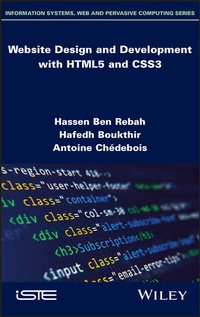
Website Design and Development with HTML5 and CSS3
1st Edition
Published on 22. December 2021
352 pages
978-1-119-88510-8 (ISBN)
Description

Combining theory and practice, Website Design and Development with HTML5 and CSS3 is aimed at both beginners who want to design their first website, and experienced developers who want to consolidate their technical skills.
This book addresses the theoretical aspects of HTML5 and CSS3, including: HTML elements, semantic containers, semantic text formatting, multimedia elements, forms, tables, definition and integration of CSS styles, text formatting, and container and box styles. It also encompasses a practical section which presents the process of creating a website, as well as the key rules to apply in order to not only achieve project success, but also to meet user needs. Illustrated by numerous examples, this book includes corrected practical work, structured according to an evolutionary logic ranging from the design of a simple HTML5 page to the creation of a professional website.
This book addresses the theoretical aspects of HTML5 and CSS3, including: HTML elements, semantic containers, semantic text formatting, multimedia elements, forms, tables, definition and integration of CSS styles, text formatting, and container and box styles. It also encompasses a practical section which presents the process of creating a website, as well as the key rules to apply in order to not only achieve project success, but also to meet user needs. Illustrated by numerous examples, this book includes corrected practical work, structured according to an evolutionary logic ranging from the design of a simple HTML5 page to the creation of a professional website.
More details
Other editions
Additional editions
H. Ben Rebah
Website Design and Development with HTML5 and CSS3
Software
01/2022
Wiley
€172.10
No shipping information available
Hassen Ben Rebah | Hafedh Boukthir | Antoine Chedebois
Website Design and Development with HTML5 and CSS3
Book
01/2022
1st Edition
ISTE Ltd
€164.50
Shipment within 3-4 weeks
Persons
Hassen Ben Rebah is Professor at the Higher Institute of Technological Studies of Mahdia, Tunisia, specializing in web programming and computer security.
Hafedh Boukthir is Professor at the Higher Institute of Technological Studies of Mahdia, Tunisia, and a webmaster and web developer. He specializes in SEO and natural referencing.
Antoine Chedebois, an engineer by training, has been developing websites for nearly twenty years. He is a specialist in HTML, CSS, JavaScript, PHP and Python, and is currently the lead developer of an international team of developers at GAFA.
Hafedh Boukthir is Professor at the Higher Institute of Technological Studies of Mahdia, Tunisia, and a webmaster and web developer. He specializes in SEO and natural referencing.
Antoine Chedebois, an engineer by training, has been developing websites for nearly twenty years. He is a specialist in HTML, CSS, JavaScript, PHP and Python, and is currently the lead developer of an international team of developers at GAFA.
Content
Foreword xi
Teddy PAYET
Preface xiii
Chapter 1 The Web and its Future 1
1.1 Background 1
1.2 Phases of evolution of the Web 3
1.3 Web application architecture 7
Chapter 2 The Language of the Web: HTML5 13
2.1 Overview 13
2.2 Structure of an HTML5 document 18
2.3 Structuring the content of a web page 21
2.4 Text organization 28
2.5 Creating hyperlinks 52
2.6 Inserting images and multimedia objects 58
2.7 Tables 65
2.8 Forms 70
Chapter 3 Style Sheets: CSS3 101
3.1 Overview 101
3.2 Text formatting 121
3.3 List formatting 131
3.4 Backgrounds, borders and shadows 133
3.5 Table formatting 144
3.6 Layout of the site 148
Chapter 4 Design and Creation of a Website 167
4.1 Process of creating a website 167
4.2 Ergonomics of the website 175
4.3 Different website types 181
Chapter 5 Practical Exercises 185
5.1 PE1: structure of an HTML5 web page 185
5.2 PE2: simple forms 195
5.3 PE3: table formatting 211
5.4 TP 4: media (image, video and audio) 240
5.5 PE: element positioning 270
5.6 PE6: creating a template model 296
5.7 PE7: creating a website from A to Z 313
References 323
Index 325
Teddy PAYET
Preface xiii
Chapter 1 The Web and its Future 1
1.1 Background 1
1.2 Phases of evolution of the Web 3
1.3 Web application architecture 7
Chapter 2 The Language of the Web: HTML5 13
2.1 Overview 13
2.2 Structure of an HTML5 document 18
2.3 Structuring the content of a web page 21
2.4 Text organization 28
2.5 Creating hyperlinks 52
2.6 Inserting images and multimedia objects 58
2.7 Tables 65
2.8 Forms 70
Chapter 3 Style Sheets: CSS3 101
3.1 Overview 101
3.2 Text formatting 121
3.3 List formatting 131
3.4 Backgrounds, borders and shadows 133
3.5 Table formatting 144
3.6 Layout of the site 148
Chapter 4 Design and Creation of a Website 167
4.1 Process of creating a website 167
4.2 Ergonomics of the website 175
4.3 Different website types 181
Chapter 5 Practical Exercises 185
5.1 PE1: structure of an HTML5 web page 185
5.2 PE2: simple forms 195
5.3 PE3: table formatting 211
5.4 TP 4: media (image, video and audio) 240
5.5 PE: element positioning 270
5.6 PE6: creating a template model 296
5.7 PE7: creating a website from A to Z 313
References 323
Index 325
