

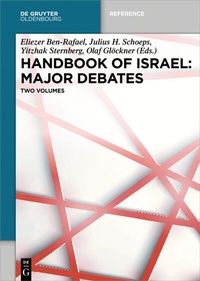
Handbook of Israel: Major Debates
Description

The Handbook of Israel: Major Debates serves as an academic compendium for people interested in major discussions and controversies over Israel. It provides innovative, updated and informative knowledge on a range of acute debates. Among other topics, the handbook discusses post-Zionism, militarism, democracy and religion, (in)equality, colonialism, today's criticism of Israel, Israel-Diaspora relations, and peace programs. Outstanding scholars face each other with unadulterated, divergent analyses. These historical, political and sociological texts from Israel and elsewhere make up a major reference book within academia and outside academia. About seventy contributions grouped in thirteen thematic sections present controversial and provocative approaches refl ecting, from different angles, on the present-day challenges of the State of Israel.
Other Major Works by the Editors:
Eliezer Ben-Rafael
Is Israel One? Religion, Nationalism and Ethnicity Confounded, Brill (2005)
Ethnicity, Religion and Class in Israel, Cambridge University Press (paperback) (2007)
Julius H. Schoeps
Begegnungen. Menschen, die meinen Lebensweg kreuzten. Suhrkamp (2016)
Pioneers of Zionism: Hess, Pinsker, Rülf. Messianism, Settlement Policy, and the Israeli-Palestinan Conflict. De Gruyter (2013)
Yitshak Sternberg
World Religions and Multiculturalism: A Relational Dialectic. Brill (2010).
Transnationalism. Brill (2009)
Olaf Glöckner
Being Jewish in 21st Century Germany. De Gruyter (2015, with Haim Fireberg)
Deutschland, die Juden und der Staat Israel. Olms (2016, with Julius H. Schoeps)
Reviews / Votes
"Bringing together 68 contributions organized in thirteen thematic sections, the Handbook of Israel enables readers to dive into an impressive overview of discussions and controversies around the complexities of Israeli society, its institutional matrices and multiple identities. (.) The editors have done a superb job, introducing each part and its subsections ('topics'), describing accurately the major lines of discussion and debate (.). It is almost impossible to sum up the vast amount of knowledge and wisdom, as well as the diversity of subjects and contributions of this reference work."
Luis Roniger in: the Israel Studies Review, Vol. 33/3, (2018)
"Usually, social scientists describe and analyze Israel in order to promote their own vision, and often to criticize other perspectives. These two solid and impressive volumes propose much more: they voice the debates that this complex, fascinating and important experience has provoked. The reader gets access to these debates, at the best level, and his or her own level of comprehension benefits from these texts that confront the challenges and trials faced by Israel."
Michel Wieviorka, École des Hautes Études en Sciences Sociales (EHESS), Paris
"[Die Beiträge] bieten klar formulierte Thesen, lassen sich als Narrative lesen und bilden mit ausführlichen Personen- und Sachregistern ein hilfreiches Nachschlagewerk. Die Autoren und Autorinnen - Historiker und Politikwissenschaftler, Juristen und Soziologen, Psychologen und Kulturwissenschaftler - sind, mit wenigen Ausnahmen, israelische Experten an führenden Universitäten und Akademien des Landes."
Jakob Hessing in: Der Tagesspiegel 31. 05. 2017
"In der Zusammenschau der unterschiedlichen Problematiken geht das Buch über die Diskussionen der einzelnen Aspekte hinaus, die sich in verschiedenen partiellen Debatten vertiefen lassen. So könnte die MMZ-Publikation auch über die tagespolitischen Aspekte hinaus zu einem wichtigen Nachschlagewerk werden."
Richard Rabensaat in: Potsdamer Neueste Nachrichten, 09.03.2017
"Neue Referenzgröße. WissenschaftlerInnen analysieren im "Handbook of Israel" den israelischen Staat. Es hat das Zeug zu einem neuem Standardwerk. [...] diese [r] Bände [...] werden noch für mindestens zwei Jahrzehnte die unverzichtbare Referenzgröße, ja das herausragende Standardwerk in Israel, den USA und Deutschland sein."
Micha Brumlik in: taz 20.06.2017
"Das Handbook of Israel ist ein aktuelles Standardwerk mit dem Potenzial, die Debatten über den jüdischen Staat zu qualifizieren und neue Sichtweisen auf das Land und seine Gesellschaft aufzuzeigen."
Jérôme Lombard, Jüdische Allgemeine, 08.12.2016
More details
Other editions
Additional editions
Persons
Eliezer Ben-Rafael , Tel-Aviv Univ.; Julius H. Schoeps, MMZ; Yitzhak Sternberg, Beit Berl Academic College; Olaf Glöckner, MMZ, Potsdam.
Content
- Intro
- Foreword
- Table of Content
- General Introduction
- Part A: Cleavages
- Topic I: Israel - West, East, or Global?
- Introduction
- 1. Israeli Culture Today: How Jewish? How Israeli?
- 2. To What Degree Is Israeli Culture Jewish, and to What Degree Israeli?
- 3. Hebrew Culture in Israel: Between Europe, the Middle East, and America
- 4. Israeli Culture(s) Today: Globalized Archipelago of Isolated Communities
- 5. Bauhaus Architecture in Israel: De-Constructing a Modernist Vernacular and the Myth of Tel Aviv's "White City"
- 6. Yam Tikhoniut: Mediterraneanism as a Model for Identity Formation in between
- Topic II: A Theocracy?
- Introduction
- 7. Religion and State, One and the Same
- 8. The Haredi-Secular Debate and the Shas Approach
- 9. The Secular State in Rabbinic Thought
- 10. Religion and State in Israel
- 11. The Non-Separation of Religion and State in Israel: Does It Support the Racism and Nationalism Wave?
- Topic III: One People? One Nation?
- Introduction
- 12. Russian-Speaking Israelis in the Ethno-Social Tapestry of Israel
- 13. Immigration and Conflict in a Deeply Divided Society: The Encounter between Russian Immigrants and the Indigenous Palestinian Minority in Israel
- 14. "About Miracles": The Flourishing of the "Torah World" of Yeshivot and Kollelim in Israel
- 15. The Divided People Revisited
- Topic IV: Ethnic (In)Equality
- Introduction
- 16. Inequality in Israel: In the End, Israel Produced Its Own 1%
- 17. What Has Become of the Ethnic Devil? Reflections on the Current State of Israeli Ethnicity
- 18. On the Cultural Distinction between East and West among Israeli Jews
- 19. We and the Others: Majority Attitudes toward Non-Jews in Israel
- Topic V: Social (In)Justice
- Introduction
- 20. Social Justice in Israel: Shifting Paradigm
- 21. Israel's Socioeconomic Debate: A New Perspective
- 22. A Short Economic History of Israel
- 23. The Myth of Ethnic Inequality in Israel
- Topic VI: Feminism
- Introduction
- 24. Debates within Israeli Feminism
- 25. Navigating Gender Inequality in Israel: The Challenges of Feminism
- 26. The Schizophrenic Reality of Israeli Women: A Cinematic Perspective,2014
- 27. Gender Policy in Family and Society among Palestinian Citizens of Israel: Outside and Inside Influences
- Topic VII: Discontinuities
- Introduction
- 28. "Ladies and Gentlemen, Mahapach": The 1977 Realignment from a Political Historical Perspective
- 29. The Likud as a Dominant Party and Israel's Post-1977 Infrastructure
- 30. The 1977 Changeover: The Emergence of a New Discourse among Palestinians in Israel
- 31. The 1977 Paradox: Immediate Crises and Long-Range Economic and Political Restructuring Outcomes of the Changeover
- 32. Dialectics of Change through Continuity: The 1977 Political Upheaval Revisited
- Part B: The Challenge of Post-Zionism
- Topic VIII: Militarism?
- Introduction
- 33. Israel: A Militaristic Society?
- 34. Are Israel's Media Critical of the IDF and the Security Culture?
- 35. Militarism and Civil-Military Relations in Israel: A New Approach
- 36. Patterns of Militarism in Israel
- Topic IX: A Democracy?
- Introduction
- 37. "Ethnocracy": The Politics of Judaizing Israel/Palestine
- 38. Israeli Democracy: Civic and Ethnonational Components
- 39. What Kind of Democracy Is Israel?
- 40. From Liberal Democracy to Ethnocracy: Different Conceptions of Israel's Democracy
- 41. Israel's Vision: Jewish and Democratic
- 42. Is Israel a Democracy?
- Topic X: Debating Post-Zionism
- Introduction
- 43. Understanding the Divide: Arabs and Jews in Israel
- 44. Is Israel a Colonial State?
- 45. Is There Still a Future for Settlements in Zionist Ideology?s
- 46. The Colonialism/Colonization Perspective on Zionism/Israel
- 47. What Do Those Who Claim Zionism Is Colonialism Overlook?
- 48. Post-Zionism and Its Moral and Political Ramifications
- 49. The Debate over the "New Historians" in Israel
- Topic XI: Criticism of Israel - A Kind of Antisemitism?
- Introduction
- 50. Post-Zionists and Anti-Zionists: The "Otherjews'" Hour
- 51. Parallel Lines: Anti-Zionism and Antisemitism in the 21st Century
- 52. Anti-Zionist Discourse of the Left in Latin America: An Assessment
- 53. Europe, Israel, the Jewish Communities, and Growing Antisemitism
- 54. Criticism of Israel: A New Antisemitism?
- Part C: Israel Outward
- Topic XII: Israel-Diaspora
- Introduction
- 55. The Changing Status of Zionism and Israel in Latin American Jewry
- 56. Ethnicity and State Policy: Israel in the Discourse of the Jewish Press in the USA during the Past Generation
- 57. The French State, the Vertical Alliance, and the State of Israel
- 58. French Jewry and the Israelization of Judaism
- 59. Israel and the Diaspora: Convergent and Divergent Markers
- 60. Israel-Diaspora Relations: "Transmission Belts" of Transnationalism
- 61. Negation of the Diaspora from an Israeli Perspective: The Case of A. B. Yehoshua
- Topic XIII: The Conflict
- Introduction
- 62. "They help to weave the veil": Edgar Salin and the Israel Economic and Sociological Research Project
- 63. A Perspective on the Prospects of Settling the Zionist-Palestinian Conflict
- 64. Accords or Peace between Israel and the Palestinians
- 65. The Binational Dilemma
- 66. Why Is It So Difficult to Resolve the Israeli-Palestinian Conflict by Israeli Jews? A Socio-Psychological Approach
- 67. Perspectives of Israeli-Palestinian Peace, 1917-2015
- 68. The Two-State Solution: A Way Out of the Impasse
- List of Contributors
- Glossary
- Index of Persons
- Index of Subjects
