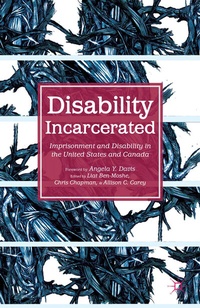
Disability Incarcerated
Description

Reviews / Votes
"The essays in Disability Incarcerated demonstrate that racialized and disabled bodies are now, and historically have been, policed in various and complex ways, causing a disproportionate number of people with disabilities to be confined in carceral spaces, whether in institutions or in prisons. The collection compellingly argues for a deeper examination of the interlocking oppressions that have caused othered bodies specifically, disabled, working-class, minority, immigrant, terrorist, and displaced bodies to be watched, controlled, and contained by the prison-industrial complex. . . Disability Incarcerated offers readers a powerful critique of neoliberalism and its exploitation of non-normative bodies, and it certainly has primed the path for future work that bridges critical prison studies and critical disability studies." - Disability Studies Quarterly
"Disability Incarcerated constitutes a major contribution to critical disability and penal studies, joining the two as no other book does . . . Only now and then does a work of scholarship so ground-breaking, so well theorized, and so daring appear on the scene. And seldom do we come across an anthology destined to become a classic." - Canadian Journal of Disability Studies
"Provocative, original, and timely, this collection reveals inextricable links between disability and incarceration. Each study of confinement places disability in sustained dialogue with broader forces and identities, including race, gender, sexuality and class. Accessible prose and collaborative projects attest to the transformative power of activist scholarship." - Susan Burch, Associate Professor of American Studies and former director of the Center for the Comparative Study of Race and Ethnicity, Middlebury College, USA
"Disability Incarcerated challenges both scholarship and activism around the prison industrial complex by demonstrating how disability is central to systems of incarceration. It further shows howthe build-up of the prison nation is not just around policing race and gender, but simultaneously policing disability. This book thus highlights how race, colonialism, and gender operate through disability. An amazing collection.' - Andrea Smith, Associate Professor of Media and Cultural Studies, University of California, Riverside, USA
"There is admirable depth to each chapter While the interconnection between incarceration and disability overall is called into question, readers are forced to pause for thought and reconsider their understanding of how social constructs and perceptions can influence persons in prison and persons with disability" Rose Ricciardelli, British Journal of Criminology 55(3)
More details
Other editions
Additional editions