

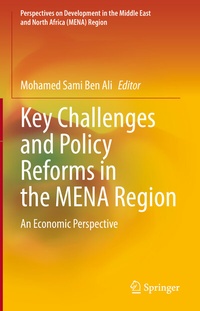
Key Challenges and Policy Reforms in the MENA Region
Description

This volume addresses economic challenges and policy reforms in the Middle East and North Africa (MENA) region. Despite important resources and strategic advantages, the region suffers from a number of economic, social, and political problems that impedes normal economic take-off. The volume contains theoretical and empirical studies covering individual countries and panel studies addressing these economic challenges. Chapters address issues such as economic growth; poverty and inequality; subsidies and public finances policies; external trade and financial liberalization; remittances,corruption, transparency, and institutions; renewable energy, digitalization, terrorism, regional integration, capital flight,money laundering, financial development and brain drain. Providing a comprehensive understanding of the most important and urgent economic challenges in the region, this volume will be a useful reference for researchers and policymakers interested in the MENA region.
More details
Other editions
Additional editions
Person
Dr. Mohamed Sami Ben Ali is a professor of Economics at Qatar University. Previously, he was head of the economics department and member of the scientific board at HEC Business School, Tunisia. He holds a H.D.R. degree, the highest European qualification for research. Previously, he received a Ph.D. in Economics with high honors from the University of Lille, France, an M.Phil. (D.E.A.) in International Finance and International Trade, and a B.A. in Business Economics. He has been teaching for the past years at graduate and undergraduate levels in Tunisia, Qatar, and France where he was a visiting professor. Dr. Ben Ali is serving as associate editor for Springer and De Gruyter journals and editor for Palgrave, Springer and Routledge (Taylor and Francis) books series. He published a couple of books on economic development and has been named in 2021 as a highly cited researcher on the United Nations' Sustainable Development Goals (SDG's) by Times Higher Education ranking. He also has published numerous articles in French and in English in international refereed academic journals on different economic development and international monetary macroeconomics issues. He is actively participating and chairing in numerous international conferences.
Content
New Empirical Evidence from Long Run Relationship in MENA Countries.- Chapter 2. Digital gaps and economic inequalities in MENA countries: An Empirical Investigation.- Chapter 3. Assessing the determinants of capital flight from Tunisia: An ARDL Investigation framework.- Chapter 4. Assessing Macroeconomic, Distributive and Environmental Impacts of Energy Subsidies Removal in Tunisia with Input-Output Modeling.- Chapter 5. Remittances, Income inequality and Brain Drain: An Empirical Investigation for the MENA Region.- Chapter 6. Digital Divide and External Trade Liberalization in the MENA Region: A theoretical and Empirical investigations.- Chapter 7. The Relationship Between Money Laundering and Economic Growth in the MENA Region - A Simultaneous Equations Model.- Chapter 8. The Institutional Approach to Financial Development: Panel Study for the MENA Region.
