

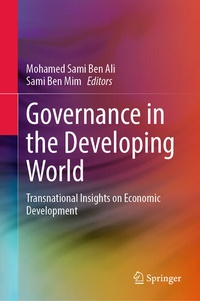
Governance in the Developing World
Description

This book assesses the extent to which good governance may contribute to enhancing economic performance and social welfare in developing countries, globally. Governance has been pointed out as one of the major weaknesses of developing economies and may largely be attributed to weak governance practices at both the macro- and micro-level. This book highlights the channels through which governance may act on various economic sectors and different key economic variables. In doing so, it enables policymakers to identify and implement policies and procedures to promote good governance. This book provides a transnational perspective on good governance in considering developing countries in Asia, Africa and beyond, presenting respective case studies in single country settings, enabling a comparative perspective between and across all chapters. Covering topics that include the intersection between governance and gender, inequality, poverty, education and health, the book provides diverse theoretical and empirical evidence on important issues facing policymakers, investors and other stakeholders and is relevant to graduate students and researchers interest in policy issues in the developing world.
More details
Other editions
Additional editions
Persons
Mohamed Sami Ben Ali is a full professor of Economics at Qatar University. Previously, he was the head of the economics department and member of the scientific board at HEC Business School, Tunisia. He holds a H.D.R degree, the highest European qualification for research. Previously, he received a Ph.D. in Economics with high honors from University of Lille-France, an M.Phil. (D.E.A) in International Finance and International Trade and a B.A. in Business Economics. He has been teaching for the past years at graduate and undergraduate levels in Tunisia, Qatar and France where he was a visiting professor. Dr. Ben Ali is serving as an associate editor for Springer and De Gruyter journals and editor for Palgrave and Springer and Routledge (Taylor and Francis) books series. He published a couple of books on economic development. His research and publications focus mainly on economic development and international monetary macroeconomics. He is actively participating and chairing in numerous international conferences.
Sami Ben Mim is a full professor of Economics at the University of Sousse in Tunisia. He holds the HDR degree, the highest qualification of research. He obtained his Ph.D. in Economics with high honors from the Paris XII University in France. He previously obtained his Masters degree in Applied Economics from the same university, graduating as a class valedictorian. He also holds an Engineer degree in Statistics and possesses a high level of scientific expertise in econometric methods, mainly in the fields of time series and panel data. Since 1999, he has been teaching at graduate and undergraduate levels in Tunisia and France. Throughout his career, he has served as the vice-dean and director of graduate studies at the Faculty of Economics and Management of Mahdia, and he was a member of the scientific board in several universities. His research work deals with macroeconomics as well as financial and monetary economics. He isregularly publishing in highly indexed revues and participated to numerous international symposiums and conferences. He is actually a member of the Management and Quantitative Finance Research Unit (Laremfiq) at the IHEC business school of Sousse and an associated researcher at the ERUDITE Research Unit at Paris-Est Créteil University.
Content
Dynamic Institutions as Pillars for Sustainable Development.- Upgrading and downgrading developing countries sovereign ratings: Does Governance matters?.- Do governance indicators predict inequality? A panel non-causality framework for the emerging countries.- Enhancing economic development through ICT-based governance: Evidence for developing countries.
