

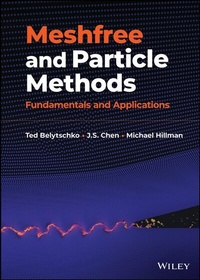
Meshfree and Particle Methods
Description

Provides thorough coverage of essential concepts and state-of-the-art developments in the field
Meshfree and Particle Methods is the first book of its kind to combine comprehensive, up-to-date information on the fundamental theories and applications of meshfree methods with systematic guidance on practical coding implementation. Broad in scope and content, this unique volume provides readers with the knowledge necessary to perform research and solve challenging problems in nearly all fields of science and engineering using meshfree computational techniques.
The authors provide detailed descriptions of essential issues in meshfree methods, as well as specific techniques to address them, while discussing a wide range of subjects and use cases. Topics include approximations in meshfree methods, nonlinear meshfree methods, essential boundary condition enforcement, quadrature in meshfree methods, strong form collocation methods, and more. Throughout the book, topics are integrated with descriptions of computer implementation and an open-source code (with a dedicated chapter for users) to illustrate the connection between the formulations discussed in the text and their real-world implementation and application. This authoritative resource:
* Explains the fundamentals of meshfree methods, their constructions, and their unique capabilities as compared to traditional methods
* Features an overview of the open-source meshfree code RKPM2D, including code and numerical examples
* Describes all the variational concepts required to solve scientific and engineering problems using meshfree methods such as Nitsche's method and the Lagrange multiplier method
* Includes comprehensive reviews of essential boundary condition enforcement, quadrature in meshfree methods, and nonlinear aspects of meshfree analysis
* Discusses other Galerkin meshfree methods, strong form meshfree methods, and their comparisons
Meshfree and Particle Methods: Fundamentals and Applications is the perfect introduction to meshfree methods for upper-level students in advanced numerical analysis courses, and is an invaluable reference for professionals in mechanical, aerospace, civil, and structural engineering, and related fields, who want to understand and apply these concepts directly, or effectively use commercial and other production meshfree and particle codes in their work.
More details
Other editions
Additional editions
Persons
Ted Belytschko, the former Walter P. Murphy and McCormick Institute Professor of Northwestern University, was one of the world's most renowned researchers in computational mechanics and meshfree methods. He was the originator of the Element-Free Galerkin (EFG) Methods, and his paper Element-Free Galerkin Methods published in 1994 remains the most widely cited paper on the subject.
J.S. Chen is Distinguished Professor and William Prager Chair Professor in the Department of Structural Engineering & Department of Mechanical and Aerospace Engineering at The University of California, San Diego. His research interests are in computational solid mechanics and multiscale materials modeling, with focus on meshfree methods and advanced finite element methods.
Michael Hillman is a Principal Scientist at Karagozian and Case Inc., and the former L. Robert and Mary L. Kimball Professor and Associate Professor of Civil Engineering at The Pennsylvania State University. His research interests are in computational solid mechanics, fundamental advancement of meshfree methods, and enhanced and novel meshfree methods.
Content
Preface xi
Glossary of Notation xvii
1 Introduction to Meshfree and Particle Methods 1
1.1 Definition of Meshfree Method 1
1.2 Key Approximation Characteristics 2
1.3 Meshfree Computational Model 3
1.4 A Demonstration of Meshfree Analysis 4
1.5 Classes of Meshfree Methods 4
1.6 Applications of Meshfree Methods 8
References 11
2 Preliminaries: Strong and Weak Forms of Diffusion, Elasticity, and Solid Continua 17
2.1 Diffusion Equation 17
2.1.1 Strong Form of the Diffusion Equation 17
2.1.2 The Variational Principle for the Diffusion Equation 19
2.1.2.1 The Standard Variational Principle 20
2.1.2.2 The Variational Equation 20
2.1.2.3 Equivalence of the Variational Equation and the Strong Form 21
2.1.3 Constrained Variational Principles for the Diffusion Equation 25
2.1.3.1 The Penalty Method 25
2.1.3.2 The Lagrange Multiplier Method 26
2.1.3.3 Nitsche's Method 28
2.1.4 Weak Form of the Diffusion Equation by the Method of Weighted Residuals 29
2.2 Elasticity 32
2.2.1 Strong Form of Elasticity 32
2.2.2 The Variational Principle for Elasticity 34
2.2.3 Constrained Variational Principles for Elasticity 35
2.2.3.1 The Penalty Method 35
2.2.3.2 The Lagrange Multiplier Method 35
2.2.3.3 Nitsche's Method 36
2.3 Nonlinear Continuum Mechanics 37
2.3.1 Strong Form for General Continua 37
2.3.2 Principle of Stationary Potential Energy 39
2.3.3 Standard Weak Form for Nonlinear Continua 40
2.A Appendix 42
2.A.1 Elasticity with Discontinuities 42
2.A.2 Continuum Mechanics with Discontinuities 44
References 44
3 Meshfree Approximations 45
3.1 MLS Approximation 45
3.1.1 Weight Functions 50
3.1.2 MLS Approximation of Vectors in Multiple Dimensions 53
3.1.3 Reproducing Properties 56
3.1.4 Continuity of Shape Functions 57
3.2 Reproducing Kernel Approximation 58
3.2.1 Continuous Reproducing Kernel Approximation 58
3.2.2 Discrete RK Approximation 62
3.3 Differentiation of Meshfree Shape Functions and Derivative Completeness Conditions 67
3.4 Properties of the MLS and Reproducing Kernel Approximations 68
3.5 Derivative Approximations in Meshfree Methods 73
3.5.1 Direct Derivatives 73
3.5.2 Diffuse Derivatives 74
3.5.3 Implicit Gradients and Synchronized Derivatives 74
3.5.4 Generalized Finite Difference Methods 79
3.5.5 Non-ordinary State-based Peridynamics under the Correspondence Principle, and RK Peridynamics 80
References 83
4 Solving PDEs with Galerkin Meshfree Methods 87
4.1 Linear Diffusion Equation 87
4.1.1 Penalty Method for the Diffusion Equation 90
4.1.2 The Lagrange Multiplier Method for the Diffusion Equation 92
4.1.3 Nitsche's Method for the Diffusion Equation 95
4.2 Elasticity 98
4.2.1 The Lagrange Multiplier Method for Elasticity 101
4.2.2 Nitsche's Method for Elasticity 102
4.3 Numerical Integration 105
4.4 Further Discussions on Essential Boundary Conditions 107
References 108
5 Construction of Kinematically Admissible Shape Functions 111
5.1 Strong Enforcement of Essential Boundary Conditions 111
5.2 Basic Ideas, Notation, and Formal Requirements 112
5.2.1 Basic Ideas 112
5.2.2 Formal Requirements 112
5.2.3 Comment on Procedures 114
5.3 Transformation Methods 114
5.3.1 Full Transformation Method: Matrix Implementation 114
5.3.2 Full Transformation Method: Row-Swap Implementation 117
5.3.3 Mixed Transformation Method 120
5.3.4 The Sparsity of Transformation Methods 121
5.3.5 Preconditioners in Transformation Methods 121
5.4 Boundary Singular Kernel Method 123
5.5 RK with Nodal Interpolation 125
5.6 Coupling with Finite Elements on the Boundary 126
5.7 Comparison of Strong Methods 127
5.8 Higher-Order Accuracy and Convergence in Strong Methods 130
5.8.1 Standard Weak Form 130
5.8.2 Consistent Weak Formulation One (CWF I) 131
5.8.3 Consistent Weak Formulation Two (CWF II) 134
5.9 Comparison Between Weak Methods and Strong Methods 135
References 136
6 Quadrature in Meshfree Methods 137
6.1 Nomenclature and Acronyms 137
6.2 Gauss Integration: An Introduction to Quadrature in Meshfree Methods 138
6.3 Issues with Quadrature in Meshfree Methods 140
6.4 Introduction to Nodal integration 142
6.5 Integration Constraints and the Linear Patch Test 144
6.6 Stabilized Conforming Nodal Integration 148
6.7 Variationally Consistent Integration 154
6.7.1 Variational Consistency Conditions 154
6.7.2 Petrov-Galerkin Correction: VCI 157
6.8 Quasi-Conforming SNNI for Extreme Deformations: Adaptive Cells 159
6.9 Instability in Nodal Integration 160
6.10 Stabilization of Nodal Integration 161
6.10.1 Notation for Stabilized Nodal Integration 163
6.10.2 Modified Strain Smoothing 164
6.10.3 Naturally Stabilized Nodal Integration 166
6.10.4 Naturally Stabilized Conforming Nodal Integration 168
Notes 168
References 169
7 Nonlinear Meshfree Methods 173
7.1 Lagrangian Description of the Strong Form 174
7.2 Lagrangian Reproducing Kernel Approximation and Discretization 177
7.3 Semi-Lagrangian Reproducing Kernel Approximation and Discretization 180
7.4 Stability of Lagrangian and Semi-Lagrangian Discretizations 185
7.4.1 Stability Analysis for the Lagrangian RK Equation of Motion 185
7.4.2 Stability Analysis for the Semi-Lagrangian RK Equation of Motion 187
7.4.3 Critical Time Step Estimation for the Lagrangian Formulation 189
7.4.4 Critical Time Step Estimation for the Semi-Lagrangian Formulation 191
7.4.5 Numerical Tests of Critical Time Step Estimation 192
7.5 Neighbor Search Algorithms 196
7.6 Smooth Contact Algorithm 198
7.6.1 Continuum-Based Contact Formulation 198
7.6.2 Meshfree Smooth Curve Representation 201
7.6.3 Three-Dimensional Meshfree Smooth Contact Surface Representation and Contact Detection by a Nonparametric Approach 204
7.7 Natural Kernel Contact Algorithm 207
7.7.1 A Friction-like Plasticity Model 209
7.7.2 Semi-Lagrangian RK Discretization and Natural Kernel Contact Algorithms 210
Notes 212
References 215
8 Other Galerkin Meshfree Methods 219
8.1 Smoothed Particle Hydrodynamics 219
8.1.1 Kernel Estimate 220
8.1.2 SPH Conservation Equations 224
8.1.2.1 Mass Conservation (Continuity Equation) 224
8.1.2.2 Equation of Motion 225
8.1.2.3 Energy Conservation Equation 227
8.1.3 Stability of SPH 228
8.2 Partition of Unity Finite Element Method and h-p Clouds 232
8.3 Natural Element Method 234
8.3.1 First-Order Voronoi Diagram and Delaunay Triangulation 234
8.3.2 Second-Order Voronoi Cell and Sibson Interpolation 235
8.3.3 Laplace Interpolant (Non-Sibson Interpolation) 236
References 237
9 Strong Form Collocation Meshfree Methods 241
9.1 The Meshfree Collocation Method 242
9.2 Approximations and Convergence for Strong Form Collocation 245
9.2.1 Radial Basis Functions 245
9.2.2 Moving Least Squares and Reproducing Kernel Approximations 246
9.2.3 Reproducing Kernel Enhanced Local Radial Basis 247
9.3 Weighted Collocation Methods and Optimal Weights 248
9.4 Gradient Reproducing Kernel Collocation Method 251
9.5 Subdomain Collocation for Heterogeneity and Discontinuities 253
9.6 Comparison of Nodally-Integrated Galerkin Meshfree Methods and Nodally Collocated Strong Form Meshfree Methods 255
9.6.1 Performance of Galerkin and Collocation Methods 255
9.6.2 Stability of Node-Based Galerkin and Collocation Methods 256
References 258
10 RKPM2D: A Two-Dimensional Implementation of RKPM 261
10.1 Reproducing Kernel Particle Method: Approximation and Weak Form 261
10.1.1 Reproducing Kernel Approximation 261
10.1.2 Galerkin Formulation 262
10.2 Domain Integration 264
10.2.1 Gauss Integration 264
10.2.2 Variationally Consistent Nodal Integration 265
10.2.3 Stabilized Nodal Integration Schemes 266
10.2.3.1 Modified Stabilized Nodal Integration 267
10.2.3.2 Naturally Stabilized Nodal Integration 268
10.3 Computer Implementation 269
10.3.1 Domain Discretization 269
10.3.2 Quadrature Point Generation 272
10.3.3 RK Shape Function Generation 273
10.3.4 Stabilization Methods 278
10.3.5 Matrix Evaluation and Assembly 281
10.3.6 Description of subroutines in RKPM2D 285
10.4 Getting Started 287
10.4.1 Input File Generation 288
10.4.1.1 Model 290
10.4.1.2 RK 294
10.4.1.3 Quadrature 295
10.4.2 Executing RKPM2D 295
10.4.3 Post-Processing 295
10.5 Numerical Examples 297
10.5.1 Plotting the RK Shape Functions 297
10.5.2 Patch Test 298
10.5.3 Cantilever Beam Problem 300
10.5.4 Plate With a Hole Problem 303
10.A Appendix 310
References 313
Index 315
Preface
We dedicate this book "Meshfree and Particle Methods: Fundamentals and Applications" to the late Professor Ted Belytschko for his vision, leadership, and remarkable contributions in this field. The book project was initiated quite a few years before Ted's illness. In the beginning and before Ted's passing in 2014, the efforts by the first two authors were on the fundamental formulation of meshfree methods, and the progress was initially slow, while the topics in the book simultaneously evolved due to the active research in meshfree methods and other related fields. Through the addition of the third author, this book project was finally brought to completion. A two-dimensional MATLAB implementation of the reproducing kernel particle method for solving linear elasticity (RKPM2D) was also attached to this book to illustrate the programming of meshfree methods.
History seems to repeat itself indeed. Like finite difference and finite element methods, meshfree and particle methods originated as fundamental research topics in academia, and eventually found their way into industrial applications. The first workshops, titled "Workshop on Meshfree Methods," sponsored by the National Science Foundation and organized by the University of Iowa, were held in 2000 and 2001. Afterward, workshops called "Workshop on Meshless Methods, Generalized Finite Element Methods, and Related Approaches" were held at the University of Maryland from 2005 to 2009. Around the same time, the biennial "International Workshop on Meshfree Methods for Partial Differential Equations" was initiated by the University of Bonn, Germany, in 2001 and then held every odd year. The biennial US version, "USACM Thematic Conference on Meshfree and Particle Methods" (slightly different names were given to each), started in 2014 and has been held every even year since.
This book is an attempt to present both the fundamentals of meshfree and particle methods, as well as the state-of-the-art of several topics that we feel are very practical for engineering applications. It does not reflect the breadth and amount of research activities across the field but instead focuses on subjects where these methods are most advantageous. It would, of course, be impossible to cover the entirety of the state of research in one book.
Our intent then is to provide a comprehensive discussion on the fundamental concepts, basic formulations, numerical algorithms, computer implementation, and the application of meshfree and particle methods to challenging engineering and scientific problems. We expect it to be a useful introduction and reference for engineers and scientists across academia, industry, and government, and suitable for the instruction of graduate courses at universities. We present the basic formulation of meshfree methods through the moving least squares and reproducing kernel approximations, to demonstrate the unique approximation and discretization properties for solving both diffusion and linear and nonlinear mechanics problems.
The Utility of Meshfree Methods
For the reader who is not intimately familiar with these approaches, we first describe why they are useful. We begin by defining meshfree methods: a class of numerical techniques that do not rely on any mesh, grid, or structured discretization, aside from a set of points. That is, the connectivity between the points (called nodes) does not have to be dictated a priori in an adjoining fashion, and only needs to satisfy some minimum requirements. The Galerkin class of meshfree methods was designed to inherit the main advantages of the finite element method, such as the compact support of shape functions, good approximation properties, and mathematical foundations in variational and related principles. At the same time, they overcome the main disadvantages of the finite element method, such as the strong tie between mesh quality and approximation quality, difficulties in constructing discontinuous or highly continuous approximations, tedious adaptive refinement, solution sensitivity to mesh distortion, and solution divergence due to mesh entanglement in large deformation problems.
The nodes, which form patches of supports, only need to cover the domain of interest. This feature obviates the conforming requirement in the finite element method. Therefore, constructing a model for engineering analysis is much less burdensome than the traditional mesh-based approach: one does not need to be concerned with "high quality" elements. When the Galerkin class of these meshfree methods spawned an explosion of research in the 1990s, this feature was highly celebrated. The tedious and time-consuming task of generating a mesh suitable for analysis can be circumvented entirely.
Several other features of these methods are quite remarkable and perhaps even more appealing. First, the order of completeness in the approximation is not only arbitrary but uncoupled from the order of continuity. This is in contrast to most formulations based on conforming polynomials, where to increase continuity, one must also increase the order. Thus low-order methods with high-order smoothness are possible, and vice versa. This feature is very practical for solving problems in mechanics, where the governing equations can involve high-order derivatives such as thin shells. It is also no longer necessary to employ the weak formulation to reduce the order of differentiation to accommodate the low order of global continuity of traditional finite elements. The most significant advantage of meshfree methods is this flexibility in customizing the approximation functions for desired regularity and ability to capture essential physics and features of particular problems of interest by embedding special functions. Adaptivity and multiple-scale solution strategies also can be implemented with relative ease.
The last unique aspect that we will highlight here is that during the simulation, significant distortions (even fluid-like material flow), fracture, and surface closure, are easily accommodated since no mesh is employed. Historically, much of the method development has been driven by large-deformation plasticity problems (metal forming and earthmoving were among the first industrial applications of the Galerkin version), high-rate defense simulations, and elastomeric devices. To this day, these remain the primary domains where these methods are applied.
Over the years, it has become clear that meshfree methods provide considerable advantages over the conventional finite element methods in solving problems involving moving discontinuities, evolving interfaces, multiple-scale phenomena, large material distortion and structural deformation, and fracture and damage processes. The overall extreme versatility has opened up seemingly limitless possibilities in method development, and there appears to be an ever-present interest in these methods despite nearly three decades of development.
What is Unique About this Book
A handful of books have been published on meshfree and particle methods, so we would like to highlight some unique aspects of this book:
- Detailed descriptions of essential issues and how to address them, not covered in detail in other books, organized over several dedicated chapters: essential boundary condition enforcement, numerical integration, and nonlinear meshfree methods.
- Up-to-date and complete information about the state-of-the-art in Galerkin and collocation meshfree and particle methods, covering the fundamental theories and applications.
- The inclusion of many meshfree methods, such as the Galerkin type, collocation type, partition of unity methods, and kernel estimate of conservation equations (smoothed particle hydrodynamics).
- The topics are integrated with an open-source code, with a chapter describing the code in detail that cross-references the methods described in the book.
Another key feature is that it can serve as both an introduction and a valuable reference to students, engineers, and scientists who either want to learn about meshfree methods or are working in this area already.
Level and Background
This book is designed for readers without prior experience with meshfree and particle methods, but it still requires some basic knowledge of numerical analysis and mechanics. In particular, readers will greatly benefit from an understanding of the linear and nonlinear finite element method, and have a deeper understanding and appreciation for the materials presented. An introductory course in mechanics or elasticity covering indicial and tensor notation is a prerequisite.
The primary audience includes practitioners and researchers in the mechanical, aerospace, civil, and structural engineering industries. A secondary audience is graduate students in these fields, and students of applied mathematics. This book provides fundamental theories, mathematical formulations, numerical algorithms, and code implementation steps to learn the fundamentals and help develop meshfree codes for performing research and analysis.
Content and Structure of this Book
The first six chapters of this book have been compiled with the help of lecture notes (in particular the example problems) from SE 279 "Meshfree Methods for Linear and Nonlinear Mechanics" at The University of California, San Diego, and CE 597 "Meshfree Methods and Advanced Computational Solid Mechanics" at The...
