

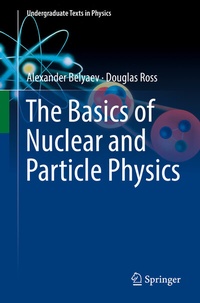
The Basics of Nuclear and Particle Physics
Description

This undergraduate textbook breaks down the basics of Nuclear Structure and modern Particle Physics. Based on a comprehensive set of course notes, it covers all the introductory material and latest research developments required by third- and fourth-year physics students.
The textbook is divided into two parts. Part I deals with Nuclear Structure, while Part II delves into Particle Physics. Each section contains the most recent science in the field, including experimental data and research on the properties of the top quark and Higgs boson. Detailed mathematical derivations are provided where necessary to helps students grasp the physics at a deeper level. Many of these have been conveniently placed in the Appendices and can be omitted if desired.
Each chapter ends with a brief summary and includes a number of practice problems, the answers to which are also provided.
More details
Other editions
Additional editions
Persons
Professor Belyaev obtained his PhD at Moscow State University in 1996, followed by postdoctoral research at Sao Paulo, CERN, Florida State and Michigan State Universities. He joined the University of Southampton as a lecturer in 2007 and became a full professor in 2014. He works on the phenomenology of beyond the Standard Model theories, including their collider and cosmological implications. His recent studies are devoted to theories of Dark Matter. He has worked in close contact with experimental groups, in particular, from 2007 he is a full member of the CMS collaboration at CERN. He is one of the developers of the CalcHEP, the package for the automatic evaluation and simulation of particles decay and scattering processes. In 2011, he pioneered the High Energy Physics Model Database, HEPMDB, project.
Professor Ross obtained his PhD under the supervision of J.C.Taylor. He had post-doctoral fellowships at Imperial College, Utrecht, CERN and Caltech, before arriving atSouthampton University. He has worked on the application of perturbative gauge theories to both strong (QCD) and electroweak interactions. Much of his latter work was devoted to the study of the pomeron in QCD. He is a coauthor of a textbook on this subject. He became a full professor at Southampton University in 1994 and was elected to the Fellowship of the Royal Society in 2005.
Content
Chapter 1. Rutherford Scattering.- Chapter 2. Nuclear Size and Shape.- Chapter 3. Nuclear Masses and the Semi-Empirical Mass Formula.- Chapter 4. The Nuclear Shell Model.- Chapter 5. Radioactivity.- Chapter 6. Alpha Decay.- Chapter 7. Beta Decay.- Chapter 8. Gamma Decay.- Chapter 9. Nuclear Fission.- Chapter 10. Nuclear Fusion.- Chapter 11. Charge Independence and Isospin.- Chapter 12. The forces of Nature and Particle Classification.- Chapter 13. Particle Accelerators.- Chapter 14. Particle Detectors.- Chapter 15. Constituent Quarks.- Chapter 16. Particle Interactions and Cross Sections.- Chapter 17. Weak Interactions.- Chapter 18. The Higgs Mechanism and the Higgs boson.- Chapter 19. Electromagnetic Interactions.- Chapter 20. Quantum Chromodynamics (QCD).- Chapter 21. Parity, Charge Conjugation, and CP.- Chapter 22. Beyond the Standard Model (BSM).
