

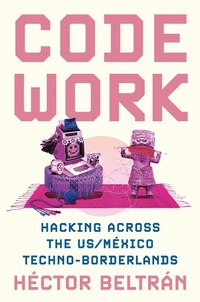
Code Work
Hacking across the US/México Techno-Borderlands
1st Edition
Published on 22. November 2023
240 pages
978-0-691-24505-8 (ISBN)
Description

How Mexican and Latinx hackers apply concepts from coding to their lived experiences
In Code Work, Héctor Beltrán examines Mexican and Latinx coders' personal strategies of self-making as they navigate a transnational economy of tech work. Beltrán shows how these hackers apply concepts from the code worlds to their lived experiences, deploying batches, loose coupling, iterative processing (looping), hacking, prototyping, and full-stack development in their daily social interactions-at home, in the workplace, on the dating scene, and in their understanding of the economy, culture, and geopolitics. Merging ethnographic analysis with systems thinking, he draws on his eight years of research in México and the United States-during which he participated in and observed hackathons, hacker schools, and tech entrepreneurship conferences-to unpack the conundrums faced by workers in a tech economy that stretches from villages in rural México to Silicon Valley.
Beltrán chronicles the tension between the transformative promise of hacking-the idea that coding will reconfigure the boundaries of race, ethnicity, class, and gender-and the reality of a neoliberal capitalist economy divided and structured by the US/México border. Young hackers, many of whom approach coding in a spirit of playfulness and exploration, are encouraged to appropriate the discourses of flexibility and self-management even as they remain outside formal employment. Beltrán explores the ways that "innovative culture" is seen as central in curing México's social ills, showing that when innovation is linked to technological development, other kinds of development are neglected. Beltrán's highly original, wide-ranging analysis uniquely connects technology studies, the anthropology of capitalism, and Latinx and Latin American studies.
In Code Work, Héctor Beltrán examines Mexican and Latinx coders' personal strategies of self-making as they navigate a transnational economy of tech work. Beltrán shows how these hackers apply concepts from the code worlds to their lived experiences, deploying batches, loose coupling, iterative processing (looping), hacking, prototyping, and full-stack development in their daily social interactions-at home, in the workplace, on the dating scene, and in their understanding of the economy, culture, and geopolitics. Merging ethnographic analysis with systems thinking, he draws on his eight years of research in México and the United States-during which he participated in and observed hackathons, hacker schools, and tech entrepreneurship conferences-to unpack the conundrums faced by workers in a tech economy that stretches from villages in rural México to Silicon Valley.
Beltrán chronicles the tension between the transformative promise of hacking-the idea that coding will reconfigure the boundaries of race, ethnicity, class, and gender-and the reality of a neoliberal capitalist economy divided and structured by the US/México border. Young hackers, many of whom approach coding in a spirit of playfulness and exploration, are encouraged to appropriate the discourses of flexibility and self-management even as they remain outside formal employment. Beltrán explores the ways that "innovative culture" is seen as central in curing México's social ills, showing that when innovation is linked to technological development, other kinds of development are neglected. Beltrán's highly original, wide-ranging analysis uniquely connects technology studies, the anthropology of capitalism, and Latinx and Latin American studies.
More details
Other editions
Additional editions
Book
11/2023
Princeton University Press
€103.99
Shipment within 10-20 days
Book
11/2023
Princeton University Press
€25.50
Shipment within 10-20 days
Person
Héctor Beltrán is assistant professor of anthropology at the Massachusetts Institute of Technology.
Content
- Cover
- Contents
- List of Illustrations
- Acknowledgments
- Note to the Reader
- [0]. Introduction
- [0] Todos con el mismo chip
- [1] Hackathons, Hacker-Entrepreneurs, and Hacker Ethics
- [2] Code Work AND the Ethno-Stack
- [3] Techno-Borderlands
- [4] Ethnographic Border Work
- [5] Chapter Overview
- [1]. Thinking with the System in México
- [0] The First Hack of the Day
- [1] Mexican Hackers as Model Entrepreneurial Subjects?
- [2] Staging the Hackathon
- [3] Code Work: Batches and Exceptions
- [4] Code Work: Loose Coupling
- [5] Still Waiting (in line for the hackathon)
- [2]. Becoming Chingón at the Hackathon
- [0] From Carneworlds to Codeworlds
- [1] Hard Work AND Hard Jefes
- [2] Breaking into OR Breaking out of?
- [3] Other(ed) Hackers
- [4] Hacking Imaginaries, Origins, and Intersections
- [3]. Code Work across Domains
- [0] Stories in the Time of Hacking
- [1] Problem-Solving across Domains
- [2] In the Mood for Love in (and out of) the Code Worlds
- [3] 0s and 1s: Between Migrant and Coder Paranoias
- [4] Rethinking Compulsive Programmers with the Ethno-Stack
- [4]. Abuelitas as Infrastructure
- [0] Firsts in the Hacker Worlds
- [1] Stacking Empowerment, Expertise, and Coded Femininity
- [2] Hacking Time
- [3] Re-coding Infrastructures of Work and Progress
- [4] Tight Coupling of the Ethno-Stack
- [5]. Making Latinx Makers
- [0] Life as Software
- [1] Prototypes
- [2] Code Work == Migra Work
- [3] Participants Who Can Participate
- [4] Prototyping Latinidad at the Migrahack
- [5] Always Already and Never Quite Yet
- [6]. Pivoting across the Techno-Borderlands
- [0] From Politics to Pizzas
- [1] Sombrero-ed Coders OR Coded Sombreros?
- [2] Pivoting Presence
- [3] "Perfect English" AND Latinx Frictions
- [4] Flexible Neoliberalisms, Precarious Pivots
- [5] The Latinx Hacker-Entrepreneur Pivot
- [7]. Coda: Working Code AND Working Futures
- Appendix 0: Glossary
- Appendix 1: Cast of Code Workers
- Appendix 2: Featured Figurillas
- References
- Index
