

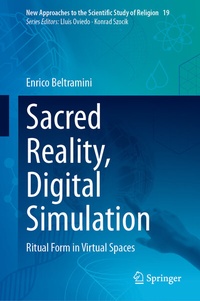
Sacred Reality, Digital Simulation
Description

This study explores the relationship between the sacred and the virtual, emphasizing the sacred as a divinely dependent, consecrated space activated through ritual, mediating between the profane and the holy. The central argument is that the virtual is fundamentally incompatible with the ritual form-a concept developed by Romano Guardini and others, including Joseph Ratzinger-which holds that the sacred is not merely acknowledged but made present through ritualized actions that require tangible, participatory engagement. Even if the virtual realm were acknowledged as real and retained both the bodily presence of the faithful and the Divine Presence, the rite would still be ineffective. Virtuality prevents the proper enactment of the rite, rendering it ineffective. At its core, the ritual form is performative, embodied, and consecratory. It requires physical presence, material elements, and a structured sequence of gestures, symbols, and words that together make the divine encounter possible. Their absence in virtual spaces disrupts ritual form, compromising its sacramental function.
More details
Other editions
Additional editions
Person
Enrico Beltramini is a theologian specializing in the theology of technology, drawing on the resources of Roman Catholicism. He has published over 70 peer-reviewed articles and book chapters and is the author of five monographs. His work has appeared in leading academic journals, including Theology and Science , European Journal of Science and Theology , Scientia et Fides , AI and Society , and Philosophy and Technology . He currently serves on the faculty of Notre Dame de Namur University in California.
Content
Chapter 1 - Framing the Problem.- Chapter 2 - This Book.- Chapter 3 - Theological Intent.- Chapter 4 - Participation and Rite.- Chapter 5 - VR.- Chapter 6 - Virtual Immersion.- Chapter 7 - The Sacred: Preliminary Review.- Chapter 8 - The Sacred in the Judeo-Christian Tradition.- Chapter 9 - The Sacred: Final Remarks.- Chapter 10 - The Sacred and the Virtual.- Chapter 11 - Masters behind the Machine.- Chapter 12 - Total Immanence.- Chapter 13. Conclusion.
