

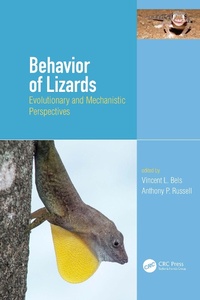
Behavior of Lizards
Evolutionary and Mechanistic Perspectives
Published on 6. February 2019
426 pages
978-0-429-63755-1 (ISBN)
Description

Key features:
Presents a contemporary snapshot of the mechanisms underlying the evolution and adaptation of behavior
Explores how genetics, epigenetics, development, and environment shape behavior
Discusses a broad range of behavioral repertoires and responses, including those related to thermoregulatory, foraging, predatory, displaying, social and escape strategies.
Examines physiological and sensory mechanisms
Covers the effects of various aspects of global change on behavior, with chapters that focus on the impacts of climate change on hydroregulatory behavior and behavioral responses to the effects of habitat alteration resulting from human-mediated change and colonization by invasive species.
Lizards serve as focal organisms for many of biological questions related to evolution, ecology, physiology, and morphology. They are studied at multiple spatial and temporal scales, from the individual to the community level. This book, authored by expert contributors from around the world, explores behaviors underlying the evolution and adaptation of these organisms. It covers conceptual, empirical, and methodological approaches to the understanding of the role that natural and sexual selection play in molding the behavioral traits of lizards.
This thorough, illustrated reference should stimulate discussion of the conceptual and methodological approaches for studying the behavioral traits of these fascinating and highly diverse vertebrates.
Presents a contemporary snapshot of the mechanisms underlying the evolution and adaptation of behavior
Explores how genetics, epigenetics, development, and environment shape behavior
Discusses a broad range of behavioral repertoires and responses, including those related to thermoregulatory, foraging, predatory, displaying, social and escape strategies.
Examines physiological and sensory mechanisms
Covers the effects of various aspects of global change on behavior, with chapters that focus on the impacts of climate change on hydroregulatory behavior and behavioral responses to the effects of habitat alteration resulting from human-mediated change and colonization by invasive species.
Lizards serve as focal organisms for many of biological questions related to evolution, ecology, physiology, and morphology. They are studied at multiple spatial and temporal scales, from the individual to the community level. This book, authored by expert contributors from around the world, explores behaviors underlying the evolution and adaptation of these organisms. It covers conceptual, empirical, and methodological approaches to the understanding of the role that natural and sexual selection play in molding the behavioral traits of lizards.
This thorough, illustrated reference should stimulate discussion of the conceptual and methodological approaches for studying the behavioral traits of these fascinating and highly diverse vertebrates.
Reviews / Votes
"Behavior of Lizards is a gift to all researchers who struggle to keep up with the rapidly growing body of scientific literature on lizard behavior. Maintaining a broad understanding of current literature on topics outside of our own areas of expertise is difficult. This volume offers an engaging solution to this predicament in 12 chapters, each a thorough review of a distinct area of research with an emphasis on the evolutionary and mechanistic impacts on lizard behavior. This volume generally reads like objective bullet points that emphasize the core results, further linking studies based on these core results, yet different authors contribute their own writing styles to each chapter. These qualities make this an excellent textbook for teaching an advanced undergraduate course on lizard behavior, exposing students to different scientific writing styles and approaches. It is therefore an excellent resource for academics, herpetologists, and researchers."-Stephanie M. Campos, Center for Behavioral Neuroscience, Georgia State University, Atlanta, Georgia in The Quarterly Review of Biology, Vol 95, 2020
More details
Language
English
Place of publication
London
United Kingdom
Publishing group
Taylor & Francis Ltd
Target group
College/higher education
Professional and scholarly
Product notice
Reflowable
Illustrations
7 Tables, black and white; 10 Line drawings, color; 15 Line drawings, black and white; 37 Halftones, color; 9 Halftones, black and white; 47 Illustrations, color; 24 Illustrations, black and white
File size
9,59 MB
ISBN-13
978-0-429-63755-1 (9780429637551)
Copyright in bibliographic data and cover images is held by Nielsen Book Services Limited or by the publishers or by their respective licensors: all rights reserved.
Schweitzer Classification
Other editions
Additional editions
Book
09/2020
1st Edition
CRC Press
€147.00
Shipment within 15-20 days
Book
02/2019
1st Edition
CRC Press
€343.20
Shipment within 15-20 days
Persons
Vincent Bels was born in Verviers, Belgium. He completed his PhD on the association between ethology and functional morphology at the University of Liege (Liege, Belgium). He used lizards as a key model to investigate the process of behavioral ritualization. He was Research Fellow and then Assistant Professor at the University of Liege (Belgium) for more than 10 years. Then he taught Biology, Zoology and Ecology, and developed an applied research program on feeding behavior in domestic animals at the Haute Ecole Condorcet and its associated Agronomic Centre (Belgium) for 10 years. He became Professor at the Museum national d'Histoire naturelle (Paris, France) in 2005, and in this capacity served as joint director of a Mixed Research Unit (CNRS/MNHN, France) for over 7 years, as a member of the Scientific Committee of the Museum national d'Histoire naturelle (Paris, France) for 8 years, and as a member of the Scientific Sections of the Centre National de Recherche Scientifique (CNRS, France) for a similar period. He has authored over 100 peer-reviewed articles, 10 chapters, and 6 books. The major theme of his research publications is the study of feeding, drinking and displaying in lizards, although he also published some papers on feeding and locomotion in fishes and birds. His main objective is the integration of behavioral and morphological studies into a comprehensive understanding of the "Form-Function" complex as it relates to the evolution of the trophic system of Vertebrates.
Tony Russell was born in London, UK. He completed his BSc at the University of Exeter and his PhD at the University of London. Upon completion of his PhD he took up a short teaching appointment at the University of Botswana, Lesotho and Swaziland before beginning his work at the University of Calgary, during which time he served for six years as head of the Department of Biological Sciences. After 40 years of teaching various aspects of vertebrate biology and evolutionary biology he retired from his faculty position in 2013, but continues with his research. He has authored over 300 peer-reviewed scientific articles, 19 chapters, and three books. Although he has published on many groups of vertebrates, the continuing focus of his research has been the structure, function and evolution of geckos. His field work has taken him to Australia, New Zealand, many islands in the Eastern Caribbean, Namibia, and, most recently, Trinidad and Tobago. He has received recognition for his contributions including the NSERC 25 Years of Excellence Award, the Alberta Foundation for Environmental Excellence Award, and the University of Calgary Distinguished Faculty Award. Outside the University he has served as President of the Canadian Society of Zoologists, and President of the International Society of Vertebrate Morphologists.
Tony Russell was born in London, UK. He completed his BSc at the University of Exeter and his PhD at the University of London. Upon completion of his PhD he took up a short teaching appointment at the University of Botswana, Lesotho and Swaziland before beginning his work at the University of Calgary, during which time he served for six years as head of the Department of Biological Sciences. After 40 years of teaching various aspects of vertebrate biology and evolutionary biology he retired from his faculty position in 2013, but continues with his research. He has authored over 300 peer-reviewed scientific articles, 19 chapters, and three books. Although he has published on many groups of vertebrates, the continuing focus of his research has been the structure, function and evolution of geckos. His field work has taken him to Australia, New Zealand, many islands in the Eastern Caribbean, Namibia, and, most recently, Trinidad and Tobago. He has received recognition for his contributions including the NSERC 25 Years of Excellence Award, the Alberta Foundation for Environmental Excellence Award, and the University of Calgary Distinguished Faculty Award. Outside the University he has served as President of the Canadian Society of Zoologists, and President of the International Society of Vertebrate Morphologists.
Content
Introduction. "Everyday" Behavior. Behavioral thermoregulation in lizards: Strategies for achieving preferred temperature. Lizard locomotion: relationships between behavior, performance, and function. Lizard foraging - A Perspective Integrating Sensory Ecology and Life Histories. Predatory behavior in lizards: strategies and mechanisms for catching prey. Antipredator behavioral mechanisms: avoidance, deterrence, escape and encounter. Social Behavior and Communication. The physiological control of social behavior in lizards. Sensory processing in relation to signaling behavior. Phylogeny and ontogeny of lizard display behavior. Behavioral ecology of aggressive behavior in lizards. Stable social grouping in lizards. Environmental impact, global change and behavior Hydroregulation - a neglected behavioral response of lizards to climate change? Impact of human-induced environmental changes on lizard behavior: insights from urbanization
