

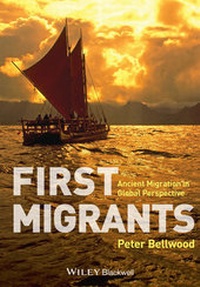
First Migrants
Description

Reviews / Votes
"In sum, First Migrantsis a commendable effort tosynthesize a growing body of literature on the subject and willserve as a useful and much needed text for courses on the subject.For those generally unfamiliar with different parts of the worldand why people moved to and fro, Bellwood has offered an attractiveresource and one which should prove useful in that regard for yearsto come." (American Antiquity, 1 July 2014) "This is a significant contribution to our understandingof world archaeology." (Antiquity, 1 June2014) "Bellwood rebalances our understanding of culturalevolution to show colonization and immigration as prime movers inspreading languages, religions and people, and in generating thediversity of ancient societies' materialcultures." Norman Hammond, Boston University "Peter Bellwood has given us a monumental, invaluable,thoughtful survey of human migration, around the whole world, from2 million years ago until modern times." Jared Diamond, University of California, Los AngelesMore details
Other editions
Additional editions

Person
Content
List of Figures ix
Preface xiv
A Note on Dating Terminology xvi
Acknowledgements xvii
1 The Relevance and Reality of Ancient Migration 1
Migration in Prehistoric Times 4
Hypothesizing About Prehistoric Migrations 6
Migrations in History and Ethnography 8
The Helvetii 8
Ancient China 9
Medieval Iceland 10
The Nuer of Sudan 10
The Iban of Sarawak 12
Relevance for Prehistoric Migration? 13
2 Making Inferences About Prehistoric Migration 17
Changes in Time and Space - Genes, Languages, Cultures 18
Human Biology, Genetics, and Migration 19
Demic Diffusion 21
Language Families and the Study of Migration in Prehistory 22
Language Family Spread: Lessons from Recent History 26
Language Family Spread: Lessons from Anthropology 28
Dating the Spreads of Language Families 29
Cultures in Archaeology - Do They Equate with Linguistic and Biological Populations? 30
Archaeology and the Study of Migration in Prehistory 32
One End of the Spectrum - Intensive Culture Change without Significant Migration 32
The Other End of the Spectrum - Intensive Cultural Change with Significant Migration 33
3 Migrating Hominins and the Rise of Our Own Species 36
Behavioral Characteristics and Origins of Early Hominins in Africa 38
First Hominin Migration(s) - Out of Africa 1 41
Unfolding Species in Time and Space 46
Java, Flores, and Crossing the Sea 48
Out of Africa 2? 50
Out of Africa 3? The Origins of H. sapiens 52
The Recognition of Modern Humans in Biology and Archaeology 54
The Expansion of Modern Humans Across the African and Eurasian Continents, 130,000-45,000 Years Ago 58
Africa 58
The Levant and Southern Asia 60
Northern and Western Eurasia 63
The Fate of the Neanderthals 66
Explanations? 67
4 Beyond Eurasia: The Pioneers of Unpeopled Lands - Wallacea and Beyond, Australia, The Americas 71
Crossing the Sea Beyond Sundaland 72
How Many Settlers? 74
The First Australo-Melanesians 76
The Archaeology of Island Colonization - Wallacea, Melanesia, Australia 77
Heading North and Offshore Again - Japan 81
The Americas 83
Getting to Beringia 84
Circumventing the Ice 88
The Rapid Unfolding of American Colonization 90
5 Hunter-Gatherer Migrations in a Warming Postglacial World 96
Postglacial Recolonizations in Northern Eurasia 97
After the First Americans: Further Migrations Across Bering Strait 101
Na-Dene and Yeniseian 101
The Apachean Migration 104
The Holocene Colonizations of Arctic Coastal North America 105
The Thule Migration and the Inuit 107
The Early Holocene Colonization of a Green Sahara 109
Continental Shelves and Their Significance for Human Migration 112
Holocene Australia - Pama-Nyungan Migration? 113
Linguistic Prehistory during the Australian Holocene 117
Who Were the Ancestral Pama-Nyungans? 119
6 The First Farmers and Their Offspring 123
Where and When Did Food Production Begin? 124
Why Did Food Production Develop in Some Places, but Not Others? 127
Why Was Domesticated Food Production Relatively Slow to Develop? 128
Food Production and Population Expansion 129
The Neolithic 133
Food Production as the Driving Force of Early Agriculturalist Migration 135
7 The Fertile Crescent Food Production Complex 140
Agricultural Origins in the Fertile Crescent 141
Neolithic and Chalcolithic Expansion Beyond the Fertile Crescent 147
Anatolia and Southeastern Europe 147
Neolithic Migration Beyond Greece and the Balkans 149
The Steppes and Central Asia 151
Iran, Pakistan, and South Asia Beyond the Indus 153
Linguistic History and the Spread of the Fertile Crescent Food Production Complex 157
Perspectives from Indo-European 157
The Possible Significance of the Turkic and Yeniseian Languages in Central Asia 163
West Eurasian Genetic and Population History in the Holocene 165
Peninsular Indian Archaeology and Dravidian Linguistic History 168
The Spread of the Fertile Crescent Food-Producing Economy into North Africa 169
The Fertile Crescent Food Production Complex and Its Impact on Holocene Prehistory in Western Eurasia 172
8 The East Asian and Western Pacific Food Production Complexes 178
Agricultural Origins in the Yellow and Yangzi Basins of East Asia 178
Migrations from the Yellow River Basin 181
Migrations from the Yangzi Basin - Mainland Southeast Asia 182
Early Rice and the Linguistic Record 187
Genetics, Human Biology, and the East Asian Mainland during the Holocene 189
Island Southeast Asia and Oceania 191
The Colonization of Oceania 194
The History of the Austronesian Language Family 197
Biological Anthropology and the Austronesians 201
The East Asian and Western Pacific Food Production Complexes and Their Impacts on Holocene Prehistory 204
9 The African and American Food Production Complexes 210
Food Production in Sub-Saharan Africa 211
West Africa and the Niger-Congo-Speaking Populations 213
The African Food Production Complex in Perspective 218
Holocene Migrations in the Americas 219
The Central Andes 221
Amazonia 224
The Caribbean Islands 228
Mesoamerica 229
Northern Mesoamerica, the Southwestern United States, and the Uto-Aztecans 230
The Eastern Woodlands 234
The American Food Production Complexes and Their Impacts on Holocene Prehistory 238
10 The Role of Migration in the History of Humanity 243
References 249
Index 299
List of Figures
2.1 Major language family distributions across the Old World at AD 1500. Some small families and isolates are omitted, for instance, Hmong-Mien and Basque. The ‘Altaic’ family contains Japonic, Korean, Ainu, Mongolic, Turkic, and Tungusic (see Figure 7.6). Original drawn by Clive Hilliker as Bellwood 2005a, Figure 1.1, using data from Ruhlen 1987. 2.2 Major language families of the New World at AD 1500. Many small families and isolates are omitted, and the large areas marked as “unrecorded, unaffiliated” reflect in part the widespread native language loss since European settlement began. Original drawn by Clive Hilliker as Bellwood 2005a, Figure 1.2, using data from Ruhlen 1987. 3.1 A current family tree for hominins, from Australopithecine ancestors to Homo sapiens. 3.2 Oxygen isotope records reflecting global temperatures at increasing resolutions for the last 5.3 million years (left), the Pleistocene and Holocene (from 2.58 million years ago; center), and the Upper Pleistocene and Holocene (from 130,000 years ago; right). Higher temperatures are to the right, lower to the left. Interglacials are identified by uneven numbered marine isotope stages (MIS – the Holocene is 1), glacials by even numbers. This figure is from Hertler et al. 2013, and contains original data from Lisiecki and Raymo 2005. Reproduced courtesy of the authors. 3.3 Early hominin (pre-Neanderthal and pre-sapiens) fossil find places and archaeological sites in the Old World. Background map by Multimedia Services, ANU, details added by the author. 3.4 Major Paleolithic stone tool forms considered by archaeologists to be diagnostic in discussions about human evolution.
(a, b) Oldowan basalt pebble core and large flake (ventral view) from Koobi Fora, Lake Turkana, Tanzania;
(c) Acheulian flint bifacial hand axe from Britain; (d) a quartzite example (with opposite orientation) from West Bengal, India;
(e, f) Mousterian retouched flake scraper and point, Combe Grenal cave (Dordogne), France;
(g) Levalloisian ‘tortoise’ (prepared) flint core with a detached flake (modern copy – white arrows show direction of strike);
(h, i) prismatic blade core and long blade of flint (Upper Paleolithic, France).
All from the collections of the School of Archaeology and Anthropology at ANU, photos by the author. 3.5 Old World localities associated with biological and cultural remains of Neanderthals and early H. sapiens. Kya = thousands of years ago. Background map by Multimedia Services, ANU, details added by the author. 4.1 The colonization of the Americas. Extents of ice cover are only approximate, but the huge extent of the North American glaciers is evident. Background map by Multimedia Services, ANU, details added by the author. 5.1 Suggested early migrations of the speakers of Uralic languages, after Blažek 2013b with minor modifications, reprinted courtesy of the author. Map production by Multimedia Services, ANU. 5.2 The distributions of Na-Dene languages and White River volcanic ash. Reproduced with minor modifications from Matson and Magne 2013, courtesy of the authors. Original map by S. Matson. 5.3 The distributions of Paleoeskimo archaeological complexes (circa 2000 BC), superimposed by the linguistic migrations of Eskimo-Aleut populations, especially the major Thule Inuit migration after AD 1200. Background map by Multimedia Services, ANU, with original data added by the author from maps in Fortescue 2013; Friesen 2013. 5.4 Pre-pastoral human occupation in the Green Sahara during the mid-Holocene. Background map by Multimedia Services, ANU, details added by the author. 5.5 Backed artifacts and geometric microliths from Australia and the southwestern arm of Sulawesi. Top row: two backed blade-like tools and four microliths (geometric and crescentic in shape) of chert from Leang Burung shelter 1, South Sulawesi, excavated by Mulvaney and Soejono 1970. Bottom row: matching tools of chert and silcrete from southern Australia (including the two backed blade-like tools marked “Lake Illawarra”), from collections of the National Museum of Australia on loan to the School of Archaeology and Anthropology at ANU. Photos by the author. 5.6 Australia, showing the almost identical distributions of Pama-Nyungan languages with backed artifacts, and Non-Pama-Nyungan languages with bifacial points. The northern Cape York Peninsula and New Guinea lack both artifact categories. Also shown is a possible sea route linking Sulawesi and Australia, utilizing historical parallels for Makassan teripang collectors. Background map by Multimedia Services, ANU, details added by the author. 6.1 The homelands of agriculture in the Old World (unbroken lines and cross-hatching), with the regions (broken lines) of summer rainfall climate in Asia and Africa, and winter rainfall in the Middle East and around the Mediterranean. This figure shows that the expansions of the East Asian, African, and Fertile Crescent agricultural complexes were each constrained by the imperatives of their climatic homelands. Also shown are the less expansive western Pacific and South Asian complexes. Arrows refer to significant plant and animal transfers out of or between the zones in prehistoric times. For the New World, see Figure 9.4. Background map by Multimedia Services, ANU, details added by the author. 6.2 Chronological chart to show the inceptions of domesticatory agriculture in the various homeland regions (earlier pre-domestication phases are not indicated), together with likely dates of initial expansion of selected language families, hunter-gatherer as well as agriculturalist. Pertinent archaeological sites and cultures are also noted. 7.1 The Fertile Crescent: likely zones of cereal and animal domestication, and some major Pre-Pottery Neolithic sites. Modified from Bellwood 2005a: Figure 3.1, original map by Multimedia Services, ANU. 7.2 The expansion of Neolithic cultures from the Fertile Crescent into Europe. Archaeological cultures are in capitals with dates. (1) LBK origin region in western Hungary; (2) early LBK expansion; (3) later LBK expansion; CW Cardial Ware. Modified from Bellwood 2005a: Figure 4.1, original map by Multimedia Services, ANU. 7.3 The spread of food-producing economies through South Asia, focusing especially on the movements of Fertile Crescent plants and animals. Background map by Multimedia Services, ANU, details added by the author. 7.4 The distributions of the Indo-European subgroups at AD 1500, with selected central Asian archaeological cultures (in bold) that have featured in debates about Indo-Iranian origins. Original drawn by Multimedia Services, ANU, as Bellwood 2005a, Figure 10.1, using data from Ruhlen 1987. 7.5 A family tree with estimated divergence dates (in millennia BC) for the subgroups within the Indo-European language family, constructed by Bouckaert et al. 2012 using statistical methods from evolutionary biology. Redrawn by the author and published courtesy of Quentin Atkinson, University of Auckland. 7.6 Map to show the likely generalized distributions of the Altaic languages prior to the recent expansions of Russian and Sinitic languages. The boundaries are approximate and do not accurately reflect current distributions, especially for the Tungusic, Mongolic, and some Turkic languages that are spoken today only in small enclaves. Also shown is the recorded distribution of the Yeniseian languages, discussed in Chapter 5, from Kari and Potter 2010, Map B. Background map by Multimedia Services, ANU, using data from Ruhlen 1987. 7.7 Suggested early migrations of the speakers of Afroasiatic languages, after Blažek 2013a, reprinted courtesy of the author. Map production by Multimedia Services, ANU. The Levant homeland is suggested as the circled “AA” on the map. 8.1 The Neolithic in China and Southeast Asia. The stars indicate pre-Neolithic sites with combinations of shell middens, contorted or sitting burials, coarse pottery, and no evidence for food production. They include (1) Da But and Con Co Ngua in northern Vietnam; (2) Dingsishan and Dayan Cave near Nanning in Guangxi; (3) Zengpiyan in Guilin, Guangxi; and (4) a site on Liang Island in the Matsu Islands off Fujian (Taiwan). Individual Neolithic sites are not shown for China since there are so many, but major cultural groups referred to in the text are labeled in italics (not all are contemporary). Background map by Multimedia Services, ANU, details added by the author. 8.2 Language families of Mainland Southeast Asia. Drawn by Carmen Sarjeant and by Multimedia Services, ANU. Reproduced...
