

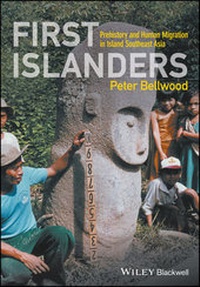
First Islanders
Description

Reviews / Votes
"In First Islanders, Peter Bellwood -without doubt the leading authority on the archaeology and prehistory of Island Southeast Asia- offers up an engaging synthesis of the grand sweep of human history in this island world, from the arrival of early hominins one million years ago, through the development of agriculture and the Austronesian expansion, up to the early Metal Age. Bellwood brings the fascinating prehistory of this vast region to life as no other archaeologist can. First Islanders belongs on the bookshelf of every scholar of world prehistory." - Patrick V. Kirch, University of California BerkeleyMore details
Other editions
Additional editions
Person
Content
Contents vii
List of Figures and Plates xii
Invited Contributors xv
Acknowledgments xvi
1 Introducing First Islanders 1
This Book 3
A Note on Dating Terminology 7
A Note on Archaeological Terminology 7
Pronunciation and Place?]names 9
Notes 9
References 10
2 Island Southeast Asia as a Canvas for Human Migration 11
The Shelves and Basins 12
Sundaland 15
Wallacea 15
Sahul 16
The Island Southeast Asian Environment 16
Climate 16
Landforms and Soils 18
The Floras of Island Southeast Asia 20
Faunal and Biogeographical Boundaries 21
The Cyclical Changes of the Pleistocene 22
The Pleistocene Epoch: Definition and Chronology 22
The Cycles of Glacials and Interglacials 23
World Sea Level Changes During the Pleistocene 23
The Consequences of Mid?]latitude Glaciation 27
Notes 30
References 30
3 Homo erectus and Homo floresiensis: Archaic Hominins in Island Southeast Asia 34
Hominin Antecedents in Africa and Asia 35
Homo erectus in Java 38
Java - Pleistocene Mammals and Stratigraphy 39
Sangiran 41
Ngandong 43
When Did Hominins Arrive in Java? 44
The Evolution of Javan Homo erectus 46
An Invited Perspective by Colin Groves 46
The Dating of the Javan Hominins 47
The Homo erectus Cranium 49
The Homo erectus Mandible 50
Homo erectus Teeth 50
Homo erectus Postcranial Material 51
Evolution within Javan Homo erectus 52
The Philippines, Sulawesi, and Nusa Tenggara: Pleistocene Mammals
and Stratigraphy 53
The Philippines 54
Sulawesi 54
Flores and Nusa Tenggara 55
Homo floresiensis (and Homo erectus?) in Flores 58
The Enigma of Homo floresiensis 60
An Invited Perspective by Debbie Argue 60
The Homo floresiensis Controversy 62
Was Homo floresiensis a Dwarfed Homo erectus? 64
Was Homo floresiensis Descended from a Separate
Early Hominin Lineage? 64
Cultural Evidence Related to Homo erectus and Homo floresiensis 65
Java and the Tools of Homo erectus 67
Flores and the Tools of Homo floresiensis 71
Retrospect 74
Notes 75
References 76
4 The Biological History of Homo sapiens in Island Southeast Asia 86
The First Homo sapiens in Southeast Asia 89
Early to Middle Holocene Skeletal Data from Island Southeast Asia 93
The Biological Arrival of an Asian Neolithic Population in Island
Southeast Asia 94
The Significance of Skin Pigmentation in Equatorial Latitudes 97
The Biological History of Southeast Asian Populations from
Late Pleistocene and Holocene Cemetery Data 98
An Invited Perspective by Hirofumi Matsumura, Marc Oxenham,
Truman Simanjuntak, and Mariko Yamagata 98
Craniometric Analysis 99
Early Indigenous Hunter?]gatherers 99
Neolithic Dispersal in Mainland Southeast Asia 103
Neolithic Dispersal in Island Southeast Asia 104
Conclusions 106
The Genetic History of Human Populations in Island Southeast
Asia During the Late Pleistocene and Holocene 107
An Invited Perspective by Murray Cox 107
The Population History of Island Southeast Asia 117
Notes 119
References 120
5 Late Paleolithic Archaeology in Island Southeast Asia 131
Mainland Southeast Asia, Peninsular Malaysia, and Sumatra: The Hoabinhian and Its Successors 134
Hoabinhian into Para?]Neolithic in Mainland Southeast Asia 134
The Hoabinhian of Sumatra 138
Beyond Sumatra - the Late Palaeolithic in the Islands of Southeast Asia 139
The Niah Caves, Sarawak 141
Eastern Sabah 143
Eastern and Central Kalimantan 147
Java 150
The Philippines 151
Sulawesi and the Talaud Islands 153
The Toalian of South Sulawesi - a Localized Revolution in Small Tool Technology 155
The Northern Moluccas 159
Eastern Nusa Tenggara and Timor?]Leste 162
Changing Patterns in Hunting Across Island Southeast Asia Before the Neolithic 165
An Invited Perspective by Philip J. Piper 165
The Late Pleistocene (45-14 kya) 165
Terminal Pleistocene to Mid?]Holocene (14-4.5 kya) 167
Some Final Thoughts on Homo sapiens and the Late Palaeolithic in Island Southeast Asia 170
Notes 171
References 172
6 The Early History of the Austronesian Language Family in Island Southeast Asia 181
What is a Language Family, and Why are Language Families Important? 185
An Introduction to Austronesian Linguistic History 187
The Linguistic History of Austronesian?]speaking Communitiesin Island Southeast Asia 190
An Invited Perspective by Robert Blust 190
Further Questions of Austronesian Linguistic History 197
Before Taiwan: The Antecedents of Proto?]Austronesian 197
How Did the Austronesian Languages Spread Initially throughout
Island Southeast Asia? 200
Directionality and Relative Chronology in the Early Austronesian Migration Process 201
The Material Culture and Economy of the Early Austronesians 204
The Austronesian Diaspora: A Perspective from Indonesia 207
An Invited Perspective by Daud Aris Tanudirjo 207
A Brief History of Austronesian Studies in Indonesia 208
Austronesian Languages and National Identity 210
Notes 211
References 212
7 Neolithic Farmers and Sailors in Southern China, Taiwan, and the Philippines 218
The Origins of Rice Production in China 220
The Evolution of Neolithic Societies in China 226
Neolithic Movement into Southern China 228
The Out of Taiwan Hypothesis for Austronesian
Dispersal into Island Southeast Asia 231
Neolithic Cultures in Southeast China, Taiwan, and Luzon 232
An Invited Perspective by Hsiao?]chun Hung 232
Taiwan 234
Between Taiwan and Luzon 236
Ludao and Lanyu (Botel Tobago) 237
The Batanes Islands 237
Northern Luzon 239
Coastal Palaeo?]landscapes of the Neolithic 240
An Invited Perspective by Mike T. Carson 240
Further Observations on Neolithic Cultures in Taiwan 244
The Neolithic of the Philippines 248
The Batanes Islands 250
The Cagayan Valley of Luzon 253
The Philippines beyond Cagayan 255
Southern China, Taiwan, and the Philippines - a Neolithic Assessment 256
Notes 257
References 259
8 The Neolithic of East Malaysia and Indonesia 267
The Western Neolithic Stream - Sarawak and Onwards 269
Java and Sumatra 274
The Eastern Neolithic Stream: Eastern Borneo, Sulawesi, and the Moluccas 276
Sabah: Bukit Tengkorak 281
Sulawesi 283
Fleshing Out the Neolithic Prehistory of Island Southeast Asia 287
Neolithic Food Production 288
Potential Phases of Neolithic Crop Production in Island Southeast Asia 289
Rice in Island Southeast Asian Prehistory, and Its Fading from Grace 293
Farmers Who Adopted Rainforest Hunting and Gathering 294
Domesticated Animals in the Island Southeast Asian Neolithic 297
An Invited Perspective by Philip J. Piper 297
Pigs and Dogs 297
Chickens 299
Bovidae 300
Domestic Animals in Cultural Context 300
Neolithic Fishing 301
Neolithic Translocations 301
Summing Up the Island Southeast Asian Neolithic 302
Notes 303
References 304
9 The Early Metal Age and Intercultural Connections in Island Southeast Asia 312
The Arrival of Metallurgy in Island Southeast Asia 314
"Indigenous" Early Metal Age Assemblages and Monuments in Island
Southeast Asia 320
Stone Monuments and Carvings: Indonesia 320
Malayic Migration 324
Burial Grounds and Their Significance 326
Chamic Migration 329
Nephrite and Other Early Metal Age Exchange Networks across
the South China Sea 333
An Invited Perspective by Hsiao?]chun Hung 333
The Arrival of Indian Influence in Island Southeast Asia 335
After the Early Metal Age 338
Notes 338
References 339
10 Island Southeast Asian Prehistory: A Comparative Perspective 345
References 351
Index 352
Chapter 1
Introducing First Islanders
The islands of Southeast Asia - Sumatra to the Moluccas, Taiwan to Timor (Figure 1.1) - present prehistorians with a unique opportunity to study some of the earliest recorded interactions between humanity and the oceans. This region has witnessed some remarkable changes in geographical configuration throughout the past 1.5 million years, throughout both an extinct hominin and an extant Homo sapiens presence. Land bridges have alternated with coastal submergence and tectonic activity has created some of the greatest volcanic eruptions in earth history, together with very rapid rates of crustal movement. An amazingly diverse variety of tropical wildlife (including humans!) has passed to and fro, some across land bridges and some across one of the most significant biogeographical divides on earth, which many of us know as the "Wallace Line." This delineates the western edge of the Wallacea region of biogeographers, which extends from Borneo and Bali across to the continental shelf of New Guinea and Australia. Because of its multiple sea passages, Wallacea has always separated the Asian and Australian continents, ensuring that cattle and pigs never met kangaroos and wombats until humans started to interfere with their natural distributions.
Figure 1.1 The basic geography and definition (shaded area) of Island Southeast Asia in its regional setting.
Source: base map by Multimedia Services, ANU; details added by the author.
In terms of ocean travel, hominins reached the island of Flores across at least two sea passages around 1 million years ago, or perhaps before. Modern human ancestors crossed multiple sea passages to reach Australia and New Guinea at least 50,000 years ago. Within the past 5000 years these islands have fueled the genesis of the greatest maritime migration in human prehistory, that of the Austronesian-speaking peoples, who made absolutely incredible canoe voyages to reach places such as Guam, Madagascar, Easter Island, New Zealand, Hawai'i, and even South America. These voyages occurred over a period of more than 4000 years, dating between 3000 BCE and 1250 CE if we begin in Neolithic Taiwan and end with the Maori settlement of New Zealand, but the sheer achievement demands great respect from all humanity and indeed was the main attraction that persuaded me to migrate from England to New Zealand in 1967, in order to study Polynesian origins and archaeology (Bellwood 1978a, 1978b, 1987).
During my career as an archaeologist, I have to admit that I have always found the ancestries and migrations of human populations, whether still living, or extinct and deep in the past, to be amongst the most interesting aspects of human prehistory. This book, therefore, presents a multidisciplinary reconstruction of the biological and cultural migrations of the inhabitants of Island Southeast Asia during the past 1.5 million years, finishing on the eve of the early historical Indic and Islamic kingdoms and religions between 500 and 1500 CE. With its focus on migration, this book links with my three other recent Wiley-Blackwell books - First Farmers (2005), First Migrants (2013), and The Global Prehistory of Human Migration (ed. 2015). For First Islanders the geographical canvas is far smaller, although I must on occasion extend my investigations as far away as the Yangzi Valley, Mainland Southeast Asia, Australia, and the islands of Oceania in order to put everything into its proper perspective.
I have also traveled a great deal in Island Southeast Asia during my career, as no doubt will have many readers of this book, and one fundamental observation never ceases to interest me. The seasoned traveler in Island Southeast Asia will be impressed by the panoply of ancient Hindu and Buddhist temples in Java, by the cultural achievements of Hinduism in Bali, by the modern vibrancy of Islam in most regions of Indonesia and Malaysia, and by the extensive influence of Christianity in the Philippines and parts of eastern Indonesia. These cultural and religious traditions were, and still are, very different in many ways from those of prehistoric times. They were external to Southeast Asia in origin, and even if the outsider religions sometimes became admixed with indigenous beliefs they still reflected the penetration of Southeast Asia by the cultural and religious interests of far-away societies. With this in mind, it is remarkable to me that the modern Island Southeast Asian peoples themselves, in their biology and languages, are entirely indigenous and have been so since long before the age of international trade and empires. These people do not speak languages derived from Sanskrit, Arabic, Spanish, or Dutch, and have never done so, despite a borrowing of large numbers of often specialized vocabulary items from these external linguistic sources. They carry indigenous DNA, apart from some minor immigration of genes, mostly on the male side, during historical times.
Anyone who has read Alfred Crosby's Ecological Imperialism (1986) will realize why this situation exists. The indigenous populations of Island Southeast Asia were already numerous and densely settled 2000 years ago, living in a tropical landscape that was unsuitable for more westerly Eurasian settlers with their Fertile Crescent domesticated crops and animals. They were also protected by a suite of diseases that literally stopped many would-be invaders from temperate lands dead in their tracks. Unlike their less fortunate cousins in the heavily colonized regions of the Americas and Australasia, Island Southeast Asians lived sufficiently close to the teeming populations of Eurasia to be only lightly affected by the diseases of immigrants, to which they had reasonable levels of immunity. Instead, their own tropical diseases often turned the tables in the other direction, as any visit to an early European cemetery in the region will probably reveal.
In other words, the peoples of Island Southeast Asia, in terms of biological and linguistic genesis, were essentially in existence almost as they are now by at least 2000 years ago. Since that time there has been a great deal of population admixture over the whole of Island Southeast Asia, as is to be expected given the lively history of the region in trade, commerce, and sea-borne interaction. But were we to travel with a time machine across the region in 500 BCE, the faces that would hopefully smile at us as we landed on each island would look essentially much as they do today.
This Book
The predecessor of this book, entitled Prehistory of the Indo-Malaysian Archipelago, was first published in 1985 by Academic Press in Sydney. A revised edition was published in 1997 by the University of Hawai'i Press in Honolulu, and translated into Bahasa Indonesia as Prasejarah Kepulauan Indo-Malaysia by PT Gramedia Pustaka Utama in Jakarta in 2000. In 2007, the ANU E Press (now ANU Press) republished the revised edition as a third edition, but with only a new preface - the remainder of the text was reprinted exactly as it was in 1997. This third edition remains in print, available for free download at http://press.anu.edu.au/titles/prehistory-of-the-indo-malaysian-archipelago/, and it continues to reflect the state of knowledge about the region in the mid-1990s. What you are about to read here is a new book that builds upon the foundation of Prehistory of the Indo-Malaysian Archipelago, rewritten and updated with a new title and a new chapter organization.
Why a new book? The answer is basically that Prehistory of the Indo-Malaysian Archipelago is now out of date and simple revision of the existing structure is no longer sufficient. The time has come for a new perspective, not just from me, but also from a number of my colleagues who specialize in areas of research that are becoming ever more complex and prolific, such that a single individual can no longer keep on top of absolutely everything. For instance, here are some important aspects of Island Southeast Asian prehistory that have undergone fundamental change in terms of both data and interpretation since the text of the second edition of Prehistory of the Indo-Malaysian Archipelago was submitted to the publisher in 1995:
- The Pleistocene biogeography of Island Southeast Asia is better understood now than 20 years ago, especially in terms of the glacial-postglacial fluctuations in sea level, temperature, and rainfall during the past 100,000 years. Much new research has, of course, been driven by the current world concern with the dangers posed by the El Niño climatic phenomenon and by anthropogenic global warming.
- As far as new discoveries in the Southeast Asian fossil record are concerned, we can point to the 2003 and 2016 publications of the bones of a new hominin species from Flores island in eastern Indonesia, the tiny Homo floresiensis, as well as to other small archaic hominin remains dating from almost 70,000 years ago from northern Luzon in the Philippines. There have also been considerable strides in the craniometric analysis and absolute dating of many early modern human (Homo sapiens) remains from Late Pleistocene contexts.
- It is now generally agreed by geneticists, biological anthropologists, and archaeologists alike that ancestral Homo sapiens did not evolve "multiregionally" all over the Old...
