

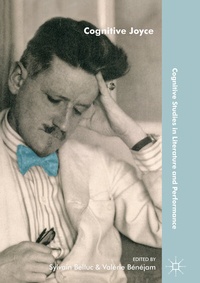
Cognitive Joyce
Description

This collection is the first book-length study to re-evaluate all of James Joyce's major fictional works through the lens of cognitive studies. Cognitive Joyce presents Joyce's relationship to the scientific knowledge and practices of his time and examines his texts in light of contemporary developments in cognitive and neuro-sciences. The chapters pursue a threefold investigation-into the author's "extended mind" at work, into his characters' complex and at times pathological perceptive and mental processes, and into the elaborate responses the work elicits as we perform the act of reading. This volume not only offers comprehensive overviews of the oeuvre, but also detailed close-readings that unveil the linguistic focus of Joyce's drama of cognition.
Reviews / Votes
"Cognitive Joyce, with its range of topics, approaches, and theorists, feels like what its editors claim it to be: an introduction, of sorts, to something diverse and new." (Royal Holloway, James Joyce Literary Supplement, Vol. 33 (2), 2019)
More details
Other editions
Additional editions
Persons
Sylvain Belluc is Maître de Conférences in English literature at the Université de Nîmes/Paul-Valéry Montpellier 3 (EMMA), France. The recipient of several research scholarships, he is the author of numerous articles on Joyce, Conrad, linguistics, translation, and intertextuality.
Valérie Bénéjam is Maître de Conférences in English literature at the Université de Nantes, France. She has written numerous articles on Joyce, Flaubert and Shakespeare, co-edited Making Space in the Works of James Joyce (with John Bishop, 2011), and is currently working on Joyce and drama.
Content
1 Introduction.- 2 Knowledge and Identity in Joyce.- 3 Intentionality and Epiphany: Husserl, Joyce and the Problem of Access.- 4 Authors' Libraries and the Extended Mind: The Case of Joyce's Books.- 5 Characters' Lapses and Language's Past: Etymology as Cognitive Tool in Joyce's Fiction.- 6 Joyce and Hypnagogia.- 7 Spatialized Thought: Waiting as Cognitive State in Dubliners.- 8 The Invention of Dublin as "Naissance de la Clinique": Cognition and Pathology in Dubliners.- 9 Cognition as Drama: Stephen Dedalus's Mental Workshop in A Portrait of the Artist as a Young Man.- 10 Joycean Text / Empathic Reader: A Modest Contribution to Literary Neuroaesthetics.- 11 Configuring Cognitive Architecture: Mind-Reading and Meta-Representations in Ulysses .- 12 Hallucination and the Text: "Circe" between Narrative, Epistemology and Neurosciences.- 13 "[The] Buzz in His Braintree, the Tic of HisConscience": Consciousness, Language and the Brain in Finnegans Wake.
