

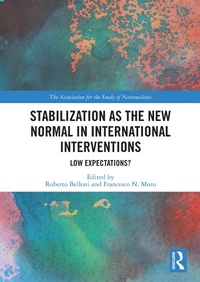
Stabilization as the New Normal in International Interventions
Low Expectations?
1st Edition
Published on 21. May 2020
130 pages
978-1-000-03348-9 (ISBN)
Description

Stabilization as the New Normal in International Interventions provides the first comprehensive analysis of stabilization, which constitutes the new reference point for international intervention in unruly parts of the Global South.
The notion of 'stabilization' and the practice of 'stability operations' experienced a revival over the last decade. The United Nations, the European Union, NATO, as well as most member states of the Organisation for Economic Cooperation and Development have embraced these terms in their foreign policy bureaucracies. The general disillusionment with the achievements of large-scale peacebuilding operations in countries like Afghanistan and Iraq, as well as the failures of the so-called Arab Springs, contributed to the success of this new discourse. Yet, while widely mentioned and endorsed, stabilization is rarely defined. This volume identifies common elements to stabilization doctrines and examines how they are applied in practice. It dissects how stabilization emerged and unfolds, how different actors adopt it and for what purposes, and how it is linked to the broader security and development discourses.
Stabilization as the New Normal in International Interventions will be of great interest to scholars of Peacebuilding, International Intervention and International Relations more generally. The chapters were originally published as a special issue of Ethnopolitics.
The notion of 'stabilization' and the practice of 'stability operations' experienced a revival over the last decade. The United Nations, the European Union, NATO, as well as most member states of the Organisation for Economic Cooperation and Development have embraced these terms in their foreign policy bureaucracies. The general disillusionment with the achievements of large-scale peacebuilding operations in countries like Afghanistan and Iraq, as well as the failures of the so-called Arab Springs, contributed to the success of this new discourse. Yet, while widely mentioned and endorsed, stabilization is rarely defined. This volume identifies common elements to stabilization doctrines and examines how they are applied in practice. It dissects how stabilization emerged and unfolds, how different actors adopt it and for what purposes, and how it is linked to the broader security and development discourses.
Stabilization as the New Normal in International Interventions will be of great interest to scholars of Peacebuilding, International Intervention and International Relations more generally. The chapters were originally published as a special issue of Ethnopolitics.
More details
Series
Edition
1. Auflage
Language
English
Place of publication
London
United Kingdom
Publishing group
Taylor & Francis Ltd
Target group
College/higher education
File size
5,11 MB
ISBN-13
978-1-000-03348-9 (9781000033489)
Copyright in bibliographic data and cover images is held by Nielsen Book Services Limited or by the publishers or by their respective licensors: all rights reserved.
Schweitzer Classification
Other editions
Additional editions
Roberto Belloni | Francesco N. Moro
Stabilization as the New Normal in International Interventions
Low Expectations?
Book
06/2024
1st Edition
Routledge
€75.70
Shipment within 10-20 days
Roberto Belloni | Francesco N. Moro
Stabilization as the New Normal in International Interventions
Low Expectations?
Book
02/2020
1st Edition
Routledge
€205.60
Shipment within 15-20 days
Persons
Roberto Belloni is Professor of International Relations at the University of Trento, Italy. His recent publications include The Rise and Fall of Peacebuilding in the Balkans (2020).
Francesco N. Moro is Associate Professor of Political Science at the University of Bologna, Italy. His research has been published, among else, in the Journal of Peace Research, Terrorism and Political Violence and Journal of Conflict Resolution.
Francesco N. Moro is Associate Professor of Political Science at the University of Bologna, Italy. His research has been published, among else, in the Journal of Peace Research, Terrorism and Political Violence and Journal of Conflict Resolution.
Content
1. Stability and Stability Operations: Definitions, Drivers, Approaches Roberto Belloni and Francesco N. Moro 2. Political Transitions and Macro-level Foundations of Political Stability Stefano Costalli and Francesco N. Moro 3. Stabilization and Local Conflicts: Communal and Civil War in South Sudan Jana Krause 4. United Nations Stabilization Operations: Chapter Seven and a Half John Karlsrud 5. From Liberal Statebuilding to Counterinsurgency and Stabilization: The International Intervention in Iraq Roberto Belloni and Irene Costantini 6. NATO's Landscape of the Mind: Stabilisation and Statebuilding in Afghanistan Mats Berdal 7. (B)ordering Hybrid Security? EU Stabilisation Practices in the Sahara-Sahel Region Luca Raineri and Francesco Strazzari
