

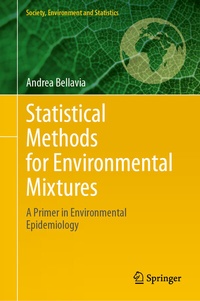
Statistical Methods for Environmental Mixtures
Description

This book provides a comprehensive introduction to statistical approaches for the assessment of complex environmental exposures, such as pollutants and chemical mixtures, within the exposome framework. Environmental mixtures are defined as groups of 3 or more chemical/pollutants, simultaneously present in nature, consumer products, or in the human body. Assessing the health effects of environmental mixtures poses several methodological challenges due to the high levels of correlation that are often present between environmental chemicals, and by the need of incorporating flexible non-additive and non-linear effects that can capture and describe the complex mechanisms by which environmental exposure contribute to diseases. Several statistical approaches are proposed and discussed, including the application of regression-based approaches (e.g. penalized regression such as LASSO and elastic net, or Bayesian variable selection) for environmental exposures, and novel methods (e.g. weighted quantile sum regression, or Bayesian Kernel Machine Regression) that account for specific complexities of environmental exposures. More recent efforts included are the application of machine learning approaches (e.g. gradient boosting) for environmental data.
Statistical Methods for Environmental Mixtures describes the statistical challenges that commonly arise when dealing with environmental exposures and provides an introduction to different statistical approaches for such data. Over the last decade, substantial efforts have been made to transition the statistical framework for environmental exposures in epidemiologic studies from a single-chemical/pollutant to a multi-chemicals/pollutants approach. This book provides a comprehensive introduction to this modern multi-chemicals/pollutants framework. Emphasis is given to interpretability, discussing issues with causal interpretation and translation of scientific finding when applying the discussed statistical approaches for complex environmental exposures.
The target audience includes researchers in environmental epidemiology and applied statisticians working in the field. As such, while rigorously presenting the statistical methodologies, the book keeps an applied focus, discussing those settings where each method is appropriate for use and for which question it can be applied, providing examples of accurate presentation and interpretation from the literature, including a basic introduction to R packages and tutorials, as well as discussing assumptions and practical challenges when applying these techniques on real data.
More details
Other editions
Additional editions
Person
Andrea Bellavia is a Lecturer with a joint appointment in the Department of Medicine, Harvard Medical, and Department of Environmental Health, Harvard T.H. Chan School of Public Health, and an Investigator and Director of Statistical Education at TIMI Study Group, Brigham and Women's Hospital. Dr Bellavia has been extensively involved in methodological and applied research on environmental mixtures, publishing several applications of novel approaches in environmental and reproductive epidemiology, and developing methodologies to incorporate environmental mixtures in mediation analysis and causal inference. Since 2018, Dr. Bellavia has served as primary instructor for the graduate course on Statistical Methods for Environmental Mixtures at Harvard.
Content
Preface.- Chapter 1 Environmental Mixtures.- Chapter 2 Characterizing Environmental Mixtures.- Chapter 3 Regression-Based Approaches for Mixture-Health Associations.- Chapter 4 Mixture Indexing Approaches.- Chapter 5 Flexible Approaches for Complex Settings.- Chapter 6 Additional Topics and Final Remarks.
