

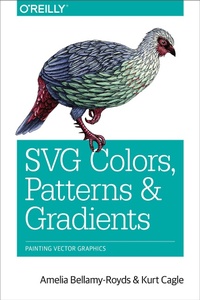
SVG Colors, Patterns & Gradients
Description

As a vector graphics format, SVG uses precisely-defined geometric shapes to build an image. But that doesn''t mean that SVG graphics have to look like technical drawings. SVG graphics can be shaded, textured, built from partially-transparent overlapping layers, or even filled with photographic images.
SVG Colors, Patterns, and Gradients takes an in-depth look at the different ways SVG text and shapes can be painted on the screen or page. You'll start with an overview of how color is defined, including the various ways you can control the transparency of SVG content. You'll then dive deep into the concept of an SVG paint server: gradients, patterns, and other complex graphical content that can be used to fill-in or outline other SVG shapes and text.
More details
Other editions
Additional editions
Content
- Intro
- Copyright
- Table of Contents
- Preface
- What We'll Cover
- About This Book
- About the Examples
- Using Code Examples
- Conventions Used in This Book
- Safari® Books Online
- How to Contact Us
- Acknowledgments
- Chapter 1. Things You Should Already Know
- SVG Is Drawing with Code
- SVG Is Always Open Source
- SVG Is XML (and Sometimes HTML)
- SVG Is Squishable
- Pictures Are a Collection of Shapes
- Images Can Have Images Inside Them
- Text Is Art
- Art Is Math
- An SVG Is a Limited View of an Infinite Canvas
- SVG Has Structure
- SVG Has Style
- Behind All Good Markup Is a Great DOM
- SVG Can Move
- SVG Can Change
- Chapter 2. The Painter's Model
- Fill 'Er Up with the fill Property
- Stroke It with the stroke Property
- Stroking the Fill and Filling the Stroke
- Take a Hint with Rendering Properties
- Chapter 3. Creating Colors
- Misty Rose by Any Other Name
- A Rainbow in Three Colors
- Custom Colors
- Mixing and Matching
- Chapter 4. Becoming Transparent
- See-Through Styles
- The Net Effect
- Chapter 5. Serving Paint
- Paint and Wallpaper
- Identifying Your Assets
- The Solid Gradient
- Chapter 6. Simple Gradients
- Gradiated Gradients
- Transparency Gradients
- Controlling the Color Transition
- Chapter 7. Gradients in All Shapes and Sizes
- The Gradient Vector
- The Object Bounding Box
- Drawing Outside the Box
- Gradients, Transformed
- Chapter 8. And Repeat
- How to Spread Your Gradient
- Reflections on Infinite Gradients
- Repeating Without Reflecting
- Using (and Reusing) Gradients in HTML
- Chapter 9. Radial Gradients
- Radial Gradient Basics
- Filling the Box
- Scaling the Circle
- Adjusting the Focus
- Transforming Radial Gradients
- Grand Gradients
- Chapter 10. Tiles and Textures
- Building a Building Block
- Stretching to Fit
- Laying Tiles
- Transformed Tiles
- Chapter 11. Picture-Perfect Patterns
- The Layered Look
- Preserved Patterns
- Background Images, SVG-Style
- Chapter 12. Textured Text
- Bounding Text
- Switching Styles Midstream
- Chapter 13. Painting Lines
- Beyond the Edges
- The Empty Box
- Using the Coordinate Space
- Patterned Lines
- Chapter 14. Motion Pictures
- Animation Options
- Coordinated Animation
- Animated Interactions
- Appendix A. Color Keywords and Syntax
- Appendix B. Elements, Attributes, and Style Properties
- &linearGradient&
- &radialGradient&
- &stop&
- &pattern&
- Index
- About the Authors
