

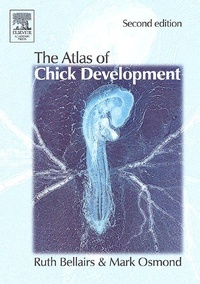
Atlas of Chick Development
Description

- Updated and expanded text to accompany diagrams
- More than 200 new labelled scanning electron micrographs showing individual tissues in great detail
- Reviews of recent molecular research
- Discusses the roles of genes such as Hox genes, BMPs, and sonic hedgehog during early development
- New sections on genetical anomalies, techniques, and the poultry industry
More details
Other editions
New editions
Additional editions
Persons
PhD in Zoology (Embryology), University of London 1951, supervised by Sir Gavin deBeer and Michael Abercrombie.
Apart from brief periods in Anatomy Department, Cambridge and Department of Biology, St Bartholomew's Hospital Medical School, academic posts have all been at UCL (University College London). Retired 1991 as Emeritus Professor in Embryology.
Research predominantly on early chick embryos concerned mainly with problems of tissue interaction, gastrulation and segmentation.
Founder member of Embryologists' Club, the predecessor of BSDB (British Society of Developmental Biology). Served on several editorial boards, including JEEM (now Development) and Anatomy and Embryology.
Publications: approximately 120, including 2 books, 5 edited books.
Content
Techniques
Early stages
The establishment of the embryonic body
Body shape and external appearance
Heart, blood vessels and lymphatics
Urino-genital system
Gut, coelom and respiratory system
Nervous system
Skeleton and muscles
Integument
Endocrine glands
Extra-embryonic membranes
