

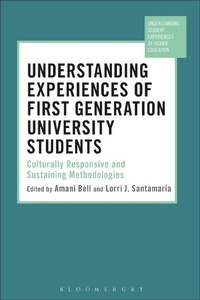
Understanding Experiences of First Generation University Students
Culturally Responsive and Sustaining Methodologies
1st Edition
Published on 22. February 2018
240 pages
978-1-350-03185-2 (ISBN)
Description

Over the past few decades universities have opened their doors to students whose parents and grandparents were historically excluded from societal participation and higher education for reasons associated with racial, ethnic, socio-economic and/or linguistic diversity. Many of these students are first generation - or first in their family to attend university. While some progress has been made in responding to the needs of these internationally underserved learners, many challenges remain.
This edited book features the unique and diverse experiences of first generation students as they transition into and engage with higher education whilst exploring ways in which universities might better serve these students. With reference to culturally responsive and sustaining research methodologies undertaken in Australia, Canada, New Zealand, South Africa, the UK and the USA, the contributors critically examine how these students demonstrate resilience within university, and ways in which success and challenges are articulated. Elements that are unique to context and shared across the international higher education milieu are explored. The book is replete with diverse student voices, and compelling implications for practice and future research.
The studies featured are centred on underlying theories of identity and intersectionality while valuing student voices and experiences. Throughout, the emphasis is on using strengths-based indigenous and decolonised methodologies. Through these culturally sustaining approaches, which include critical incident technique, participatory learning and action, talanoa and narrative inquiry, the book explores rich data on first generation student experiences at seven institutions in six countries across four continents.
This edited book features the unique and diverse experiences of first generation students as they transition into and engage with higher education whilst exploring ways in which universities might better serve these students. With reference to culturally responsive and sustaining research methodologies undertaken in Australia, Canada, New Zealand, South Africa, the UK and the USA, the contributors critically examine how these students demonstrate resilience within university, and ways in which success and challenges are articulated. Elements that are unique to context and shared across the international higher education milieu are explored. The book is replete with diverse student voices, and compelling implications for practice and future research.
The studies featured are centred on underlying theories of identity and intersectionality while valuing student voices and experiences. Throughout, the emphasis is on using strengths-based indigenous and decolonised methodologies. Through these culturally sustaining approaches, which include critical incident technique, participatory learning and action, talanoa and narrative inquiry, the book explores rich data on first generation student experiences at seven institutions in six countries across four continents.
More details
Series
Edition
1. Auflage
Language
English
Place of publication
London
United Kingdom
Publishing group
Bloomsbury Publishing PLC
Target group
College/higher education
Illustrations
10 bw illus
ISBN-13
978-1-350-03185-2 (9781350031852)
Copyright in bibliographic data and cover images is held by Nielsen Book Services Limited or by the publishers or by their respective licensors: all rights reserved.
Schweitzer Classification
Other editions
Additional editions
Amani Bell | Lorri J. Santamaria
Understanding Experiences of First Generation University Students
Culturally Responsive and Sustaining Methodologies
Book
08/2019
Bloomsbury Academic
€60.84
Shipment within 15-20 days
Amani Bell | Lorri J. Santamaria
Understanding Experiences of First Generation University Students
Culturally Responsive and Sustaining Methodologies
Book
02/2018
Bloomsbury Academic
€178.27
Shipment within 15-20 days
Persons
Amani Bell is the Innovative Research Universities Vice-Chancellors' Fellow and an honorary Senior Lecturer at the University of Sydney, Australia. Her research takes a participatory approach to exploring the challenges and opportunities of higher education.
Lorri J. Santamaría is an Associate Professor in the Faculty of Education at the University of Auckland, New Zealand. She is an expert in culturally responsive education and the impact of cultural and linguistic diversity on the field of educational leadership.
Lorri J. Santamaría is an Associate Professor in the Faculty of Education at the University of Auckland, New Zealand. She is an expert in culturally responsive education and the impact of cultural and linguistic diversity on the field of educational leadership.
Content
List of Figures
Notes on Contributors
Series Editors Foreword
Foreword, Arnetha F. Ball with Lorri J. Santamaría
1. Introduction: Why Focus on First Generation Students?, Amani Bell and Lorri J. Santamaría
2. Excavating Stories of First Generation Students in Aotearoa New Zealand, 'Ema Wolfgramm-Foliaki and Lorri J. Santamaría
3. Experiences of Indigenous and Non-Indigenous First Generation Students at an Australian
University, Amani Bell and Matthew Benton
4. University Practices That Help Canadian First Generation Student Success, Airini and Sereana Naepi
5. Factors Affecting the Success of First Generation University Students at a South African University, Roisin Kelly-Laubscher, Moragh Paxton, Ziyanda Majombozi and Samukele Mashele
6. Transitions of First Generation Students to Higher Education in the UK, Claire Hamshire, Rachel Forsyth and Catherine Player
7. Considering the Cultural Strengths of Older First Generation University Students: An Australian Perspective, Sarah O'Shea
8. As They See It: First Generation College Students and Photovoice, Rashne R. Jehangir and Veronica Deenanath
9. Conclusion: Beyond Listening to First Generation Students Amani Bell and Lorri J. Santamaría
Index
Notes on Contributors
Series Editors Foreword
Foreword, Arnetha F. Ball with Lorri J. Santamaría
1. Introduction: Why Focus on First Generation Students?, Amani Bell and Lorri J. Santamaría
2. Excavating Stories of First Generation Students in Aotearoa New Zealand, 'Ema Wolfgramm-Foliaki and Lorri J. Santamaría
3. Experiences of Indigenous and Non-Indigenous First Generation Students at an Australian
University, Amani Bell and Matthew Benton
4. University Practices That Help Canadian First Generation Student Success, Airini and Sereana Naepi
5. Factors Affecting the Success of First Generation University Students at a South African University, Roisin Kelly-Laubscher, Moragh Paxton, Ziyanda Majombozi and Samukele Mashele
6. Transitions of First Generation Students to Higher Education in the UK, Claire Hamshire, Rachel Forsyth and Catherine Player
7. Considering the Cultural Strengths of Older First Generation University Students: An Australian Perspective, Sarah O'Shea
8. As They See It: First Generation College Students and Photovoice, Rashne R. Jehangir and Veronica Deenanath
9. Conclusion: Beyond Listening to First Generation Students Amani Bell and Lorri J. Santamaría
Index
