

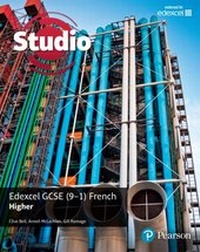
Studio Edexcel GCSE French Higher Student Book
1st Edition
Published on 17. January 2017
240 pages
978-1-292-20542-7 (ISBN)
Description

Expertly structured Student Book for Edexcel GCSE (9-1) French (higher tier). Designed to help learners use language independently and to the best of their ability, with fresh and engaging content from the target language culture. Suitable for the new Edexcel GCSE (9-1) French qualification (higher tier). A carefully designed programme of learning teaches the building blocks of French grammar and vocabulary. Includes popular topics, authentic material and real life-contexts, all with links to the French culture. Each unit and module is structured to allow gradual progression. Exam preparation units are included for Reading, Writing, Speaking and Listening. Revision forms the final module.
More details
Other editions
Additional editions

Clive Bell | Anneli McLachlan | Gill Ramage
Studio Edexcel GCSE French Higher Student Book
Book
08/2016
Pearson Education Limited
€43.50
Shipment within 10-20 days
Content
- Cover
- Table des matières
- Module 1: Qui suis-je? Theme: Identity and culture
- Point de départ 1: Revising family and describing people
- Point de départ :2 Revising places in town and activities
- Unité 1: A comme amitié
- Talking about friends and what makes a good friend
- Using irregular verbs in the present tense
- Unité 2: C'est de famille!
- Talking about family relationships
- Using reflexive verbs in the present tense
- Unité 3: On va voir un spectacle?
- Making arrangements to go out
- Using the near future tense
- Unité 4: Quelle soirée!
- Describing a night out with friends
- Using the perfect tense
- Unité 5: Il était une fois .
- Talking about your life when you were younger
- Using the imperfect tense
- Unité 6: La personne que j'admire
- Discussing role models
- Using the present, perfect and imperfect tenses
- Contrôle de lecture et d'écoute
- Contrôle oral
- Contrôle écrit
- Vocabulaire
- Module 2: Le temps des loisirs Theme: Identity and culture
- Point de départ 1: Revising sport and music
- Point de départ 2: Revising technology, films and TV
- Unité 1: Tu es plutôt foot, tennis ou basket?
- Talking about sport
- Using depuis + the present tense
- Unité 2: Ma vie d'internaute
- Talking about your life online
- Using the comparative
- Unité 3: La lecture
- Talking about books and reading
- More practice of the imperfect tense
- Unité 4: Mes émissions préférées
- Talking about television programmes
- Using direct object pronouns (le, la, les)
- Unité 5: Zoom sur le cinéma
- Talking about actors and films
- Using superlative adjectives
- Contrôle de lecture et d'écoute
- Contrôle oral
- Contrôle écrit
- Vocabulaire
- Module 3: Jours ordinaires, jours de fête Theme: Identity and culture
- Point de départ 1: Talking about food and meals
- Point de départ 2: Discussing and shopping for clothes
- Unité 1: C'est bientôt dimanche?
- Describing your daily life
- Using pouvoir and devoir
- Unité 2: Regarde ce que je mange!
- Talking about food for special occasions
- Using the pronoun en
- Unité 3: On peut se tutoyer?
- Using polite language
- Asking questions in the tu and vous forms
- Unité 4: Félicitations!
- Describing family celebrations
- Using venir de + infinitive
- Unité 5: C'est la fête!
- Describing festivals and traditions
- Using a combination of tenses
- Contrôle de lecture et d'écoute
- Contrôle oral
- Contrôle écrit
- Vocabulaire
- Module 4: De la ville à la campagne Theme: Local area, holiday and travel
- Point de départ 1: Talking about where you live, weather and transport
- Point de départ 2: Describing a town and asking the way
- Unité 1: Ma région est top!
- Describing a region
- Using the pronoun y
- Unité 2: Ville de rêve ou ville de cauchemar?
- Talking about your town, village or district
- Using negatives
- Unité 3: C'est pour un renseignement
- Discussing what to see and do
- Asking questions using quel/quelle/quels/quelles
- Unité 4: Il fera beau demain?
- Discussing plans and the weather
- Using the future tense
- Unité 5: En pleine action!
- Describing community projects
- Using the present, perfect and future tenses
- Contrôle de lecture et d'écoute
- Contrôle oral
- Contrôle écrit
- Vocabulaire
- Module 5: Le grand large . Theme: Local area, holiday and travel
- Point de départ 1: Talking about what you normally do on holiday
- Point de départ 2: Talking about holidays (past, present and future)
- Unité 1: Des vacances de rêve
- Talking about an ideal holiday
- Using the conditional
- Unité 2: Les hôtels, mode d'emploi
- Booking and reviewing hotels
- Using reflexive verbs in the perfect tense
- Unité 3: Bon appétit!
- Ordering in a restaurant
- Using en + the present participle
- Unité 4: En route!
- Talking about travelling
- Using avant de + the infinitive
- Unité 5: On négocie au souk
- Buying souvenirs
- Using demonstrative adjectives and pronouns
- Unité 6: C'était catastrophique!
- Talking about holiday disasters
- Using the pluperfect tense
- Contrôle de lecture et d'écoute
- Contrôle oral
- Contrôle écrit
- Vocabulaire
- Module 6: Au collège Theme: School
- Point de départ: Revising school subjects
- Unité 1: Mon bahut
- Talking about your school
- Using the pronouns il and elle
- Unité 2: L'école chez nous, l'école chez vous
- Comparing school in the UK and French-speaking countries
- Using the pronouns ils and elles
- Unité 3: Liberté, égalité, fraternité?
- Discussing school rules
- Using il faut and il est interdit de
- Unité 4: Vive la scolarité!
- Talking about getting the best out of school
- Using the imperative
- Unité 5: En échange
- Talking about a school exchange
- Using past, present and future timeframes
- Contrôle de lecture et d'écoute
- Contrôle oral
- Contrôle écrit
- Vocabulaire
- Module 7: Bon travail! Theme: Future aspirations, study and work
- Point de départ: Discussing jobs and work preferences
- Unité 1: Quelle orientation t'attire?
- Discussing career choices
- Saying 'better/worse' and 'the best/worst thing'
- Unité 2: Il faut que je fasse ça!
- Talking about plans, hopes and wishes
- Understanding the subjunctive
- Unité 3: Les langues sont un atout!
- Discussing the importance of languages
- Using adverbs
- Unité 4: Je voudrais postuler .
- Applying for jobs
- Using direct object pronouns in the perfect tense
- Unité 5: Mon boulot dans le tourisme
- Understanding case studies
- Using verbs followed by à or de
- Contrôle de lecture et d'écoute
- Contrôle oral
- Contrôle écrit
- Vocabulaire
- Module 8: Un oil sur le monde Theme: International and global dimension
- Point de depart: Talking about what makes you tick
- Unité 1: Notre planète
- Discussing problems facing the world
- Making connections between word types
- Unité 2: Protéger l'environnement
- Talking about protecting the environment
- Using the modal verbs pouvoir and devoir in the conditional
- Unité 3: D'où vient ton tee-shirt?
- Discussing ethical shopping
- Using the passive
- Unité 4: Je suis solidaire
- Talking about volunteering
- Using indirect object pronouns
- Unité 5: Les grands événements
- Discussing big events
- Giving arguments for and against
- Contrôle de lecture et d'écoute
- Contrôle oral
- Contrôle écrit
- Vocabulaire
- Module de révisions
- General conversation questions
- À toi
- Grammaire
- Useful verb tables
