

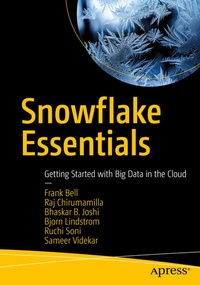
Snowflake Essentials
Getting Started with Big Data in the Cloud
Published on 14. December 2021
XVIII, 337 pages
978-1-4842-7316-6 (ISBN)
Description

Understand the essentials of the Snowflake Database and the overall Snowflake Data Cloud. This book covers how Snowflake's architecture is different from prior on-premises and cloud databases. The authors also discuss, from an insider perspective, how Snowflake grew so fast to become the largest software IPO of all time.
Snowflake was the first database made specifically to be optimized with a cloud architecture. This book helps you get started using Snowflake by first understanding its architecture and what separates it from other database platforms you may have used. You will learn about setting up users and accounts, and then creating database objects. You will know how to load data into Snowflake and query and analyze that data, including unstructured data such as data in XML and JSON formats. You will also learn about Snowflake's compute platform and the different data sharing options that are available.
What YouWill Learn
Who This Book Is For
Database professionals or information technology professionals who want to move beyond traditional database technologies by learning Snowflake, a new and massively scalable cloud-based database solution
Snowflake was the first database made specifically to be optimized with a cloud architecture. This book helps you get started using Snowflake by first understanding its architecture and what separates it from other database platforms you may have used. You will learn about setting up users and accounts, and then creating database objects. You will know how to load data into Snowflake and query and analyze that data, including unstructured data such as data in XML and JSON formats. You will also learn about Snowflake's compute platform and the different data sharing options that are available.
What YouWill Learn
- Run analytics in the Snowflake Data Cloud
- Create users and roles in Snowflake
- Set up security in Snowflake
- Set up resource monitors in Snowflake
- Set up and optimize Snowflake Compute
- Load, unload, and query structured and unstructured data (JSON, XML) within Snowflake
- Use Snowflake Data Sharing to share data
- Set up a Snowflake Data Exchange
- Use the Snowflake Data Marketplace
Who This Book Is For
Database professionals or information technology professionals who want to move beyond traditional database technologies by learning Snowflake, a new and massively scalable cloud-based database solution
More details
Series
Edition
1st ed.
Language
English
Place of publication
Berkeley
United States
Publishing group
APRESS
Target group
Professional and scholarly
Product notice
Reflowable
Illustrations
XVIII, 337 p. 225 illus.
ISBN-13
978-1-4842-7316-6 (9781484273166)
DOI
10.1007/978-1-4842-7316-6
Schweitzer Classification
Other editions
Additional editions
Frank Bell | Raj Chirumamilla | Bhaskar B. Joshi
Snowflake Essentials
Getting Started with Big Data in the Cloud
Book
12/2021
APress
€64.19
Shipment within 15-20 days
Persons
Frank Bell
is a SnowPro, entrepreneur, and data thought leader and has been working with databases since 1994 when he first started with Oracle in the United States Air Force. He ran the consulting firm IT Strategists from 1999 to 2019 and built one of the fastest growing Snowflake practices in 2018 which was sold to Fairway Technologies and then acquired by Accenture. He now runs IT Strategists Cloud Products (ITS) and Snowflake Solutions which are focused on building Snowflake tools such as DQmation (data quality automation). He also leads the Accenture Snowflake West Market unit. He has lived, breathed, and eaten Snowflake since early 2018 and believes Snowflake and the data cloud are one of the top game-changing technologies of this decade.
Raj Chirumamilla is a Snowflake Certified Architect and AWS Solutions Architect Associate with 20+ years of IT experience. He is an experienced, hands-on solutions architect working in the data and analytics area: helping customers migrate to cloud and build cost-effective and highly available solutions and data pipelines with modern data architecture frameworks. He has been working with Snowflake's Cloud Data platform for more than three years.
Bhaskar B. Joshi is a Snowflake Certified Architect with 20 years of experience in managing data on various platforms. He has been working with Snowflake for over three years in multiple industries. He is currently a hands-on Data Architect helping customers create scalable solutions using the Modern Data Architecture frameworks in the cloud.
Bjorn Lindstrom is an IT veteran with 40 years of experience in many aspects of computer technologies. He has held roles in software development, software quality assurance, database administration, large-scale big data systems, and is an experienced solutions architect. He was one of the first to be certified in Snowflake.
Sameer Videkar is a data expert with more than 12 years of experience working on data platforms, enterprise data warehouse systems, master data management, data migration, and ETL implementations. He is a certified Data Architect with additional certifications in Snowflake, Agile Scrum, and PMP.
Raj Chirumamilla is a Snowflake Certified Architect and AWS Solutions Architect Associate with 20+ years of IT experience. He is an experienced, hands-on solutions architect working in the data and analytics area: helping customers migrate to cloud and build cost-effective and highly available solutions and data pipelines with modern data architecture frameworks. He has been working with Snowflake's Cloud Data platform for more than three years.
Bhaskar B. Joshi is a Snowflake Certified Architect with 20 years of experience in managing data on various platforms. He has been working with Snowflake for over three years in multiple industries. He is currently a hands-on Data Architect helping customers create scalable solutions using the Modern Data Architecture frameworks in the cloud.
Bjorn Lindstrom is an IT veteran with 40 years of experience in many aspects of computer technologies. He has held roles in software development, software quality assurance, database administration, large-scale big data systems, and is an experienced solutions architect. He was one of the first to be certified in Snowflake.
Ruchi Soni is a technology leader and multi-cloud enterprise architect. Her work lies in helping customers to accelerate their digital transformation journey to the cloud and to build next-generation apps on forward-looking platforms such as Snowflake. She brings extensive experience in planning, architecting, building, and scaling future-ready platforms that are highly available and agile. Ruchi is SnowPro Core certified, Google Cloud certified, AWS certified, and is a Certified Master Data Architect.
Sameer Videkar is a data expert with more than 12 years of experience working on data platforms, enterprise data warehouse systems, master data management, data migration, and ETL implementations. He is a certified Data Architect with additional certifications in Snowflake, Agile Scrum, and PMP.
Content
1. The Snowflake Data Cloud.- 2. Snowflake Quick Start.- 3. Snowflake Data Cloud Architecture.-
4. Snowflake Web Interface -- Classic Console.- 5. Snowflake Web Interface -- Preview App (Snowsight).- 6. Account Management.- 7. Security.- 8. Database Objects.- 9. Querying and Cloning Data in Snowflake.- 10. How Snowflake Compute Works.- 11. Semi-Structured Data in Snowflake.- 12. Loading Data.- 13. Unloading Data.- 14. Data Sharing, Data Exchanges, and the Snowflake Data Marketplace.
