

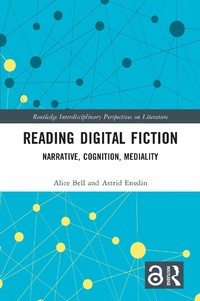
Reading Digital Fiction
Narrative, Cognition, Mediality
1st Edition
Published on 18. April 2024
218 pages
978-1-040-01050-1 (ISBN)
Description

Reading Digital Fiction offers the first comprehensive and systematic theoretical, methodological, and analytical examination of digital fiction from a cognitive and empirical perspective. Proposing the new concept of "medial reading", it argues for the centrality of an audience's interest in, awareness of and/or attention to the medium in which a text is produced and received, and which we argue should be applied to reader data across media. The book analyses and theorises five generations of digital fiction and their reading including hypertext fiction, hypermedia fiction, narrative video games, app fiction, and virtual reality. It showcases medium- and platform-specific methods of qualitative reader response research across a variety of contexts and settings from screen-based and embodied interaction to gallery installation, and from reading group and individual interview to think-aloud methodologies. The book thus addresses the unique affordances of digital fiction reading by designing and reporting on new empirical studies focusing on hypertextuality, interactivity, immersion, as well as medium-specific forms of textual "you", ontological ambiguity, reader orientation and empathy. In so doing, the book refines, critiques, and expands cognitive, transmedial, and empirical narratology and stylistics by placing the reader of these new narratives front and centre.
The Open Access version of this book, available at http://www.taylorfrancis.com, has been made available under a Creative Commons [Attribution-Non Commercial-No Derivatives (CC-BY-NC-ND)] 4.0 license.
The Open Access version of this book, available at http://www.taylorfrancis.com, has been made available under a Creative Commons [Attribution-Non Commercial-No Derivatives (CC-BY-NC-ND)] 4.0 license.
More details
Series
Edition
1. Auflage
Language
English
Place of publication
London
United Kingdom
Publishing group
Taylor & Francis Ltd
Target group
College/higher education
Product notice
Reflowable
Illustrations
5 Tables, black and white; 14 Halftones, black and white; 14 Illustrations, black and white
File size
4,03 MB
ISBN-13
978-1-040-01050-1 (9781040010501)
Copyright in bibliographic data and cover images is held by Nielsen Book Services Limited or by the publishers or by their respective licensors: all rights reserved.
Schweitzer Classification
Other editions
Additional editions
Book
09/2025
1st Edition
Routledge
€55.50
Shipment within 10-20 days
Book
04/2024
1st Edition
Routledge
€183.50
Shipment within 15-20 days
Persons
Alice Bell is Professor of English language and literature at Sheffield Hallam University, UK. She researches digital fiction, narratology, stylistics, and empirical literary methods. Her publications include The Possible Worlds of Hypertext Fiction ( 2010), Digital Fiction and the Unnatural (co-authored with Astrid Ensslin, 2021), Possible Worlds Theory and Contemporary Narratology (co-edited with Marie-Laure Ryan, 2019), and Style and Reader Response (co-edited with Browse et al., John Benjamins Benjamins, 2021).
Astrid Ensslin is Professor of Digital Cultures and Communication at the University of Regensburg, Germany, where she directs the Digital Area Studies Lab (DAS|LAB). Her research sits at the intersections between digital culture, critical media studies, narratology, sociolinguistics, digital humanities, and empirical audience research. Recent publications include The Routledge Companion to Literary Media (co-edited with Julia Round and Bronwen Thomas, 2023), Pre-web Digital Publishing and the Lore of Electronic Literature (2022), and Digital Fiction and the Unnatural (co-authored with Alice Bell, 2021).
Astrid Ensslin is Professor of Digital Cultures and Communication at the University of Regensburg, Germany, where she directs the Digital Area Studies Lab (DAS|LAB). Her research sits at the intersections between digital culture, critical media studies, narratology, sociolinguistics, digital humanities, and empirical audience research. Recent publications include The Routledge Companion to Literary Media (co-edited with Julia Round and Bronwen Thomas, 2023), Pre-web Digital Publishing and the Lore of Electronic Literature (2022), and Digital Fiction and the Unnatural (co-authored with Alice Bell, 2021).
Content
Acknowledgements
Chapter 1. Introduction: Digital Fiction, Empirical Research, and Medial Reading
Chapter 2. Second-Person Narration in Ludic Hypermedia Fiction
Chapter 3. Hyperlinks in Hypertext Fiction
Chapter 4. Immersion in Literary Games
Chapter 5. App-Fiction and the Ethics of Ontological Ambiguity
Chapter 6. Orientation and Empathy in VR Fiction
Chapter 7. Conclusion: Medially Reading Digital Fiction
References
Index
Chapter 1. Introduction: Digital Fiction, Empirical Research, and Medial Reading
Chapter 2. Second-Person Narration in Ludic Hypermedia Fiction
Chapter 3. Hyperlinks in Hypertext Fiction
Chapter 4. Immersion in Literary Games
Chapter 5. App-Fiction and the Ethics of Ontological Ambiguity
Chapter 6. Orientation and Empathy in VR Fiction
Chapter 7. Conclusion: Medially Reading Digital Fiction
References
Index
