

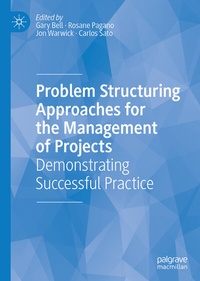
Problem Structuring Approaches for the Management of Projects
Description

Exploring the three levels of project management, this edited collection analyses the practice of problem structuring approaches (PSAs) with an aim to improve organisational adaptability and value creation. By studying these approaches, the authors present techniques for enhancing project management knowledge, informing decision-making and guiding management actions. This book is an insightful and timely read, as it addresses the need for organisations to adapt in order to tackle new challenges within today's changing business landscape. Undoubtedly useful to those studying project management and operational research, this book is also an important read for managers and decision-makers within organisations as it identifies and examines the effective outcomes of PSAs.
More details
Other editions
Additional editions
Persons
Gary Bell is a Teaching Fellow in Project Management with Innovation and Strategy Studies at the University of Sussex, UK.
Rosane Pagano is a Principal Lecturer in the Business School of Manchester Metropolitan University, UK.
Jon Warwick is Professor of Educational Development in the Mathematical Sciences at London South Bank University, UK.
Carlos Sato is a Lecturer in Management at the University of Sussex, UK.
Content
1. A Systematic 'Theories of Changes' Approach for Projects and Change Initiatives in the Context of Quality Enhancement Activity in Higher Education; Diane Hart.- 2. Explore, Experiment, Experience: A Synthesis of Vickers' Appreciative Learning System and Ackoff's Problem Approach Applied in Practice; Christine Welch and Paul Summer.- 3. Multi-criteria Mapping as a Problem Structuring Method for Project Front-ending; Josie Coburn and Andrew Stirling.- 4. Evaluating Understanding: Endrogenous Project Evaluation Using Practice-based Interaction Analysis (PIA); Andrew Carlin and Sheena Murdoch.- 5. Delivering Better Outcomes through Customer-led Project Management: The Case of the Major Project BT 21st Century Network in the UK; Carlos Sato.- 6. Exploring the Use of Soft Systems Methodology (SSm) in Front-ending Public Funded Rural Bridge Construction Projects in Bangladesh; Shah Saadi and Gary Bell.- 7. Managing Context: Lessons from a Large-scale Science Project; Stephen Little.- 8.Systematic Approach and Problem Structuring Methods in Teaching Sustainability on Project Management Courses at Manchester Metropolitan University: Some Reflections on Good Practice; Garry Blair and Alberto Paucar-Caceres.- 9. Using SSM in Project Management: Aligning Objectives and Outcomes in Organizational Change Projects; Lee Sarnoe, Alberto Paucar-Caceres, Rosane Pagano and Maria Castellini.
