

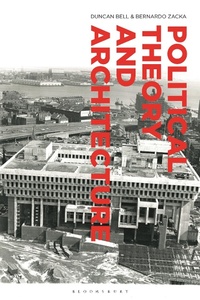
Political Theory and Architecture
1st Edition
Published on 20. February 2020
328 pages
978-1-350-10376-4 (ISBN)
Description

What can political theory teach us about architecture, and what can it learn from paying closer attention to architecture? The essays assembled in this volume begin from a common postulate: that architecture is not merely a backdrop to political life but a political force in its own right. Each in their own way, they aim to give countenance to that claim, and to show how our thinking about politics can be enriched by reflecting on the built environment.
The collection advances four lines of inquiry, probing the connection between architecture and political regimes; examining how architecture can be constitutive of the ethical and political realm; uncovering how architecture is enmeshed in logics of governmentality and in the political economy of the city; and asking to what extent we can think of architecture-tributary as it is to the flows of capital-as a partially autonomous social force.
Taken together, the essays demonstrate the salience of a range of political theoretical approaches for the analysis of architecture, and show that architecture deserves a place as an object of study in political theory, alongside institutions, laws, norms, practices, imaginaries, and discourses.
The collection advances four lines of inquiry, probing the connection between architecture and political regimes; examining how architecture can be constitutive of the ethical and political realm; uncovering how architecture is enmeshed in logics of governmentality and in the political economy of the city; and asking to what extent we can think of architecture-tributary as it is to the flows of capital-as a partially autonomous social force.
Taken together, the essays demonstrate the salience of a range of political theoretical approaches for the analysis of architecture, and show that architecture deserves a place as an object of study in political theory, alongside institutions, laws, norms, practices, imaginaries, and discourses.
More details
Edition
1. Auflage
Language
English
Place of publication
London
United Kingdom
Publishing group
Bloomsbury Publishing PLC
Target group
College/higher education
ISBN-13
978-1-350-10376-4 (9781350103764)
Copyright in bibliographic data and cover images is held by Nielsen Book Services Limited or by the publishers or by their respective licensors: all rights reserved.
Schweitzer Classification
Other editions
Additional editions
Duncan Bell | Bernardo Zacka
Political Theory and Architecture
Book
06/2021
Bloomsbury Academic
€53.47
Shipment within 15-20 days
Persons
Duncan Bell is Professor of Political Thought and International Relations at the University of Cambridge, UK.
Bernardo Zacka is Assistant Professor of Political Science at the Massachusetts Institute of Technology, USA.
Bernardo Zacka is Assistant Professor of Political Science at the Massachusetts Institute of Technology, USA.
Content
Introduction, Duncan Bell (University of Cambridge, UK) and Bernardo Zacka (Massachusetts Institute of Technology, USA)
Part One: Architecture and Political Regimes
1. What (If Anything) is 'Democratic Architecture'? Jan-Werner Müller (Princeton University, USA)
2. Fortification and Democracy in the Ancient Greek World, Josiah Ober (Stanford University, USA) and Barry Weingast (Stanford University, USA)
3. Plato's Magnesia and Costa's Brasilia, Gabor Betegh (University of Cambridge, UK)
Part Two: Architecture as Constitutive of Political Space
4. What's in a Balcony? The In-Between as Public Good, Bernardo Zacka (Massachusetts Institute of Technology, USA)
5. Durability and Citizenship: Towards an Arendtian Political Philosophy of Architecture, Ronald Beiner (University of Toronto, Canada)
6. The Soft Power of Neighbors: Proximity, Scale, and Responses to Violence, Nancy Rosenblum (Harvard University, USA)
Part Three: Architecture as Infrastructure: Governmentality and Political Economy
7. Scripting the City: J. G. Ballard Among the Architects, Duncan Bell (University of Cambridge, UK)
8. Architecture as Government, Ali Aslam (Mount Holyoke College, USA)
9. Making Superstar Cities Work: Jane Jacobs in Toronto, Margaret Kohn (University of Toronto, USA)
10. Whose Right to the City? Lessons from the Territorial Rights Debate, Benjamin Hofmann (Princeton University, USA)
Part Four: The Political Agency of Architecture
11. Can Architecture Really Do Nothing? Lefebvre, Bloch, and Jameson on Utopia, Nathaniel Coleman (Newcastle University, UK)
12. The Architecture of Political Renewal, Mihaela Mihai (University of Edinburgh, UK)
13. The Modesty of Architecture, Randall Lindstrom (University of Tasmania, Australia) and Jeff Malpas (University of Tasmania, Australia)
14. Architecture, Materiality and Politics: Sensations, Symbols, Situations and Decors, Antoine Picon (Harvard Graduate School of Design, USA)
Epilogue: Top-Down / Bottom-Up: Co-Producing the City, Fonna Forman (UC San Diego, USA)
Index
Part One: Architecture and Political Regimes
1. What (If Anything) is 'Democratic Architecture'? Jan-Werner Müller (Princeton University, USA)
2. Fortification and Democracy in the Ancient Greek World, Josiah Ober (Stanford University, USA) and Barry Weingast (Stanford University, USA)
3. Plato's Magnesia and Costa's Brasilia, Gabor Betegh (University of Cambridge, UK)
Part Two: Architecture as Constitutive of Political Space
4. What's in a Balcony? The In-Between as Public Good, Bernardo Zacka (Massachusetts Institute of Technology, USA)
5. Durability and Citizenship: Towards an Arendtian Political Philosophy of Architecture, Ronald Beiner (University of Toronto, Canada)
6. The Soft Power of Neighbors: Proximity, Scale, and Responses to Violence, Nancy Rosenblum (Harvard University, USA)
Part Three: Architecture as Infrastructure: Governmentality and Political Economy
7. Scripting the City: J. G. Ballard Among the Architects, Duncan Bell (University of Cambridge, UK)
8. Architecture as Government, Ali Aslam (Mount Holyoke College, USA)
9. Making Superstar Cities Work: Jane Jacobs in Toronto, Margaret Kohn (University of Toronto, USA)
10. Whose Right to the City? Lessons from the Territorial Rights Debate, Benjamin Hofmann (Princeton University, USA)
Part Four: The Political Agency of Architecture
11. Can Architecture Really Do Nothing? Lefebvre, Bloch, and Jameson on Utopia, Nathaniel Coleman (Newcastle University, UK)
12. The Architecture of Political Renewal, Mihaela Mihai (University of Edinburgh, UK)
13. The Modesty of Architecture, Randall Lindstrom (University of Tasmania, Australia) and Jeff Malpas (University of Tasmania, Australia)
14. Architecture, Materiality and Politics: Sensations, Symbols, Situations and Decors, Antoine Picon (Harvard Graduate School of Design, USA)
Epilogue: Top-Down / Bottom-Up: Co-Producing the City, Fonna Forman (UC San Diego, USA)
Index
