

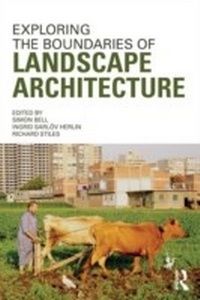
Exploring the Boundaries of Landscape Architecture
1st Edition
Published on 20. February 2011
344 pages
978-1-136-64603-4 (ISBN)
Description

What have cultural anthropologists, historical geographers, landscape ecologists and environmental artists got in common? Along with eight other disciplines, from domains as diverse as planning and design, the arts and humanities as well as the social and natural sciences, they are all fields of importance to the theory and practice of landscape architecture.
In the context of the EU funded LE:NOTRE Project, carried out under the auspices of ECLAS, the European Council of Landscape Architecture Schools, international experts from a wide range of related fields were asked to reflect, each from their own perspective, on the interface between their discipline and landscape architecture. The resulting insights presented in this book represent an important contribution to the development the discipline of landscape architecture, as well as suggesting new ways in which future collaboration can help to create a greater interdisciplinary richness at a time when the awareness of the importance of the landscape is growing across a wide range of disciplines.
Exploring the Boundaries of Landscape Architecture is the first systematic attempt to explore the territory at the boundaries of landscape architecture. It addresses academics, professionals and students, not just from landscape architecture but also from its neighbouring discipline, all of whom will benefit from a better understanding their areas of shared interest and the chance to develop a common language with which to converse.
In the context of the EU funded LE:NOTRE Project, carried out under the auspices of ECLAS, the European Council of Landscape Architecture Schools, international experts from a wide range of related fields were asked to reflect, each from their own perspective, on the interface between their discipline and landscape architecture. The resulting insights presented in this book represent an important contribution to the development the discipline of landscape architecture, as well as suggesting new ways in which future collaboration can help to create a greater interdisciplinary richness at a time when the awareness of the importance of the landscape is growing across a wide range of disciplines.
Exploring the Boundaries of Landscape Architecture is the first systematic attempt to explore the territory at the boundaries of landscape architecture. It addresses academics, professionals and students, not just from landscape architecture but also from its neighbouring discipline, all of whom will benefit from a better understanding their areas of shared interest and the chance to develop a common language with which to converse.
More details
Language
English
Place of publication
London
United Kingdom
Publishing group
Taylor & Francis Ltd
Target group
College/higher education
Professional and scholarly
Illustrations
1 s/w Tabelle, 52 s/w Photographien bzw. Rasterbilder, 13 s/w Zeichnungen
1 Tables, black and white; 13 Line drawings, black and white; 52 Halftones, black and white
File size
3,66 MB
ISBN-13
978-1-136-64603-4 (9781136646034)
Copyright in bibliographic data and cover images is held by Nielsen Book Services Limited or by the publishers or by their respective licensors: all rights reserved.
Schweitzer Classification
Other editions
Additional editions

Simon Bell | Ingrid Herlin | Richard Stiles
Exploring the Boundaries of Landscape Architecture
Book
08/2011
1st Edition
Routledge
€262.80
Shipment within 15-20 days
Simon Bell | Ingrid Herlin | Richard Stiles
Exploring the Boundaries of Landscape Architecture
Book
08/2011
1st Edition
Routledge
€86.30
Shipment within 15-20 days
Persons
Simon Bell OPENspace research centre, Edinburgh College of Art, Edinburgh, Scotland, and Estonian University of Life Sciences, Tartu, Estonia
Ingrid Sarloev Herlin Swedish Agricultural University, Alnarp, Sweden
Richard Stiles Vienna University of Technology, Vienna, Austria
Ingrid Sarloev Herlin Swedish Agricultural University, Alnarp, Sweden
Richard Stiles Vienna University of Technology, Vienna, Austria
Content
Foreword. Introduction Part 1 1. Theoretical Landscapes 2. Trees: The Living Structure of the Landscape 3. Space, Place and Perception 4. A Prospect of Time Part 2 5. Space, Place and Gaze 6. Are Landscape Ecology/Architecture Synergistic? 7. Past Meets Present 8. Trees Shaping Landscapes Part 3 9. Valuing the View 10. Space, Place, Site and Locality 11. Greening Planning 12. The Place of Landscape Part 4: Conclusions 13. Reflections and Conclusions
