

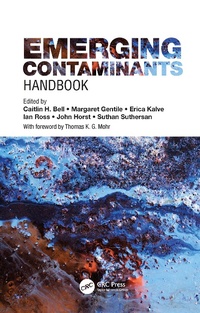
Emerging Contaminants Handbook
Published on 15. January 2019
469 pages
978-1-351-66506-3 (ISBN)
Description

The term "emerging contaminants" and its multiple variants has come to refer to unregulated compounds discovered in the environment that are also found to represent a potential threat to human and ecological receptors. Such contaminants create unique and considerable challenges as the push to address them typically outpaces the understanding of their toxicity, their need for regulation, their occurrence, and techniques for treating the environmental media they affect.
With these challenges in mind, this handbook serves as a primer regarding the topic of emerging contaminants, with current and practical information to help support the goal of protection where they are encountered.
Features
Explores the definition, identification, and life cycle of emerging contaminants.
Reviews current information on sources, toxicology, regulation, and new tools for characterization and treatment of:
1,4-Dioxane (mature in its emerging contaminant life cycle)
Per- and polyfluoroalkyl substances (PFASs; a newer group of emerging contaminant)
Hexavalent chromium (former emerging contaminant with evolving science)
1,2,3-Trichloropropane (progressing in its emerging contaminant life cycle)
Provides thoughts on opportunities in managing emerging contaminants to help balance uncertainty, compress life cycle, and optimize outcomes.
With these challenges in mind, this handbook serves as a primer regarding the topic of emerging contaminants, with current and practical information to help support the goal of protection where they are encountered.
Features
Explores the definition, identification, and life cycle of emerging contaminants.
Reviews current information on sources, toxicology, regulation, and new tools for characterization and treatment of:
1,4-Dioxane (mature in its emerging contaminant life cycle)
Per- and polyfluoroalkyl substances (PFASs; a newer group of emerging contaminant)
Hexavalent chromium (former emerging contaminant with evolving science)
1,2,3-Trichloropropane (progressing in its emerging contaminant life cycle)
Provides thoughts on opportunities in managing emerging contaminants to help balance uncertainty, compress life cycle, and optimize outcomes.
More details
Language
English
Place of publication
London
United Kingdom
Publishing group
Taylor & Francis Ltd
Target group
Professional and scholarly
Product notice
Reflowable
Illustrations
54 Tables, black and white; 63 Illustrations, black and white
File size
14,77 MB
ISBN-13
978-1-351-66506-3 (9781351665063)
Copyright in bibliographic data and cover images is held by Nielsen Book Services Limited or by the publishers or by their respective licensors: all rights reserved.
Schweitzer Classification
Other editions
Additional editions
Caitlin H. Bell | Margaret Gentile | Erica Kalve
Emerging Contaminants Handbook
Book
01/2019
1st Edition
CRC Press
€275.29
Shipment within 10-20 days
Persons
Caitlin H. Bell, P.E. is a Senior Environmental Engineer at Arcadis. She holds a B.S. in Chemical Engineering, a M.S. in Environmental Engineering, and has nearly 10 years of consulting experience. Ms. Bell is a remediation engineer that focuses on sub-surface treatment of soil and groundwater using in-situ techniques. Specifically, she focuses on in-situ bio-remediation applications for a variety of chemicals of concern, including emerging contaminants. She serves as a technical resource to clients on topics such as molecular biology tools, bio-augmentation, compound specific isotope analysis, and challenging bio-remediation approaches for compounds like 1,4-dioxane.
Erica Kalve, P.G., is a Principal Geologist at Arcadis. She holds a B.S. in Geology, a B.A. in Chemistry, and has over 16 years of experience in the environmental field. Ms. Kalve is an environmental geologist that focuses on site investigation, characterization, and development of conceptual site models to support remedial decisions, long-term site management, and regulatory approval. She is actively engaged in characterization and management of emerging contaminants including poly- and perfluoroalkyl substances (PFAS), 1,4-dioxane, and n-nitrosodimethylamine. She serves as a technical resource to clients on topics such as SMART characterization, vapor intrusion, remedial alternative analyses, monitored natural attenuation, and regulatory strategies.
Margaret Gentile, Ph.D., P.E. is an Associate Vice President at Arcadis. She holds a B.S. in Chemical Engineering from the University of Maryland, a M.S. and Ph.D. in Environmental Engineering from Stanford University, and has 10 years of consulting experience. Dr. Gentile is an environmental engineer leading teams in the design and implementation of remediation systems. She specializes in biological treatment processes, large-scale remediation and remediation of metals, including hexavalent chromium. She has presented routinely on hexavalent chromium at industry conferences, and leads the In-Situ Reactive Treatment technical group within Arcadis.
Dr. Suthan Suthersan is Chief Technical Officer and Executive Vice President at Arcadis. He has enabled Arcadis to become one of the most respected knowledge-based environmental services company in the world through his contributions towards technology development and developing best practices and knowledge sharing platforms. His expertise and experience is gained from participating in hundreds of environmental remediation projects in the U.S., Canada, Europe, Latin America and Asia.
Erica Kalve, P.G., is a Principal Geologist at Arcadis. She holds a B.S. in Geology, a B.A. in Chemistry, and has over 16 years of experience in the environmental field. Ms. Kalve is an environmental geologist that focuses on site investigation, characterization, and development of conceptual site models to support remedial decisions, long-term site management, and regulatory approval. She is actively engaged in characterization and management of emerging contaminants including poly- and perfluoroalkyl substances (PFAS), 1,4-dioxane, and n-nitrosodimethylamine. She serves as a technical resource to clients on topics such as SMART characterization, vapor intrusion, remedial alternative analyses, monitored natural attenuation, and regulatory strategies.
Margaret Gentile, Ph.D., P.E. is an Associate Vice President at Arcadis. She holds a B.S. in Chemical Engineering from the University of Maryland, a M.S. and Ph.D. in Environmental Engineering from Stanford University, and has 10 years of consulting experience. Dr. Gentile is an environmental engineer leading teams in the design and implementation of remediation systems. She specializes in biological treatment processes, large-scale remediation and remediation of metals, including hexavalent chromium. She has presented routinely on hexavalent chromium at industry conferences, and leads the In-Situ Reactive Treatment technical group within Arcadis.
Dr. Suthan Suthersan is Chief Technical Officer and Executive Vice President at Arcadis. He has enabled Arcadis to become one of the most respected knowledge-based environmental services company in the world through his contributions towards technology development and developing best practices and knowledge sharing platforms. His expertise and experience is gained from participating in hundreds of environmental remediation projects in the U.S., Canada, Europe, Latin America and Asia.
Content
Chapter 1 Introduction to Emerging Contaminants. Chapter 2 1,4-Dioxane. Chapter 3 Per- and Polyfluoroalkyl Substances. Chapter 4 Hexavalent Chromium. Chapter 5 1,2,3-Trichloropropane. Chapter 6 Considerations for Future Contaminants of Emerging Concern. Appendix A USEPA Candidate Contaminant List. Appendix B REACH Candidate List. Appendix C Emerging Contaminants and Their Physical and Chemical Properties. Appendix D NGI Preliminary List of Substances That Could Be Considered to Meet the PMT or vPvM Criteria. Appendix E.1 Summary of PFAS Environmental Standards: Soil. Appendix E.2 Summary of PFAS Environmental Standards: Groundwater. Appendix E.3 Summary of PFAS Environmental Standards: Surface Water. Appendix E.4 Summary of PFAS Environmental Standards: Drinking Water. Appendix E Notes.
