

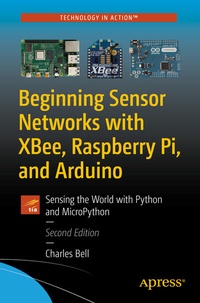
Beginning Sensor Networks with XBee, Raspberry Pi, and Arduino
Sensing the World with Python and MicroPython
2nd Edition
Published on 25. June 2020
XXVI, 716 pages
978-1-4842-5796-8 (ISBN)
Description

Build sensor networks with Python and MicroPython using XBee radio modules, Raspberry Pi, and Arduino boards. This revised and updated edition will put all of these together to form a sensor network, and show you how to turn your Raspberry Pi into a MySQL database server to store your sensor data!
You'll review the different types of sensors and sensor networks, along with new technology, including how to build a simple XBee network. You'll then walk through building an sensor nodes on the XBee, Raspberry Pi, and Arduino, and also learn how to collect data from multiple sensor nodes. The book also explores different ways to store sensor data, including writing to an SD card, sending data to the cloud, and setting up a Raspberry Pi MySQL server to host your data. You'll even learn how to connect to and interact with a MySQL database server directly from an Arduino! Finally you'll see how to put it all together by connecting your sensor nodes to your new Raspberry Pi database server.
If you want to see how well XBee, Raspberry Pi, and Arduino can get along, especially to create a sensor network, then Beginning Sensor Networks with XBee, Raspberry Pi, and Arduino is just the book you need.
What You'll Learn
Who This Book Is For
Those interested in building or experimenting with sensor networks and IoT solutions, including those with little or no programming experience. A secondary target includes readers interested in using XBee modules with Raspberry Pi and Arduino, those interested in controlling XBee modules with MicroPython.
You'll review the different types of sensors and sensor networks, along with new technology, including how to build a simple XBee network. You'll then walk through building an sensor nodes on the XBee, Raspberry Pi, and Arduino, and also learn how to collect data from multiple sensor nodes. The book also explores different ways to store sensor data, including writing to an SD card, sending data to the cloud, and setting up a Raspberry Pi MySQL server to host your data. You'll even learn how to connect to and interact with a MySQL database server directly from an Arduino! Finally you'll see how to put it all together by connecting your sensor nodes to your new Raspberry Pi database server.
If you want to see how well XBee, Raspberry Pi, and Arduino can get along, especially to create a sensor network, then Beginning Sensor Networks with XBee, Raspberry Pi, and Arduino is just the book you need.
What You'll Learn
-
Code your sensor nodes with Python and MicroPython
- Work with new XBee 3 modules
- Host your data on Raspberry Pi
- Get started with MySQL
- Create sophisticated sensor networks
Who This Book Is For
Those interested in building or experimenting with sensor networks and IoT solutions, including those with little or no programming experience. A secondary target includes readers interested in using XBee modules with Raspberry Pi and Arduino, those interested in controlling XBee modules with MicroPython.
More details
Series
Edition
Second Edition
Language
English
Place of publication
Berkeley
United States
Publishing group
APRESS
Product notice
Reflowable
Illustrations
XXVI, 716 p. 164 illus., 161 illus. in color.
File size
15,06 MB
ISBN-13
978-1-4842-5796-8 (9781484257968)
DOI
10.1007/978-1-4842-5796-8
Schweitzer Classification
Other editions
Additional editions
Charles Bell
Beginning Sensor Networks with XBee, Raspberry Pi, and Arduino
Sensing the World with Python and MicroPython
Book
06/2020
2nd Edition
APress
€80.24
Shipment within 15-20 days
Person
Charles Bell conducts research in emerging technologies. He is a member of the Oracle MySQL Development team and is the team lead for the MySQL Utilities team. He lives in a small town in rural Virginia with his loving wife. He received his Doctor of Philosophy in Engineering from Virginia Commonwealth University in 2005. Dr. Bell is an expert in the database field and has extensive knowledge and experience in software development and systems engineering. His research interests include 3D printers, microcontrollers, three-dimensional printing, database systems, software engineering, and sensor networks. He spends his limited free time as a practicing Maker focusing on microcontroller projects and refinement of three-dimensional printers. Dr. Bell maintains a blog on his research projects and many other interests.
Content
Chapter 1: Introduction to Sensor Networks.- Chapter 2: Tiny Talking Modules: An Introduction to XBee.- Chapter 3: Programming in MicroPython.- Chapter 4: XBee-based Sensor Nodes.- Chapter 5: Raspberry Pi-based Sensor Nodes.- Chapter 6: Arduino-based Sensor Nodes.- Chapter 7: Methods for Storing Sensor Data.- Chapter 8: Turning Your Raspberry Pi into a Database Server.- Chapter 9: MySQL and Arduino: United at Last!.- Chapter 10: Building Your Network: Arduino Wireless Aggregator + Wireless Sensor Node + Raspberry Pi Server.- Chapter 11: Putting It All Together.- Appendix.
