

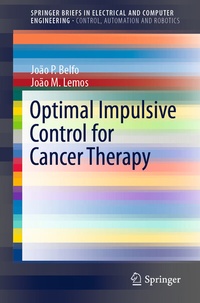
Optimal Impulsive Control for Cancer Therapy
Description

This Springer brief discusses the use of control engineering methods to plan a cancer therapy which tends to reduce tumour size in patients, striking a balance that minimizes the toxic effects of the treatment. The authors address the design and computation of impulsive control therapies, a methodology previously underexplored in the application of control methods to medical modelling. This allows simulation of such discrete events as taking a pill rather than relying on the supply of therapy being continuous and steady.
The book begins with an introduction to the topic, before moving onto pharmacokinetic, pharmacodynamical and tumour-growth models and explaining how they describe the relationship between a certain therapy plan and the evolution of cancer. This is placed firmly in the context of work introducing impulsive differential equations. The final chapter summarizes the research presented and suggests future areas of research to encourage readers in taking the subject forward.
This book is of interest to biomedical engineers, researchers and students, particularly those with a background in systems and control engineering.
More details
Other editions
Additional editions
Persons
In 2018, João P. Belfo received his M.Sc. degree in Electrical and Computer Engineering with a dissertation on the design of cancer therapy based on impulsive optimal control. He is currently a grant researcher at INESC-ID.
João M. Lemos is a Full Professor of the Department of Electrical and Computer Engineering of IST, the School of Engineering of the University of Lisboa, Portugal, and Head of the Research Group on Control of Dynamic Systems of INESC-ID, where he currently develops research and teaching activities in the scientific area of systems, decision and control. His areas of activity mainly comprise applications to biomedical systems, and other areas, of adaptive, predictive and optimal control.
Professor Lemos has published more than 200 scientific papers in peer-reviewed international journals and conference proceedings; he has also (co)authored two books: a university manual on state-space-based control design (in Portuguese) and Adaptive Control of Solar Energy Collector Systems (Springer, ISBN ISBN 978-3-319-06852-7).
Content
Chapter 1. Introduction.- Chapter 2. Pharmacokinetic and Pharmacodynamical Models.- Chapter 3. Tumor Growth Models.- Chapter 4. Optimal Impulsive Control.- Chapter 5. Cancer Therapy Optimization.- Chapter 6. Complementary Aspects.- Chapter 7. Conclusions and Research Topics.
