

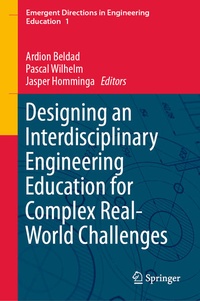
Designing an Interdisciplinary Engineering Education for Complex Real-World Challenges
Description

This edited volume presents conceptual and empirical research on the design and implementation of an interdisciplinary engineering education programme grounded in a liberal arts philosophy. Authored by researchers from diverse disciplines, the chapters explore and reflect on the elements that characterise this educational programme.
The first two chapters examine the societal value of inter- and transdisciplinary education within a liberal arts framework. Subsequent chapters discuss the features and components of interdisciplinary engineering education, while also addressing the challenges associated with implementing such an approach. Particular attention is given to the role and impact of self-directed learning, a key feature of this educational model. The volume further describes the various paradigms and approaches the programme employs to realise its vision.
What distinguishes this edited volume from other works on interdisciplinary engineering education is its strong integration of insights and experiences from students, alumni, and teachers who have participated in the programme's learning and teaching activities.
More details
Other editions
Additional editions
Persons
Dr. Ardion Beldad is an associate professor at the University College Twente, University of Twente, the Netherlands. He has been involved in designing and implementing an interdisciplinary engineering education based on a liberal arts philosophy - the three-year Dutch bachelor's programme in technology, liberal arts, and sciences (ATLAS) at the University of Twente. Within this programme, he co-designs and teaches social science courses that equip students with the required competencies to become interdisciplinary engineers. As a social scientist, he researches trust building and maintenance, crisis management and communication, information privacy, technology adoption, and sustainable behaviour and ethical consumption.
Dr. Pascal Wilhelm is an educational psychologist by training and an experienced curriculum and course developer. As a teacher, he received several teaching awards, including the university-wide "Teacher of the Year" award. He is a Teaching and Learning fellow at University Twente, the Netherlands and published mainly in the field of the learning sciences. In his capacity as a curriculum developer, he co-designed a three-year interdisciplinary engineering program fully based on the concept of self-directed learning. His main contribution was the concrete elaboration of the self-directed learning concept and supporting students' reflective practice. He currently works as a teacher and researcher at the Academy of Applied Psychology and Human Resource Management of Saxion University of Applied Sciences in the Netherlands.
Dr. Jasper Homminga is a biomechanical engineer focused on education, on learning opportunities, and curricula that build the students' confidence. He has designed education in fields ranging from medicine to engineering. He has worked on the design of curricula such as Biomedical Engineering and Technology and Liberal Arts & Sciences. He has been programme director for the programmes of Technical Medicine and of Technology and Liberal Arts & Sciences.
Content
Chapter 1. The societal value of an interdisciplinary engineering education : A systematic literature review.- Chapter 2. Designing a liberal arts program on interdisciplinary engineering education.- Chapter 3. Autonomy in an interdisciplinary engineering classroom.- Chapter 4. Reflections on teaching social science in an interdisciplinary engineering education program.- Chapter 5. Societal challenges as foundations for designing an interdisciplinary engineering education curriculum.- Chapter 6. Self-directed learning and the role of individual reflection on academic and personal development in interdisciplinary engineering education.- Chapter 7. Personal pursuit - Turning students' passion into opportunities for academic and personal growth.- Chapter 8. Beyond Technical skills - Balancing academic, personal, and professional growth for new engineers.- Chapter 9. Building a community of learners in an interdisciplinary engineering education.- Chapter 10. Self-directed learning beyond the curriculum - Understanding the implications of SDL for the professional lives of interdisciplinary engineering education graduates.
