

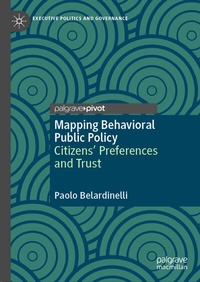
Mapping Behavioral Public Policy
Description

This book provides a new perspective on behavioral public policy. The field of behavioral public policy has been dominated by the concept of 'nudging' over the last decade. As this book demonstrates, however, 'nudging' is one of many behavioral techniques that practitioners and policymakers can utilize in order to achieve their goals. The book discusses the advantages and disadvantages of these alternative techniques, and demonstrates empirically how the impact of 'nudging' and 'non-nudging' interventions are often dependent on varying political contexts and the degree of trust that citizens have toward policymakers. In doing so, it addresses the important question of how citizens understand and approve of the use of behavioral techniques by governments. The book will appeal to all those interested in public management, public policy, behavioral psychology, and 'nudging'.
Reviews / Votes
"Paolo Belardinelli's book, Mapping Behavioral Public Policy, briefly examines the state of literature in the field. Being part of the Palgrave Pivot series, this volume is short, but provides a useful introduction to the topic at hand." (C. L. Atkinson, Public Organization Review, March 27, 2025)
More details
Other editions
Additional editions
Person
Paolo Belardinelli is Assistant Professor in the O'Neill School of Public and Environmental Affairs, Indiana University Bloomington, USA, and Faculty Affiliate to the Ostrom Workshop.
Content
.- Chapter 1: Introduction.
.- Chapter 2 - Behavioral insights and public policy.
.- Chapter 3 - Behavioral public policy and the monopoly of nudging.
.- Chapter 4 - The right behavioral technique for the right context.
.- Chapter 5 - Legitimacy of behavioral public policy and trust in public institutions.
.- Chapter 6 - Implications for research and practice.
