

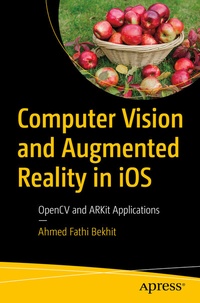
Computer Vision and Augmented Reality in iOS
Description

Learn how computer vision works, how augmented reality renders digital graphics into the physical world via an iPhone's camera, and how to incorporate these technologies into your own apps. This book shows you how to take full advantage of computer vision technologies.
Interacting with other people online usually involves user-generated images and videos; whether it be "memes", short videos, or heavily-modified images. Before smart phones, generating this content required a professional using high-level image and video editing software. Not any more.
This book will teach you to use computer vision in the most popular ways, such as for facial recognition, image to text analysis and, of course, recording a video of a dancing hot dog in your living room. Starting with the history of computer vision, image and video processing fundamentals, and an introduction to developing augmented reality applications, you'll learn to incorporate computer vision both in the content youcreate and the apps you develop for end users.
Computer Vision and Augmented Reality in iOS
reveals how every user with access to the Internet and a smart phone can easily generate heavily-modified images and videos.
-
Incorporate mathematics related to computer vision into your apps
-
Host computer vision models remotely for mobile use
-
Implement visual-inertial state estimation algorithms for mobile augmented reality
Who This Book Is For
Professionals or post graduate students in software development or engineering who have a basic understanding of how software development works and are interested in implementing computer vision into their development. It's recommended that readers already have a working knowledge of C++ and Swift.
More details
Other editions
Additional editions
Person
Content
Chapter 1. Introduction to Computer Vision.- Chapter 2. Introduction to Augmented Reality.- Chapter 3. Image and Video Processing Fundamentals.- Chapter 4. Computer Vision Applications.- Chapter 5. Custom Object Tracking.- Chapter 6. Augmented Reality using OpenCV.- Chapter 7. Augmented Reality using ARKit & OpenCV.
