

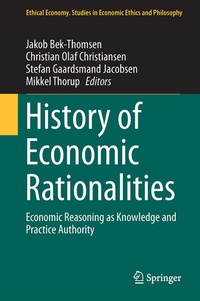
History of Economic Rationalities
Description

This book concentrates upon how economic rationalities have been embedded into particular historical practices, cultures, and moral systems. Through multiple case-studies, situated in different historical contexts of the modern West, the book shows that the development of economic rationalities takes place in the meeting with other regimes of thought, values, and moral discourses.
The book offers new and refreshing insights, ranging from the development of early economic thinking to economic aspects and concepts in the works of classical thinkers such as Thomas Hobbes, John Locke and Karl Marx, to the role of economic reasoning in contemporary policies of art and health care. With economic rationalities as the read thread, the reader is offered a unique chance of historical self-awareness and recollection of how economic rationality became the powerful ideological and moral force that it is today.
More details
Other editions
Additional editions
Persons
Christian Olaf Christiansen , Ph.D., is currently working on his second post.doc. He is specialized in the history of American economic and political thought. His first soleauthored book, Progressive Business - An Intellectual History of the Role of Business in American Society, is to be published by Oxford University Press in November 2015.
Stefan Gaardsmand Jacobsen , Ph.D., also part of the ECORA research project. He has published numerous articles on the intellectual history of economics, European conceptions of China, ideas of natural order, and the French physiocrats political economy.
Mikkel Thorup is Associate professor in the history of political thought, University of Aarhus, Denmark, and the author of several books including An intellectual History of Terror (2010), The Total Enemy (2014) and Pro Bono? (2015). Directs the research projects 'Economic Rationalities' and 'Contested Property Claims'.
Content
About the Authors.- 1. Introduction; Jakob Bek-Thomsen, Christian O. Christiansen, Stefan G. Jacobsen, Mikkel Thorup.- 2. From "Permutation of Commodities" to the Praise of "Doux Commerce." Changes in Economic Rationality in Early Modern Times; Catherine Secretan.- 3. "The Nutrition of a Commonwealth:" On Hobbes's Economic Thought; Laurens van Apeldoorn.- 4. Circulation of Blood and Money in Leviathan - Hobbes on the Economy of the Body; Christoffer Basse Eriksen.- 5. Profits and Morals in Leon Battista Alberti's I libri della famiglia; Jakob Bek-Thomsen.- 6. The Meanings of Work in John Locke; Campbell Jones.- 7. Financial Reasoning in The Midst of Revolution and Wars: Merchants and Bankers Between Paris, London, and Amsterdam, 1789-1810; Niccolò Valmori.- 8. Prose Genre and the Emergence of Modern Economic Reasoning in Eighteenth-Century Britain; Jill Marie Bradbury.- 9. Political Economy and its Public Contenders 1820-1850; Stefan Gaardsmand Jacobsen, Thomas Palmelund Johansen.- 10. The Promissory Self - Credit and Debt Rationalities in the Work and Life of Karl Marx; Mikkel Thorup.- 11. Democratic Governance: A Genealogy; Mark Bevir.- 12. The Economic De-Legitimization and Legitimization of Arts Policies 1970-1985; Erwin Dekker.- 13. From "Health for All" to "Health as Investment:" The Role of Economic Rationalities in the Transition from International to Global Health 1978 - 2013; Katherine E. Kenny.- 14. The Economic Rationality of "Doing Good To Do Well" and Three Critiques, 1990 to The Present; Christian Olaf Christiansen.
