

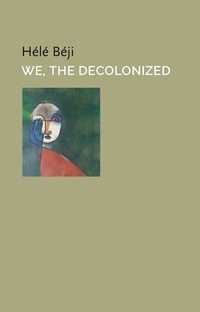
We, the Decolonized
Description

Béji delivers an trenchant critique of decolonization: the saddest of all liberties, because it has not kept its promises. Those who had vanquished colonialism, vindicated civilization and struggled free from the yoke of illegitimate government found themselves ensnared in a new trap, having achieved emancipation without liberation. They remained entangled in a compulsive recycling of colonial impulses. To re-embark on the route to a truly free society, intellectuals and political figures must lead by example in acknowledging the reality of the past, adopting tolerant attitudes towards religions and embracing a new and secular democratic mentality.
Béji's important contribution to the decolonial canon will be of great interest to anyone concerned with the politics of decolonization in Africa and the Maghreb and in the Global South more broadly.
More details
Other editions
Additional editions
Persons
Content
We, the Decolonized
Index
Foreword
Nouri Gana
The Unfinished Project of Decolonization
When I consider the extent of our dependence, it is hard to imagine we are in fact independent.
Hélé Béji, We, the Decolonized, p. 33
We thought we'd do better than you Europeans. But what came of it? No matter how hard I look for this second-stage humanism, I can't find it anywhere.
Hélé Béji, We, the Decolonized, p. 129
Rarely had a scholar from the Maghreb been more unsparingly critical of self and other than Hélé Béji in her surgical reflections on the state of the postcolony in We, the Decolonized. Béji delves into the record of the postcolonial nation state to discern the failures of its leadership and the frustrations of an entire generation of intellectuals who took seriously the project of forging a new humanism, uninhibited by the pitfalls of European humanism and colonial racism. After heralding a promissory future for the newly independent nation states of Africa and Asia, decolonization became gradually but steadily a tool of oppression and despotism in the hands of the nationalist elites. Even the discourse of national self-determination, which galvanized the anticolonial thrust toward liberty, has slipped into identitarian visions of purism and given rise to chauvinistic and nihilistic tendencies that hastened the descent into spirals of uncivil violence. Keeping the balance between a critique of the decolonized - the policymakers, the elites, the public intellectuals as well as the misled and gullible masses - and a critique of the neocolonial encroachments of the Euro-American empire, Béji masterfully weaves a composite and complex narrative of the story of the postcolony in the throes of a constant struggle for survival.
We, the Decolonized was originally written in 2007 and published in French as Nous, Décolonisés in 2008, more than half-a-century after the independence of most of the formerly colonized countries of Africa and Asia. This 2024 English translation comes at a time when much has changed in the world at large, yet not much in the world of the nominally decolonized. Even though the hegemony of American imperialism is being challenged more than ever since the fall of the Berlin wall, Palestine is still settler-colonized and (as I write, May 2024) is undergoing a renewed ethnic cleansing of genocidal proportions. Decolonization remains from this perspective starkly incomplete, but whether it still warrants the same critique as any given political project that has been fully completed is a question that Béji neither readily dismisses nor addresses fully - only by implication. It is therefore best to understand Béji's polemical reactions and critical reflections in a positive spirit, which is not only awake to the urgent task of pressing forward, like before, with the unfinished project of decolonization, but also highly mindful of the profound despair and resignation that would result from giving up on the promise of worldly humanism to come. As she incisively puts it herself, "[t]he time for bitter truths has come, and I won't stand in the way of what they have to reveal. Whatever we confront by charging forward will be less devastating than what we lose by giving up" (pp. 6-7).
Béji begins We, the Decolonized with an autobiographical sketch that recounts her upbringing in a household in which the dividing lines between the private and the political were completely blurred. Political debate was not an anomaly or a luxury but tantamount to doing what comes naturally: it not only cemented the overall commitment of her family members to the cause of anticolonialism and national self-determination but also gave meaning and purpose to their lives. As she reminisces quite tellingly: "When something was off in my life, I sensed that something was going wrong on a national level, that a global affair didn't bode well for our country. Since our passion for nationalism was a core part of our being, we felt, in our own bodies, the slightest tremor in the body politic." The private is almost always political in the postcolony, but the intertwinement of the private and the political in Béji's case is also a matter of fact: she belongs to an anticolonial family committed to the struggle for independence and nation-building (her father, for example, held leading positions in the postcolonial government of freshly independent Tunisia, under Habib Bourguiba [1957-1987]). In a nutshell, it is fair to say that Béji was in the loop of Tunisian politics but it is hard to assume that she was necessarily privy to much governmental, policymaking, or diplomatic information.
Béji writes We, the Decolonized from the unique perspective of someone who has had the opportunity to observe the formation and workings of the political system of the postcolony at close quarters. She did the same in 1982, when she wrote Désenchantement national: Essai sur la décolonisation (National Disenchantment: Essay on Decolonization) - a much earlier assessment of the state of the postcolonial state. More than two decades had passed since Béji announced her disillusion with the governmental process in the postcolony, yet not much had changed. Arguably - and this was, in my opinion, Béji's position in 2007, when she wrote We, the Decolonized - things got worse and would culminate in mass social insurrection and revolt. On January 14, 2011, Zine El Abidine Ben Ali would be ousted from power; he had assumed the presidency of Tunisia on November 7, 1987, after an orchestrated palace coup against his predecessor, Habib Bourguiba. Béji's writings after January 14 take stock of the opening of a new corridor for hope and optimism, as well as of the uncanny resurgence of the same old mood of disenchantment and despair.1 The entrenchment and solidification of power structures and influence, both religious and neoliberal, cast a shadow of gloom on many of the promises of the Tunisian Revolution of Freedom and Dignity.
While National Disenchantment may be said to have portended the end of Bourguiba's presidency for life, We, the Decolonized can be seen as foreshadowing the fall of Ben Ali's regime. Each of the two books was published on the eve of the demise of an era of authoritarian rule and could, at least retrospectively, be seen as an obituary or a death certificate meted out to the regimes of Bourguiba and Ben Ali respectively. Béji wrote We, the Decolonized in the post-9/11 context of a global war on terror and of an imperialist politics of regime change that paved the way for the American military takeover in Afghanistan and Iraq. Besides, the brazen visit of Ariel Sharon - the orchestrator of the massacre of Palestinians in the Sabra and Shatila refugee camps in West Beirut - to al-Aqsa Mosque sparked a massive intifada (2000-2004), which deployed the tactic of martyrdom operations to spread awareness of the plight of Palestinians who were living for decades under the illegal Israeli occupation. Regardless of the debatable character and aims of such a tactic, there is ample evidence to suggest that any form of resistance that Palestinians may adopt, be it peaceful or combative in style, will always be immediately painted by Zionist and Euro-American politicians, pontificators, and mainstream media as a form of terrorism. Zionist and Euro-American neoliberal expansionist hegemony is always in search of the ideal victim or puppet to simultaneously exploit and idolize. The vacuity of the humanist liberal rhetoric is not a novelty anymore, given the complicity of most western leaders with the genocidal Israeli onslaught on Gazans, but the combination of ferocity and delirium with which such a rhetoric has been endorsed and paraded beggars the imagination.
The crisis of the western humanist paradigm continues unchecked, even though it has clearly reached its peak at a time when the contradictions, double standards, and hypocrisies of this paradigm have been starkly exposed for the whole world to ponder about and rebuke them. Béji does remind the harbingers of the European Enlightenment and universal human rights of their longstanding incoherence and cognitive deficit, if not callous blindness: "While you were judging crimes against humanity at Nuremberg in 1945, you were perpetrating the Sétif massacre in Algeria! You were condemning the very horrors you were committing on our soil. Did this irony escape you? Your humanism has perished" (p. 5). With an implicit allusion to Fanon's rallying cry, at the end of The Wretched of the Earth, for a new vision of humanism forged in the smithy of the decolonized subject's soul, Béji traces the development of this admirable project - which she herself calls a "second-stage humanism" - against the actual governance and functioning of the administrative structure of the postcolony. While unapologetic in her scrutiny of the pitfalls of decolonization, Béji does not fall into the trap of "blaming the victim," a trap in which Albert Memmi deliberately falls (free-fall style) in his 2004 book Portrait du décolonisé arabo-musulman et de quelques autres (Portrait of the Decolonized Arab Muslim...
