

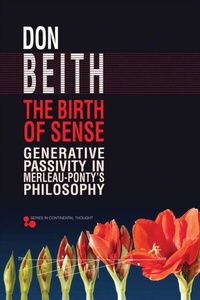
The Birth of Sense
Generative Passivity in Merleau-Ponty's Philosophy
1st Edition
Published on 1. April 2018
277 pages
978-0-8214-4626-3 (ISBN)
Description

In The Birth of Sense, Don Beith proposes a new concept of generative passivity, the idea that our organic, psychological, and social activities take time to develop into sense. More than being a limit, passivity marks out the way in which organisms, persons, and interbodily systems take time in order to manifest a coherent sense. Beith situates his argument within contemporary debates about evolution, developmental biology, scientific causal explanations, psychology, postmodernism, social constructivism, and critical race theory. Drawing on empirical studies and phenomenological reflections, Beith argues that in nature, novel meaning emerges prior to any type of constituting activity or deterministic plan.
The Birth of Sense is an original phenomenological investigation in the style of Maurice Merleau-Ponty, and it demonstrates that the French philosopher's works cohere around the notion that life is radically expressive. While Merleau-Ponty's early works are widely interpreted as arguing for the primacy of human consciousness, Beith argues that a pivotal redefinition of passivity is already under way here, and extends throughout Merleau-Ponty's corpus. This work introduces new concepts in contemporary philosophy to interrogate how organic development involves spontaneous expression, how personhood emerges from this bodily growth, and how our interpersonal human life remains rooted in, and often thwarted by, domains of bodily expressivity.
The Birth of Sense is an original phenomenological investigation in the style of Maurice Merleau-Ponty, and it demonstrates that the French philosopher's works cohere around the notion that life is radically expressive. While Merleau-Ponty's early works are widely interpreted as arguing for the primacy of human consciousness, Beith argues that a pivotal redefinition of passivity is already under way here, and extends throughout Merleau-Ponty's corpus. This work introduces new concepts in contemporary philosophy to interrogate how organic development involves spontaneous expression, how personhood emerges from this bodily growth, and how our interpersonal human life remains rooted in, and often thwarted by, domains of bodily expressivity.
Reviews / Votes
"An original and thoughtful contribution to scholarship on Maurice Merleau-Ponty....Beith draws Merleau-Ponty's thought into conversation with a wide range of thinkers and traditions-Bergson, Deleuze, Derrida, liberalism, social constructivism, autopoietic enactivism-and articulates an original conception of life and personhood. Summing up: Essential." (CHOICE Reviews) "A timely contribution to scholarship on Merleau-Ponty's work, considering the emerging focus in phenomenological literature on the significance of the dimension of passivity.... Beith advances a phenomenology of embodiment by going beyond a mere 'corporeal essentialism' to a focus that can engage with difference and oppression generally and issues of gender and race more specifically" "Beith fruitfully deploys the concepts of 'institution' and 'passivity' to interpret central issues in Merleau-Ponty's corpus and in contemporary philosophy, ultimately offering an account of the emergence of personhood and sociality out of the matrix of intercorporeal embodiment and behavior. This is a significant addition not only to Merleau-Ponty scholarship but also, more broadly, to philosophical discussions about nature, development, learning, self-consciousness, agency, and politics."More details
Series
Edition
1. Auflage
Language
English
Place of publication
Athens
United States
Target group
Professional and scholarly
File size
0,89 MB
ISBN-13
978-0-8214-4626-3 (9780821446263)
Copyright in bibliographic data and cover images is held by Nielsen Book Services Limited or by the publishers or by their respective licensors: all rights reserved.
Schweitzer Classification
Other editions
Additional editions
Book
04/2018
Ohio University Press
€114.09
Shipment within 10-20 days
Person
Don Beith practices philosophy phenomenologically, researching the role of the body in self-identity and learning, the nature of interpersonal relationships, and existential concepts of health, care, and authenticity. His work appears in Chiasmi, Continental Philosophy Review, Symposium, and elsewhere. He teaches at the University of Maine.
Content
- Intro
- Series Page
- Title Page
- Copyright
- Dedication
- Epigraph
- Contents
- Acknowledgments
- Abbreviations
- Introduction. In the Shadow of Philosophy: The Problem of Passivity in the Philosophy of Merleau-Ponty
- Reading Merleau-Ponty
- Three Concepts of Passivity
- Summary of Chapters
- Between Husserl and Merleau-Ponty: The Inversion of Phenomenology
- 1. Consciousness and Animality: The Problem of Constituting Activity in The Structure of Behavior
- Consciousness and the Problem of Organic Form
- Genetic Passivity in the Structure of Consciousness
- The Epistemology of Form: Learning to Perceive (as) Animals
- Autopoiesis and Transcendental Vitalism versus Melodic Forms
- 2. The Passivity of Life: The Problem of the Genesis of Possibility in Institution and Nature
- The Generative Passivity of Life in Nature
- The Spatiality of Generative Passivity in Life
- The Time of Life in Institution: Beyond A Priori and A Posteriori
- Bergson and the Becoming-True of Possibility
- Foucault's Criticisms of Merleau-Ponty's Naturalism
- 3. The Passivity of Second Nature: The Genesis of the Person in the Phenomenology of Perception
- Static Phenomenology: The Person as Irreducible Form
- Genetic Grounds of Personality: The Bodily Temporality of Habit
- Habit and the Genetic Passivity of Conscious Activity
- The Soil of Habits: The Deconstruction of Generative Passivity
- 4. The Intercorporeal Institution of Agency: Merleau-Ponty's Generative Psychology and Politics
- Institution of the Person: The Birth of Sense in Nonsense
- The Person as Instituted: Childhood
- The Emergence of Instituting Personality: Puberty
- Beyond Liberalism and Social Constructivism: Intercorporeal Agency
- Conclusion. The Hidden Nature of Passivity
- Interpreting Merleau-Ponty: Thinking on the Move
- Gestures at Future Investigations
- Notes
- References
- Index
