

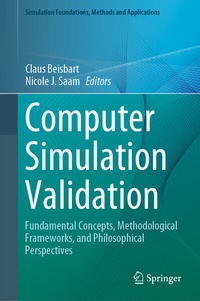
Computer Simulation Validation
Description

This unique volume introduces and discusses the methods of validating computer simulations in scientific research. The core concepts, strategies, and techniques of validation are explained by an international team of pre-eminent authorities, drawing on expertise from various fields ranging from engineering and the physical sciences to the social sciences and history. The work also offers new and original philosophical perspectives on the validation of simulations.
Topics and features: introduces the fundamental concepts and principles related to the validation of computer simulations, and examines philosophical frameworks for thinking about validation; provides an overview of the various strategies and techniques available for validating simulations, as well as the preparatory steps that have to be taken prior to validation; describes commonly used reference points and mathematical frameworks applicable to simulation validation; reviews the legal prescriptions, and the administrative and procedural activities related to simulation validation; presents examples of best practice that demonstrate how methods of validation are applied in various disciplines and with different types of simulation models; covers important practical challenges faced by simulation scientists when applying validation methods and techniques; offers a selection of general philosophical reflections that explore the significance of validation from a broader perspective.This truly interdisciplinary handbook will appeal to a broad audience, from professional scientists spanning all natural and social sciences, to young scholars new to research with computer simulations. Philosophers of science, and methodologists seeking to increase their understanding of simulation validation, will also find much to benefit from in the text.
More details
Other editions
Additional editions
Persons
Prof. Dr. Dr. Claus Beisbart is Professor for Philosophy of Science (Extraordinarius) in the Institute for Philosophy at the University of Bern, Switzerland.
Prof. Dr. Nicole J. Saam
is Professor for Sociology (Chair) in the Institute of Sociology at Friedrich-Alexander University Erlangen-Nürnberg, Germany.
Content
Introduction.- Part I: Foundations - Basic Conceptions in Simulation Model Validation .- What Is Validation of Computer Simulations?.- Simulation Accuracy, Uncertainty, and Predictive Capability.- Verification and Validation Principles from a Systems Perspective.- Errors and Uncertainties.- Part II: Foundations - Validation as a Scientific Method: Philosophical Frameworks for Thinking about Validation .- Invalidation of Models and Fitness-for-purpose.- Simulation Validation from a Bayesian Perspective.- Validation of Computer Simulations from a Kuhnian Perspective.- Understanding Simulation Validation.- Part III: Methodology - Preparatory Steps .- Assessing the Credibility of Conceptual Models.- The Foundations of Verification in Modeling and Simulation.- The Method of Manufactured Solutions for Code Verification.- Validation Metrics: A Case for Pattern-based Methods.- Analyzing Output from Stochastic Computer Simulations.- Part IV: Methodology - Points of Reference and Related Techniques .- The Use of Experimental Data in Simulation Model Validation.- How to Use and Derive Stylized Facts for Validating Simulation Models.- The Users' Judgements.- Validation Benchmarks and Related Metrics.- Part V: Methodology - Mathematical Frameworks and Related Techniques .- Testing Simulation Models Using Frequentist Statistics.- Validation Using Bayesian Methods.- Imprecise Probabilities.- Objective Uncertainty Quantification.- Part VI: Methodology - The Organization and Management of Simulation Validation .- Standards for Evaluation of Atmospheric Models in Environmental Meteorology.- The Management of Simulation Validation.- Valid and Reproducible Simulation Studies.- Part VII: Validation at Work - Best Practice-Examples .- Validation of Particle Physics Simulation.- Validation in Fluid Dynamics and Related Fields.- Astrophysical Validation.- Validation in Weather Forecasting.- Validation of Climate Models: An Essential Practice.- Validation of Agent-based Models in Economics and Finance.- Part VIII: Challenges in Simulation Model Validation .- Validation and Equifinality.- Validation and Overparameterization.- Uncertainty Quantification Using Multiple Models.- Challenges to Simulation Validation in the Social Sciences.- Validation and the Uniqueness of Historical Events.- Part IX: Reflecting on Simulation Validation: Philosophical Perspectives and Discussion Points .- What Is a Computer Simulation and What Does This Mean for Simulation Validation?.- How Do the Validations of Simulations and Experiments Compare?.- How Does Holism Challenge the Validation of Computer Simulation?.- What Types of Values Enter Simulation Validation and What are Their Roles?.- Calibration, Validation, and Confirmation.- Should Validation and Verification Be Separated Strictly?.- The Multi-Dimensional Epistemology of Computer Simulations.
