

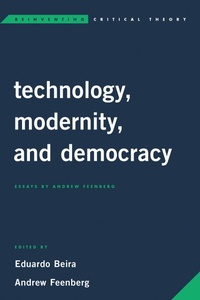
Technology, Modernity, and Democracy
Essays by Andrew Feenberg
1st Edition
Published on 29. May 2018
192 pages
978-1-78660-720-1 (ISBN)
Description

This important collection of essays by Andrew Feenberg presents his critical theory of technology, an innovative approach to philosophy and sociology of technology based on a synthesis of ideas drawn from STS and Frankfurt School Critical Theory.
According to critical theory of technology, technologies are neither neutral nor deterministic, but are encoded with specific socio-economic values and interests. Feenberg explores how they can be developed and adapted to more or less democratic values and institutions, and how their future is subject to social action, negotiation and reinterpretation. Technologies bring with them a particular "rationality," sets of rules and implied ways of behaving and thinking which, despite their profound influence on institutions, ideas and actions, can be transformed in a process of democratic rationalization. Feenberg argues that the emergence of human communication on the Internet and the environmental movement offer abundant examples of public interventions that have reshaped technologies originally designed for different purposes. This volume includes chapters on citizenship and critical theory of technology, philosophy of technology and modernity, and Heidegger and Marcuse, two of the most prominent philosophers of technology.
According to critical theory of technology, technologies are neither neutral nor deterministic, but are encoded with specific socio-economic values and interests. Feenberg explores how they can be developed and adapted to more or less democratic values and institutions, and how their future is subject to social action, negotiation and reinterpretation. Technologies bring with them a particular "rationality," sets of rules and implied ways of behaving and thinking which, despite their profound influence on institutions, ideas and actions, can be transformed in a process of democratic rationalization. Feenberg argues that the emergence of human communication on the Internet and the environmental movement offer abundant examples of public interventions that have reshaped technologies originally designed for different purposes. This volume includes chapters on citizenship and critical theory of technology, philosophy of technology and modernity, and Heidegger and Marcuse, two of the most prominent philosophers of technology.
Reviews / Votes
Part of what makes Feenberg's work philosophically significant is his style as a writer. He is able to craft sentences and paragraphs to reveal a lifetime's worth of philosophical insights presented in a way that is accessible but not patronizing. Amongst the essays found in this collection, there are a few that stand out. 'Ten paradoxes of technology' is an excellent introduction to the discipline of the philosophy of technology that would benefit undergraduate students, 'Agency and citizenship in a technological society' serves as a concise summary of Feenberg's argument for the democratization of technology and 'The politics of meaning: modernity, technology, and rationality' provides a thorough intellectual history of the critique of instrumental and technological rationality. More intriguing than these individual essays, though, are the hints towards a social theory of rationality that accounts for the ways in which technologies, organizations, forms of administration and markets share the same form of rationality. * Prometheus * Andrew Feenberg has done more than anyone else to develop a critical constructivism that ensures the relevance of critical theory to technology studies in the 21st century. This collection of essays is a fine crystallisation of that perspective and represents the ideal point of entry for anyone new to Feenberg's thought. This impressive collection of essays shows why Feenberg is rightly regarded as the leading expert on science and technology studies writing today. Having participated in pioneering developments in medical research protocols, on-line education platforms, and digital information systems, he brings a profound critical awareness to the social politics informing the democratization of science and technology in the age of economic domination.More details
Series
Edition
1. Auflage
Language
English
Place of publication
London
United Kingdom
Target group
Professional and scholarly
ISBN-13
978-1-78660-720-1 (9781786607201)
Copyright in bibliographic data and cover images is held by Nielsen Book Services Limited or by the publishers or by their respective licensors: all rights reserved.
Schweitzer Classification
Other editions
Additional editions
Book
05/2018
Rowman & Littlefield International
€151.00
Shipment within 3-4 weeks
Persons
Andrew Feenberg is Canada Research Chair in Philosophy of Technology in the School of Communication, Simon Fraser University, where he directs the Applied Communication and Technology Lab. His many publications include Lukacs, Marx and the Sources of Critical Theory (1981 and 1986), Critical Theory of Technology (1991 and 2002), Alternative Modernity (1995), Questioning Technology (1999), Heidegger and Marcuse: The Catastrophe and Redemption of History (2005), Between Reason and Experience: Essays in Technology and Modernity (2010), The Philosophy of Praxis: Marx, Lukacs and the Frankfurt School (2014) and Technosystem: The Social Life of Reason (2017).
Eduardo Beira is an engineer teaching at the University of Minho and the MIT Portugal Program.
Eduardo Beira is an engineer teaching at the University of Minho and the MIT Portugal Program.
Content
Introduction / Part I: Philosophy of Technology / 1. What is Philosophy of Technology? / 2. Ten Paradoxes of Technology / Part II: Citizenship and Critical Theory of Technology / 3. Technoscience at the Fork / 4. Agency and Citizenship in a Technological Society / 5. Function and Meaning: The Double Aspect of Technology / Part III: Heidegger and Marcuse / 6. The Critique of Technology / 7. On Reification and Concrete Philosophy / 8. The Politics of Meaning: Modernity, Technology and Rationality / Conclusion: Encountering Technology / Bibliography / Index
