

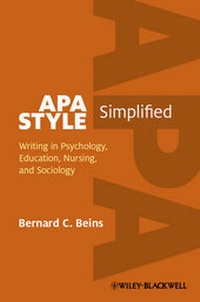
APA Style Simplified
Description

Reviews / Votes
''As with previous editions Browne et al have provided acomprehensive, contemporary and focussed A2 textbook which directlyapplies to the AQA specification. Via attention to the demands ofthe specification and reference to exam style questions the book isthoroughly usable and gives the reader clarity of purposeconcerning the material. A balance is achieved between classicSociology and up to date material, giving students the opportunityto recognise the relevance and importance of sociologicalinvestigations in today's society.'' David Morton, King Edward VI College, Stourbridge and examinerfor AQA ''This is an magnificent text. It won't just be anothertext on A2 Sociology for students but will serve as the leader inthe area. It has key concepts but with inspirational examples.It's the best textbook I have ever read for AQA A2 forSociology.'' Jason L. Powell, Coventry University ''This is an outstanding addition to the range of resources nowavailable to sociology students. Ken Brown and his colleaguesrepresent the very best in sociology teaching and this text, now inits long-awaited second edition, should be on the shelves of allaspiring sociology students and their teachers.'' Dr Gerry Czerniawski, University of East London, A-levelexaminer and National Teaching FellowProvides valuable guidance...Beins is an outstanding teacher,researcher, author, and editor. Following his suggestions willimprove your clarity, conciseness, and felicity ofexpression. - Charles Brewer, Furman University Not only does Beins explain how one should write, more importantly,he explains why one should write. This book will be a greatresource for both new and experienced writers alike. - Bryan K. Saville, James Madison University The author presents APA style in ways that are accessible tostudents and that address the various struggles they encounter inlearning how to write for professional audiences. - M. Elise Radina, Miami UniversityMore details
Other editions
Additional editions
Person
Bernard C. (Barney) Beins, Ph.D., is professor and chair of psychology at Ithaca College. He is author of about 150 articles, chapters, books, and pedagogical material. He recently received the Charles L. Brewer Distinguished Teaching of Psychology Award from the American Psychological Foundation. He is author with his daughter Agatha of Effective Writing in Psychology: Papers, Posters, and Presentations, 2nd Edition (Wiley-Blackwell, 2012) and Research Methods: A Tool for Life (2008). He is a Fellow of the American Psychological Association, the Association for Psychological Science, and the Eastern Psychological Association.
Content
2
Elements of Style
Agatha M. Beins
Social criticism begins with grammar and the re-establishing of meanings.
Octavio Paz
Easy reading is damned hard writing.
Nathaniel Hawthorne
A panda walks into a café. He orders a sandwich, eats it, then draws a gun and proceeds to shoot through the ceiling.
“Why?” asks the confused waiter, as the panda makes toward the exit. The panda produces a badly punctuated wildlife manual and tosses it over his shoulder.
“Well, I’m a panda,” he says at the door. “Look it up.”
The waiter turns to the relevant entry in the manual and, sure enough, finds an explanation. “Panda. Large black-and-white bear-like mammal, native to China. Eats, shoots and leaves.”
As this joke shows us, just one extra comma changes the entire meaning of a sentence. Consider the difference between Eats, shoots and leaves and Eats shoots and leaves. Most likely, a misplaced punctuation mark in your paper will not result in the firing of any guns; however, a number of misplaced punctuation marks or stylistic errors may result in a B+ rather than an A. This is because grammar is not just a series of unfortunate rules that you are supposed to learn. Rather, grammar is what enables us to communicate effectively.
In this chapter you will read about good grammar and elements of style. If grammar symbolizes the tools of construction, then style symbolizes the way you decorate that construction.
Recognizing the Importance of Good Grammar and Style
Generally, grammar and style do not seem to be exciting topics. They involve rules that don’t make sense (e.g., why is it considered improper to end a sentence with a preposition?) and seemingly obscure terms that confuse more than they clarify. Furthermore, knowing the difference between a subordinating and a correlative conjunction does not necessarily mean that a writer is able to use them correctly (the latter connects two independent clauses in a particular way and the former joins an independent clause with a dependent one).
Communication, however, does not occur only at the level of grammar. Through your style of writing, your words also convey a specific tone that carries beyond the denotative meaning. Consider that the way you describe your research paper to a friend and to your psychology professor would probably be different. Academic tone tends to be more formal than that of daily conversation. To write in a way that conveys such a tone avoid the following:
- contractions (use do not rather than don’t);
- colloquial expressions, such as you know and got to;
- vague expressions, such as practically all, most of them, a lot, some;
- shortcuts used for instant messaging or text messaging such as lol or omg;
- hyperbolic language, such as stupid, dumb, awesome, shocking;
- ridiculing another person’s work.
Another facet of grammar and style relates to APA guidelines. APA has a citation style that differs from what scholars in the English department would use; and APA style has specific rules, such as those relating to the use of acronyms and formatting a paper.
As you can see, grammar and style are shaped by both the requirements for basic meaningful communication and the specific expectations of your readers. In other words, your writing should be stylistically fluent and technically proficient. Errors in grammar can make your reader expend a lot of effort trying to understand the meaning of a sentence, and deviations from the conventional style can weaken your credibility as a writer.
Choosing Effective Wording
Although writing in the sciences might seem dry and uncreative, there are subtle gestures you can make to increase the power and readability of your writing. For example, in addition to employing good grammar and active verbs, you can vary the kind and length of your sentences. It is not grammatically incorrect to write with a series of sentences that are the same length or with sentences that begin in the same way, but this style of writing can be tedious to read. Furthermore, if you present your information in an unvarying manner, it can be easy for your reader to overlook important information. Therefore, changing sentence length is a tool to guide your reader. Following a long sentence with a brief sentence will draw attention to the information in the brief sentence.
The way you construct a sentence also enables you to emphasize different pieces of information. Hyde (2005) wrote, “In an important experiment, Lightdale and Prentice (1994) demonstrated the importance of gender roles and social context in creating or erasing the purportedly robust gender differences in aggression” (p. 588). The examples below are phrased differently, and, as a result, highlight different information.
1. Surprisingly, the purportedly robust gender differences in aggression can be created or erased in different social contexts, according to an important experiment by Lightdale and Prentice (1994). 2. Social context is an important factor in determining levels of aggression for both men and women (Lightdale and Prentice 1994). 3. The purportedly robust gender differences in aggression need to be analyzed within their social context, as shown by Lightdale and Prentice (1994). 4. Although one may believe that gender differences are innate, Lightdale and Prentice’s (1994) research demonstrates the importance of gender roles and social context in creating or erasing the purportedly robust gender differences in aggression. 5. Research by Lightdale and Prentice (1994) has shown that levels of aggression, generally thought to be higher in males, are affected by social context as well as biology.The way you start a sentence can give your reader clues about how to read the sentence and to connect it to other ideas. Words like surprisingly and although signal a relation between ideas that may be one of contrast (examples 1 and 4). Also, note that example 2 mentions the researchers only in a citation, whereas the original sentence and examples 1 and 5 emphasize the role of the researchers. Lastly, compare the tone of sentences 2 and 3. Sentence 2 offers information in a relatively neutral tone, whereas sentence 3 expresses a more persuasive tone with the word purportedly and the phrase need to be.
Another aspect of effective wording involves the skillful use of transitions that show a relation among ideas or concepts in your writing. Transitions bridge ideas, signaling the kind of statement you are making. Table 2.1 offers a series of situations in which you might use transitions as well as a list of transition words or phrases you can use to illustrate a relation. Transitional words and phrases in each row can take on slightly different meanings. Thus, it is important that you use transitions deliberately.
Table 2.1 Transitions and Their Uses
Purpose Transition words To add accordingly, in addition, both … and, equally important, further, furthermore, moreover, not only … but also To show contrast although, but, in contrast, conversely, despite, meanwhile, on the other hand, notwithstanding, otherwise, rather, whereas, yet To show similarity in the same way, likewise, similarly To show exception despite, however, in spite of, nevertheless, still, yet To show that you are elaborating on a point that is, in fact, to illustrate, in other words To show a result because, as a consequence, consequently, hence, for this (these) reason(s), as a result, therefore, thus To show the passage of time or sequence after, afterward, at this point, before, concurrently, earlier, finally, following, formerly, immediately, meanwhile, next, previously, prior to, simultaneously, subsequently, then, thereafter, thus, while, since To give an example to demonstrate, for example, for instance, in another case, to illustrate, in particular, in this case, in this situation, specifically, such as To emphasize actually, certainly, extremely, emphatically, in fact, indeed, most importantly, unquestionably, without a doubt, without reservation To summarize or conclude as I have shown, in brief, to conclude, in conclusion, hence, on the wholeUsing Inclusive and Appropriate Language
Inclusive language means language that does not unnecessarily exclude or single out groups of people. We emphasize inclusive language because of concerns about precision and ethics.
Regarding precision, good research requires accuracy. Accuracy is critical not only to the validity of your results, but also to your credibility as a researcher. If your pool of participants includes men and women, using masculine pronouns (him, his, or he) to refer to an average participant is a form of exclusive language and does not accurately reflect your...
