

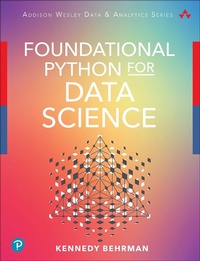
Foundational Python for Data Science
1st Edition
Published on 29. November 2021
256 pages
978-0-13-662431-8 (ISBN)
Description

Learn all the foundational Python you'll need to solve real data science problems
Data science and machine learning--two of the world's hottest fields--are attracting talent from a wide variety of technical, business, and liberal arts disciplines. Python, the world's #1 programming language, is also the most popular language for data science and machine learning. This is the first guide specifically designed to help millions of people with widely diverse backgrounds learn Python so they can use it for data science and machine learning.
Leading data science instructor and practitioner Kennedy Behrman first walks through the process of learning to code for the first time with Python and Jupyter notebook, then introduces key libraries every Python data science programmer needs to master. Once you've learned these foundations, Behrman introduces intermediate and applied Python techniques for real-world problem-solving.
Master Google colab notebook Data Science programming
Manipulate data with popular Python libraries such as: pandas and numpy
Apply Python Data Science recipes to real world projects
Learn functional programming essentials unique to Data Science
Access case studies, chapter exercises, learning assessments, comprehensive Jupyter based Notebooks, and a complete final project
Throughout, Foundational Python for Data Science presents hands-on exercises, learning assessments, case studies, and more--all created with colab (Jupyter compatible) notebooks, so you can execute all coding examples interactively without installing or configuring any software.
Data science and machine learning--two of the world's hottest fields--are attracting talent from a wide variety of technical, business, and liberal arts disciplines. Python, the world's #1 programming language, is also the most popular language for data science and machine learning. This is the first guide specifically designed to help millions of people with widely diverse backgrounds learn Python so they can use it for data science and machine learning.
Leading data science instructor and practitioner Kennedy Behrman first walks through the process of learning to code for the first time with Python and Jupyter notebook, then introduces key libraries every Python data science programmer needs to master. Once you've learned these foundations, Behrman introduces intermediate and applied Python techniques for real-world problem-solving.
Master Google colab notebook Data Science programming
Manipulate data with popular Python libraries such as: pandas and numpy
Apply Python Data Science recipes to real world projects
Learn functional programming essentials unique to Data Science
Access case studies, chapter exercises, learning assessments, comprehensive Jupyter based Notebooks, and a complete final project
Throughout, Foundational Python for Data Science presents hands-on exercises, learning assessments, case studies, and more--all created with colab (Jupyter compatible) notebooks, so you can execute all coding examples interactively without installing or configuring any software.
More details
Series
Edition
1. Auflage
Language
English
Place of publication
Hoboken
United States
Publishing group
Pearson Education (US)
Target group
Professional and scholarly
File size
18,35 MB
ISBN-13
978-0-13-662431-8 (9780136624318)
Copyright in bibliographic data and cover images is held by Nielsen Book Services Limited or by the publishers or by their respective licensors: all rights reserved.
Schweitzer Classification
Other editions
Additional editions
Kennedy Behrman
Foundational Python for Data Science
Book
01/2022
Pearson
€56.00
Shipment within 15-20 days
Person
Kennedy Behrman is a veteran software and data engineer. He first used Python writing asset management systems in the Visual Effects industry. He then moved into the startup world, using Python at startups using machine learning to characterize videos and predict the social media power of athletes.
Content
Preface xiii
I: Learning Python in a Notebook Environment 1
1 Introduction to Notebooks 3
2 Fundamentals of Python 13
3 Sequences 25
4 Other Data Structures 37
5 Execution Control 55
6 Functions 67
II: Data Science Libraries 83
7 NumPy 85
8 SciPy 103
9 Pandas 113
10 Visualization Libraries 135
11 Machine Learning Libraries 153
12 Natural Language Toolkit 159
III: Intermediate Python 171
13 Functional Programming 173
14 Object-Oriented Programming 187
15 Other Topics 201
A Answers to End-of-Chapter Questions 215
Index 221
I: Learning Python in a Notebook Environment 1
1 Introduction to Notebooks 3
2 Fundamentals of Python 13
3 Sequences 25
4 Other Data Structures 37
5 Execution Control 55
6 Functions 67
II: Data Science Libraries 83
7 NumPy 85
8 SciPy 103
9 Pandas 113
10 Visualization Libraries 135
11 Machine Learning Libraries 153
12 Natural Language Toolkit 159
III: Intermediate Python 171
13 Functional Programming 173
14 Object-Oriented Programming 187
15 Other Topics 201
A Answers to End-of-Chapter Questions 215
Index 221
