

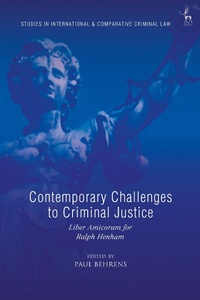
Contemporary Challenges to Criminal Justice
Liber Amicorum for Ralph Henham
1st Edition
Published on 28. December 2023
464 pages
978-1-5099-4864-2 (ISBN)
Description

This study provides a critical examination of seminal issues within the main areas of criminal justice: its theoretical framework, domestic and comparative criminal justice, transnational and international criminal law.
Exploring some of the most interesting challenges arising in these fields, it examines the impact of 'public morality' on sentencing policy, murder and the mandatory life sentence, genocide and the notion of magnitude and incitement to terrorism. Taking an approach that is fully integrated in contemporary criminal justice scholarship, it offers a diverse and expert perspective. With a comprehensive introduction and conclusion drawing the various strands together, it offers a rigorous, coherent overview of the key issues in play in contemporary international criminal justice. This diversity and expertise ensures its appeal to a large audience of students, scholars and practitioners of criminal justice around the world.
Exploring some of the most interesting challenges arising in these fields, it examines the impact of 'public morality' on sentencing policy, murder and the mandatory life sentence, genocide and the notion of magnitude and incitement to terrorism. Taking an approach that is fully integrated in contemporary criminal justice scholarship, it offers a diverse and expert perspective. With a comprehensive introduction and conclusion drawing the various strands together, it offers a rigorous, coherent overview of the key issues in play in contemporary international criminal justice. This diversity and expertise ensures its appeal to a large audience of students, scholars and practitioners of criminal justice around the world.
More details
Series
Edition
1. Auflage
Language
English
Place of publication
London
United Kingdom
Publishing group
Bloomsbury Publishing PLC
Target group
Professional and scholarly
College/higher education
ISBN-13
978-1-5099-4864-2 (9781509948642)
Copyright in bibliographic data and cover images is held by Nielsen Book Services Limited or by the publishers or by their respective licensors: all rights reserved.
Schweitzer Classification
Other editions
Additional editions
Book
07/2025
Hart Publishing
€74.20
Shipment within 15-20 days
Book
12/2023
Hart Publishing
€148.80
Shipment within 15-20 days
Person
Paul Behrens is Reader in International Law at the University of Edinburgh, UK.
Content
- Intro
- Table of Contents
- Notes on Contributors
- Ralph Henham - A Homage
- 1. Ralph Henham Through His Works
- 2. Common Themes in Henham's Research
- 3. Recognition and Cooperation
- 4. Conclusion
- PART 1: INTRODUCTION AND FOUNDATIONS
- 1. Challenges to Contemporary Criminal Justice
- 1. Introduction
- 2. The Challenges
- 3. About This Book
- 2. The Concept of Crime in Transnational Perspective
- 1. Introduction
- 2. State and Crime: Perspectives from Social Theory
- 3. The Concept of Crime and International Criminal Law
- 4. Locating Ideas of Crime in Communal Networks
- 5. The Relativity of the Concept of Crime
- 3. 'The Mob Is Fickle, Brother': Bringing Public Morality into Sentencing Policy
- 4. Ethics, Education and Employment: Criminal Defence Solicitors, Law Schools and the Legitimacy of the Criminal Justice System
- 1. Introduction
- 2. The Background of the Author and the Primary Purposes of this Chapter
- 3. The Work of Criminal Defence Solicitors in Context
- 4. The Multidimensional Duties of Criminal Defence Solicitors
- 5. The Bad Apples in the Barrel
- 6. Ethics and the Individual and Collective Integrity of Solicitors
- 7. The Status of Each Solicitor as an Officer of the Court with Corresponding Duties to the Court
- 8. Ethics, Education and Employment
- 9. Conclusions
- PART 2: DOMESTIC AND COMPARATIVE CRIMINAL JUSTICE
- 5. Mainstreaming Redress in Criminal Justice
- 1. Introduction
- 2. The Rebirth of Reparation
- 3. International Trailblazing
- 4. Realising Redress Within Criminal Justice
- 5. Options for Reform
- 6. Conclusions
- 6. Murder, the Mandatory Life Sentence and the Question of Perceived Legitimacy
- 1. Introduction
- 2. Law and Public Opinion
- 3. Murder
- 4. The Sentence for Murder
- 5. Implications for Survey Methodology and Public Education
- 6. Implications for Law Reform and Further Research
- 7. Pleas Without Bargains: Guilty Plea Discount or Coercive Trial Penalty?
- 1. What Accounts for the Differences in Sentences after Guilty Pleas versus Trials?
- 2. How Steep Is the Sentencing Differential?
- 3. Does Size Matter?
- 4. Due Process versus Crime Control Debates on the Trial Penalty
- 5. A Quick Glimpse at the Effect of Timing on Guilty Pleas in Federal Court
- 6. Conclusion
- 8. OFAC's Strict Liability Regime: Blackstone and Holmes were Right
- 1. An Overview of OFAC
- 2. Non-Culpable Conduct Should Not be Punished
- 3. Review of the Totality of the Circumstances
- 4. OFAC Strict Liability and the Modern Banking System
- 5. How a Mistake-of-Law Defence Would Work with OFAC Sanctions
- 6. In Defence of OFAC
- 7. Mistake of Law as Counterbalance to OFAC's Unfettered Prosecutorial Discretion
- 8. Conclusion
- 9. Understanding (and Reforming) Criminal Justice in the Former Soviet Union
- 1. Globalisation and Comparative Criminal Justice
- 2. Extending Our Generalisations to Include Crime and Criminal Justice in the former Soviet Union
- 3. Describing
- 4. Explaining
- 5. Interpreting
- 6. Reforming
- PART 3: INTERNATIONAL CRIMINAL JUSTICE
- 10. Victors' Justice? Selecting Targets for Prosecution
- 1. Taking Sides at the AD HOC Tribunals
- 2. Selecting 'Situations' at the International Criminal Court
- 3. The Law of Gravity
- 4. The 'Interests of Justice'
- 5. An Incomplete Debate About Political Direction
- 6. The Independent Prosecutor and the Rome Statute
- 7. Who's Afraid of Victors' Justice?
- 8. The Intractable Challenge of Balanced Prosecutions
- 11. Mr Seferovic's Pigeons: A Brief Encounter with International Criminal Justice
- 1. Institutional and Disciplinary Context
- 2. Witness to Cold-Blooded Murder
- 3. Trial and Appeal before the ICTY
- 4. Analysis
- 5. Leveraging the Critical Resources of International Criminal Trials
- 6. Inconclusive Thoughts on Methodological Work in Progress
- 12. Defining 'Senior Leaders' and 'Most Responsible' for Prosecution at the Extraordinary Chambers in the Courts of Cambodia: A Jurisdictional Conundrum or a Policy-Driven Discretionary Diktat
- 1. Introduction
- 2. Overview of the Negotiations
- 3. Personal Jurisdiction in Case 001
- 4. Unpeeling the Onion: An Analysis of Case 001 Appeal Judgment
- 5. Conclusion
- 13. Standing the Test of Time: The Dynamic Interpretation of the Genocide Convention
- 1. Introduction
- 2. A Modern Understanding of the Genocidal Actus Reus 'In the Light of Present-Day Conditions'
- 3. A Teleological Approach to the Groups Protected: Safeguarding Rights that Are 'Practical and Effective'
- 4. The Judicial Understanding of the Genocidal Mens Rea: An Overly Conservative Approach?
- 5. Concluding Remarks
- 14. 'A Matter of Utmost Gravity': Approaching the Magnitude of Genocide
- 1. Genocide and the Problem of Magnitude: An Overview
- 2. Difficulties Inherent in the Trial Chamber's Approaches to Destruction 'In Part'
- 3. Ways Out of the Quagmire? Understanding the Role of the Individual
- 4. Concluding Thoughts
- PART 4: TRANSNATIONAL CRIMINAL JUSTICE
- 15. The Offence of Incitement to Terrorism
- 1. Introduction
- 2. The International Legal Framework of Incitement to Terrorism
- 3. Incitement to Terrorism in National Legal Systems
- 4. Towards an Internationally Accepted Definition of Incitement to Terrorism?
- 5. Conclusion
- 16. Towards a Criminal Code for the World?
- 1. Introduction
- 2. The Concept of Universal Criminal Law
- 3. Challenges and Methodology
- 4. Findings
- 5. Evaluation of the Findings
- 6. Conclusion
- PART 5: CONCLUDING THOUGHTS
- 17. Criminal Justice in an Age of Uncertainty
- 1. Criminal Law Between Challenges and Aspirations
- 2. The Aspirations and the Reality
- 3. An ARC That Bends Towards Hope
- PART 6: RALPH HENHAM: LIFE AND WORK
- Reflections on Ralph Henham
- Ralph's Voice and Energy
- A Case Study in Collegiality
- A Valued and Admired Colleague
- Henham Ahead of the Curve
- Ralph Henham - Humanising Criminal Justice for All
- A Pioneer of International and Transnational Criminal Justice
- Two Nottingham Law Schools, Only One Ralph Henham
- Personal Reflection on Professor Ralph Henham
- Memories of a Friend
- Ralph Henham's Life and Work
- Ralph Henham: A Bibliography
- Index
