

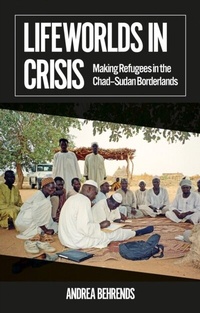
Lifeworlds in Crisis
Description

The continuing Darfur War has caused mass displacement since 2003, with hundreds of thousands driven from their homes and many forced into refugee camps in western Sudan and neighbouring Chad. Building on twenty years of research in the region, Andrea Behrends tracks the repercussions of this conflict?sometimes referred to as the 'first genocide of the twenty-first century'?for those living through it: those who stayed put, those who fled from rural areas to towns, those who moved to refugee camps, and those who fought. Telling the story of everyday survival on the Chad?Sudan border, an area central to state politics in the larger region, her account sheds light on how people create belonging, exchange knowledge, develop new practices and build futures in the face of extreme uncertainty.
Departing from the focus on large-scale humanitarian and military interventions associated with 'states of emergency', Behrends highlights the forms of cooperation and mutual knowledge production that emerge on the ground in these lifeworlds in crisis. She combines meticulous ethnographic description with theoretically grounded arguments to offer a pioneering study of how individuals have anticipated, survived and adapted to recurring crises and war in one of the world's most economically marginalised regions.
All prices
More details
Other editions
Additional editions
Person
Content
- Cover
- Halftitle
- Title
- Copyright
- Contents
- List of abbreviations
- List of names and places
- Acknowledgements
- Map of the region
- 1. Tomorrow, there will be war! Living with crisis in the borderlands
- Part I War Comes to the Borderlands Difference and Belonging in the Villages
- 2. We have to make a list: Representing lifeworlds in a crisis
- 3. So, we went with them: Making sense of conflict and competition in the villages
- 4. In general, they are comfortable: Opportunity and threat in a better-off town
- Part II Wartime in the Borderlands aid and emplacement at the camps
- 5. Clearly, they are 'internally displaced persons': Aid agencies and the making of 'refugees'
- 6. Those are the only real refugees: Aid and competition in the camps and villages
- 7. The camps are very different: Negotiating security amidst uncertainty
- 8. They are our relatives now: Exiting aid, but exiting displacement?
- Part III The Aftermath of war state and development from the capital to the borderlands
- 9. This is neither my first nor second time seeing war: Living through rebellion
- 10. Before oil, we were poor. Now, we're miserable: Oil's position at the margins of the state
- 11. This money belongs to the people of Chad: Oil, development, and imagining the state
- 12. Conclusion: Survival at the margins of the world
- Epilogue: War, again
- Notes
- References
- Index
- Back cover
