

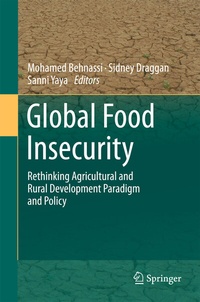
Global Food Insecurity
Description

Human-kind and ecological systems are currently facing one of the toughest challenges: how to feed more billions of people in the future within the perspective of climate change, energy shortages, economic crises and growing competition for the use of renewable and non renewable resources. This challenge is even more crucial given that we have not yet come close to achieving the Millennium Development Goal of halving the number of people living in extreme poverty and hunger.
Scientists and relevant stakeholders are now voicing a clear message: that multiple challenges the world is facing require innovative, multifaceted, science-based, technological, economic and political approaches in theoretical thinking, decision making and action. With this background central to survival and well-being, the purpose of this volume is to formulate and promote relevant theoretical analysis and policy recommendations. The major perspective of this publication is that paradigm and policy shifts at all levels are needed urgently. This is based on the evidence that agriculture in the 21st century will be undergoing significant demands, arising largely from the need to increase the global food enterprise, while adjusting and contributing to climate change adaptation and mitigation.
Global Food Insecurity aims at providing structure to effect achievement of this critically needed roadmap.
More details
Other editions
Additional editions
Content
2 - Acknowledgements [Seite 10]
3 - Contents [Seite 12]
4 - List of Figures [Seite 16]
5 - List of Tables [Seite 18]
6 - List of Abbreviations and Acronyms [Seite 22]
7 - Part I Agriculture and Rural Development at the Heart of Sustainability and Food Security [Seite 26]
7.1 - Chapter 1: A New Conceptual Framework for Assessing Rural Development Performance: Sustainability of Scale, Scope and Integration [Seite 27]
7.1.1 - 1 Introduction [Seite 28]
7.1.2 - 2 A New Conceptual Framework [Seite 28]
7.1.3 - 3 Scale, Scope, Integration: Tripartition of Strategies [Seite 29]
7.1.3.1 - 3.1 Scale and Scope [Seite 29]
7.1.3.2 - 3.2 Integration [Seite 29]
7.1.4 - 4 Economy, Ecology, Sociology: Tripartition of Criteria [Seite 29]
7.1.4.1 - 4.1 Economy [Seite 29]
7.1.4.2 - 4.2 Ecology [Seite 30]
7.1.4.3 - 4.3 Sociology [Seite 30]
7.1.5 - 5 How It Works [Seite 30]
7.1.5.1 - 5.1 Theoretical [Seite 30]
7.1.5.2 - 5.2 Practical [Seite 32]
7.1.6 - 6 Concluding Remarks [Seite 32]
7.1.7 - References [Seite 32]
7.2 - Chapter 2: A Knowledge Approach to Sustainable Agriculture [Seite 34]
7.2.1 - 1 Introduction [Seite 34]
7.2.2 - 2 Knowledge Approach [Seite 36]
7.2.3 - 3 Exploratory Study [Seite 38]
7.2.4 - 4 Results [Seite 39]
7.2.5 - 5 Conclusions [Seite 41]
7.2.6 - References [Seite 42]
7.3 - Chapter 3: Sustainable Agriculture Ensures Sustainable Rural Development: A Reality or a Myth [Seite 44]
7.3.1 - 1 Introduction [Seite 45]
7.3.2 - 2 Overview of Pakistan's Agricultural Sector [Seite 45]
7.3.3 - 3 Constraints Associated with Pakistan Agriculture [Seite 46]
7.3.3.1 - Box 3.1 Constraints and Threats Associated with the Agricultural Sector and Rural Development in Pakistan [Seite 47]
7.3.3.2 - 3.1 Water Shortage [Seite 48]
7.3.3.3 - 3.2 Smaller Land Holdings and Neglect of Small Farmers [Seite 48]
7.3.3.4 - 3.3 Gaps in Productivity [Seite 49]
7.3.3.5 - 3.4 Women Farmers Working in Agriculture and Their Status [Seite 49]
7.3.4 - 4 Pakistani Rural Development [Seite 50]
7.3.4.1 - 4.1 Women and Their Role in Rural Development [Seite 51]
7.3.4.2 - 4.2 Poor Infrastructure and Lower Quality of Social Services [Seite 51]
7.3.5 - 5 Suggested Strategies to Achieve Sustainable Agriculture and Rural Development [Seite 52]
7.3.6 - 6 Conclusions and Recommendations [Seite 54]
7.3.7 - References [Seite 54]
7.4 - Chapter 4: Policies for Sustainable Agricultural Production and Consumption [Seite 56]
7.4.1 - 1 Introduction [Seite 56]
7.4.2 - 2 Resource Use [Seite 59]
7.4.3 - 3 Impacts on the Earth [Seite 61]
7.4.4 - 4 Greenhouse Gas Emissions (GHGS) [Seite 62]
7.4.5 - 5 Pollution of the Environment [Seite 63]
7.4.6 - 6 Ethics, Religion and Science [Seite 64]
7.4.7 - 7 Animal Welfare [Seite 66]
7.4.8 - 8 Compassion, Health and a Better Environment - a Positive Way Forward for Farming [Seite 69]
7.4.9 - 9 Conclusions [Seite 70]
7.4.10 - References [Seite 72]
7.5 - Chapter 5: Cultivating Faith: The Relationship Between Islam and Sustainable Agriculture in Rural Communities of American Muslims [Seite 75]
7.5.1 - References [Seite 83]
7.6 - Chapter 6: Agricultural Development for Food Security and Sustainability in Nigeria [Seite 85]
7.6.1 - 1 The Nigeria's Agricultural Sector [Seite 86]
7.6.2 - 2 The Nigerian Rural Economy, Poverty and Environmental Degradation [Seite 87]
7.6.2.1 - 2.1 Food Security [Seite 88]
7.6.2.2 - 2.2 Technology and Technological Change [Seite 89]
7.6.2.3 - 2.3 Sustainable Agricultural Development [Seite 89]
7.6.3 - 3 Conclusion [Seite 92]
7.6.4 - References [Seite 93]
7.7 - Chapter 7: African Agriculture at Crossroads: Balancing the Needs of Increased Productivity and the Challenges of Sustainability. The Case of Fadama Agriculture in Semi-Arid North-Central Nigeria [Seite 94]
7.7.1 - 1 Introduction [Seite 95]
7.7.2 - 2 Typology and Importance of Fadama Areas and Agriculture [Seite 96]
7.7.2.1 - 2.1 Fadama Agriculture in Karshi and Baddeggi [Seite 97]
7.7.2.2 - 2.2 Indigenous Resource Management in Fadama Areas of Karshi and Baddeggi [Seite 98]
7.7.3 - 3 Mechanization and Agrochemicals Use in Fadama Areas of Karshi and Baddeggi [Seite 100]
7.7.3.1 - 3.1 Developing a Conceptual Basis for Agricultural Hybridization [Seite 102]
7.7.4 - 4 Conclusion: Balancing Productivity and Sustainability [Seite 106]
7.7.5 - References [Seite 106]
8 - Part II Governance for Food Security: Key Challenges and Relevant Debates [Seite 111]
8.1 - Chapter 8: Food Crisis Mitigation: The Need for an Enhanced Global Food Governance [Seite 112]
8.1.1 - 1 Introduction [Seite 113]
8.1.2 - 2 Research Background and Scope [Seite 113]
8.1.3 - 3 Factors Behind Food Crisis [Seite 117]
8.1.3.1 - 3.1 Climate Change: Critical Implications for Food Security [Seite 117]
8.1.3.2 - 3.2 Energy Shortages and Prices [Seite 119]
8.1.3.3 - 3.3 Inadequacy of Agricultural and Food Practices and Policies [Seite 121]
8.1.3.3.1 - 3.3.1 Global Food and Agriculture System and Food Crisis [Seite 121]
8.1.3.3.2 - 3.3.2 Loss of Crop Varieties and Genetic Contamination [Seite 122]
8.1.3.3.3 - 3.3.3 Fish Stocks and Marine Biodiversity Decline [Seite 123]
8.1.3.3.4 - 3.3.4 Farmer Shortages [Seite 124]
8.1.3.4 - 3.4 National and International Policies on Trade, Economics and Agriculture [Seite 125]
8.1.3.5 - 3.5 Food for Aid Programs [Seite 126]
8.1.3.6 - 3.6 Population Growth and the Shift in Global Food Production and Consumption [Seite 130]
8.1.4 - 4 Global Food Governance Regime: Actors, Powers and Dynamics [Seite 134]
8.1.4.1 - 4.1 Conflicting Actors and Interests [Seite 134]
8.1.4.1.1 - 4.1.1 Role and Power of Powerful States [Seite 135]
8.1.4.1.2 - 4.1.2 Role and Powerful Corporate Influence [Seite 136]
8.1.4.2 - 4.2 Potential of Global Food Regime to Enhance Food Security [Seite 139]
8.1.5 - 5 Concluding Remarks [Seite 142]
8.1.6 - References [Seite 143]
8.2 - Chapter 9: 18,000 Children Die of Starvation Everyday: Cannot We Save Them? [Seite 145]
8.2.1 - 1 Introduction [Seite 145]
8.2.2 - 2 Methodology [Seite 146]
8.2.3 - 3 Hungry People [Seite 147]
8.2.4 - 4 Why People Are Hungry? [Seite 148]
8.2.5 - 5 Cannot We Save the Hungry People? [Seite 149]
8.2.6 - 6 How Can We Save Them? [Seite 149]
8.2.6.1 - 6.1 Short-Term Plan [Seite 150]
8.2.6.2 - 6.2 Long-Term Plan [Seite 150]
8.2.6.2.1 - 6.2.1 Increase Agricultural Production [Seite 151]
8.2.6.2.2 - 6.2.2 Come Out of Protectionism [Seite 151]
8.2.6.2.3 - 6.2.3 Stop Food Wastage [Seite 152]
8.2.6.2.4 - 6.2.4 Obesity Control [Seite 153]
8.2.6.2.5 - 6.2.5 Food Safety [Seite 154]
8.2.6.2.6 - 6.2.6 Well-Planned Market System [Seite 154]
8.2.6.2.7 - 6.2.7 No Bio-fuel [Seite 155]
8.2.6.2.8 - 6.2.8 Economy Lifestyle [Seite 155]
8.2.6.2.9 - 6.2.9 No War [Seite 156]
8.2.6.2.10 - 6.2.10 No Ethnic Violence [Seite 157]
8.2.6.2.11 - 6.2.11 Population Control/Management [Seite 157]
8.2.6.2.12 - 6.2.12 Corruption Control [Seite 157]
8.2.6.2.13 - 6.2.13 No Military Administration [Seite 158]
8.2.6.2.14 - 6.2.14 Fight Diseases [Seite 159]
8.2.6.2.15 - 6.2.15 Proper Education and Training [Seite 159]
8.2.6.2.16 - 6.2.16 Right to Migration [Seite 159]
8.2.6.2.17 - 6.2.17 Industrialisation and Job Creation [Seite 160]
8.2.6.2.18 - 6.2.18 Reduce Greenhouse Gas (GHG) Emissions [Seite 160]
8.2.6.2.19 - 6.2.19 Root Out Terrorism [Seite 161]
8.2.7 - 7 Finance [Seite 161]
8.2.8 - 8 Conclusion [Seite 163]
8.2.9 - References [Seite 164]
8.3 - Chapter 10: The Self-Reliant Country: Sustainable Agricultural Policy for Australia? [Seite 166]
8.3.1 - 1 Introduction [Seite 166]
8.3.1.1 - 1.1 Historical Background [Seite 167]
8.3.2 - 2 Sustainable Agriculture and Food Production [Seite 168]
8.3.3 - 3 Analysis: Creating Our Future. Agriculture and Food Policy for the Next Generation [Seite 170]
8.3.3.1 - 3.1 Markets Section [Seite 170]
8.3.3.2 - 3.2 Natural Resources Section [Seite 171]
8.3.4 - 4 Limitations of the Current Agriculturaland Food Policy Framework [Seite 172]
8.3.5 - 5 Conclusion [Seite 173]
8.3.6 - References [Seite 174]
8.4 - Chapter 11: LCA Potentials and Limits Within a Sustainable Agri-food Statutory Framework [Seite 177]
8.4.1 - 1 Introduction [Seite 177]
8.4.2 - 2 LCA as a Tool for the Development of a Sustainable Agri-food Statutory Framework [Seite 178]
8.4.2.1 - 2.1 "Life-Cycle Thinking" Within LCA [Seite 178]
8.4.2.2 - 2.2 The LCA Methodology [Seite 179]
8.4.3 - 3 LCA Possibilities Leading to the Generation of a More Sustainable Agri-food Statutory Framework [Seite 180]
8.4.3.1 - 3.1 Current Applications of LCA in Agricultural Production [Seite 180]
8.4.3.2 - 3.2 Current Applications of LCA in Food Processing [Seite 181]
8.4.4 - 4 Challenges Facing LCA for a More Sustainable Agri-food Statutory Framework [Seite 182]
8.4.4.1 - 4.1 Challenges Facing the Specific Nature of the Agri-food Sector [Seite 182]
8.4.4.2 - 4.2 Challenges Facing an Agri-food Statutory Framework [Seite 183]
8.4.5 - 5 Conclusion [Seite 184]
8.4.6 - References [Seite 185]
8.5 - Chapter 12: Risk Communication at the Hungarian Guar-Gum Scandal [Seite 188]
8.5.1 - 1 Introduction [Seite 189]
8.5.1.1 - 1.1 What Is Guar Gum? [Seite 189]
8.5.1.2 - 1.2 The Process of the Contamination [Seite 190]
8.5.2 - 2 Objective [Seite 190]
8.5.3 - 3 Materials and Methods [Seite 191]
8.5.4 - 4 Results and Discussion [Seite 191]
8.5.5 - 5 Conclusion [Seite 197]
8.5.6 - References [Seite 197]
8.6 - Chapter 13: The Environmental Challenges and Its Security Implications for South Asia [Seite 199]
8.6.1 - 1 Introduction [Seite 199]
8.6.2 - 2 Environment and Security: A Conceptual Understanding [Seite 201]
8.6.3 - 3 Global Warming: A Major Environmental Threat for South Asia [Seite 202]
8.6.4 - 4 Social Effects of Environmental Degradation [Seite 203]
8.6.4.1 - 4.1 Population Growth [Seite 203]
8.6.4.2 - 4.2 Agricultural Land and Agricultural Production [Seite 205]
8.6.4.3 - 4.3 Population Displacement or Migration [Seite 206]
8.6.4.4 - 4.4 Disrupted Institutions and Social Relations [Seite 207]
8.6.5 - 5 Need for a Regional Approach on Environmental Crisis [Seite 207]
8.6.5.1 - 5.1 Deep Cuts in Carbon Emissions [Seite 208]
8.6.5.2 - 5.2 Population Control [Seite 208]
8.6.5.3 - 5.3 Strengthening Institutions and Legislation [Seite 209]
8.6.5.4 - 5.4 Accounting and Cooperative Management of Natural Resources [Seite 209]
8.6.5.5 - 5.5 Training and Orientation Programs in Environmental Management [Seite 210]
8.6.5.6 - 5.6 Promoting Environmental Awareness [Seite 210]
8.6.5.7 - 5.7 Promoting Appropriate Environmental Technologies [Seite 210]
8.6.6 - 6 Conclusion [Seite 211]
8.6.7 - References [Seite 211]
9 - Part III Climate Change and Energy as New Major Factors Redefining the World Food Equation [Seite 213]
9.1 - Chapter 14: Climate Change, Seasonality and Hunger: The South Asian Experience [Seite 214]
9.1.1 - 1 Backdrop [Seite 214]
9.1.2 - 2 Seasonality and Hunger [Seite 215]
9.1.3 - 3 The Controlling of Climate in South Asia [Seite 217]
9.1.4 - 4 The Heightened Impacts of Climate Change [Seite 220]
9.1.5 - 5 Climate Proofing the Farmer to Ensure Food Security [Seite 223]
9.1.6 - 6 Summing Up [Seite 224]
9.1.7 - References [Seite 227]
9.2 - Chapter 15: Effects of Climate Change on Food and Human Security in Nigeria [Seite 229]
9.2.1 - 1 Introduction [Seite 229]
9.2.2 - 2 Theoretical and Conceptual Frameworks on Climate Change and Human Security [Seite 230]
9.2.2.1 - 2.1 What Is Climates and Climate Change? [Seite 230]
9.2.2.2 - 2.2 Meaning and Dimensions of Food Security [Seite 231]
9.2.2.3 - 2.3 The Concepts and Meaning of Human Security [Seite 231]
9.2.2.4 - 2.4 Relationship Between Climate Change, Food Security and Human Security [Seite 232]
9.2.2.5 - 2.5 Mitigation and Adaptation Strategies Against Climate Change [Seite 233]
9.2.3 - 3 Methodology [Seite 234]
9.2.3.1 - 3.1 Study Area: Nature of Climate Change in Nigeria [Seite 234]
9.2.3.2 - 3.2 Types and Methods of Data Collection [Seite 234]
9.2.4 - 4 Results and Discussion of Findings [Seite 234]
9.2.4.1 - 4.1 Factors Influencing Climate Change in Nigeria [Seite 235]
9.2.4.2 - 4.2 Effects of Climate Change [Seite 235]
9.2.4.2.1 - 4.2.1 Economic Effects of Climate Change [Seite 235]
9.2.4.2.2 - 4.2.2 Social Effects of Climate Change [Seite 236]
9.2.4.2.3 - 4.2.3 Effects of Climate Change on Agriculture and Food Security [Seite 236]
9.2.4.2.4 - 4.2.4 Human Consequences of Climate Change [Seite 237]
9.2.4.2.5 - 4.2.5 Adaptation and Mitigation Strategies to Reduce Climate Change Effects in Nigeria [Seite 238]
9.2.4.3 - 4.3 Government Responses to Climate Change and Constraining Factors [Seite 239]
9.2.5 - 5 Conclusion and Recommendations [Seite 240]
9.2.6 - References [Seite 241]
9.3 - Chapter 16: Quantitative Assessment of Climate Change by Weather Generation Models and Downscaling GCM Data in Tehran, Iran [Seite 244]
9.3.1 - 1 Introduction [Seite 245]
9.3.2 - 2 Study Area [Seite 246]
9.3.3 - 3 Methodology [Seite 247]
9.3.3.1 - 3.1 Model Calibration [Seite 248]
9.3.4 - 4 Modeling Results [Seite 249]
9.3.4.1 - 4.1 Precipitation [Seite 249]
9.3.4.2 - 4.2 Major and Extreme Rainfall [Seite 249]
9.3.4.3 - 4.3 Temperature [Seite 250]
9.3.4.4 - 4.4 Number of Hot and Icy Days [Seite 251]
9.3.5 - 5 Conclusions [Seite 253]
9.3.6 - References [Seite 254]
9.4 - Chapter 17: The Role of Biofuels in the Sustainability of the Environment [Seite 256]
9.4.1 - 1 Introduction [Seite 257]
9.4.2 - 2 Features of Energy Consumption [Seite 257]
9.4.3 - 3 The Environmental Protection Problem of the Increasing Energy Consumption [Seite 260]
9.4.4 - 4 The International Situation of Utilization of Biofuels [Seite 262]
9.4.5 - 5 Connection Between Food Supply, Biofuel Production and Environmental Protection [Seite 265]
9.4.6 - 6 Doubts of Biofuel Utilization [Seite 266]
9.4.7 - 7 Conclusions [Seite 266]
9.4.8 - References [Seite 267]
9.5 - Chapter 18: Energy Efficiency, Methane Output, Required Carbon Sequestration Area and Water Productivity in Extensive and Semi-intensive Beef Production in South America - A Comparison of Ecological Currencies [Seite 268]
9.5.1 - 1 Introduction [Seite 269]
9.5.2 - 2 General Approach and Methods [Seite 270]
9.5.2.1 - 2.1 Energy Efficiency and Methane Emissions [Seite 270]
9.5.2.2 - 2.2 Shadow Area [Seite 271]
9.5.2.3 - 2.3 Water Footprint [Seite 272]
9.5.3 - 3 Results and Discussion [Seite 273]
9.5.3.1 - 3.1 Energetic Efficiency and Methane Production [Seite 273]
9.5.3.2 - 3.2 Shadow Area [Seite 275]
9.5.3.3 - 3.3 Water Footprint [Seite 275]
9.5.4 - 4 Conclusions and Implications [Seite 276]
9.5.5 - References [Seite 277]
9.6 - Chapter 19: Biogas Energy From Agricultural By-Products: Energy Yields and Effects on Organic Farming Systems Compared with Energy Maize Cropping [Seite 279]
9.6.1 - 1 Introduction and Goals [Seite 280]
9.6.2 - 2 Material and Methods [Seite 280]
9.6.2.1 - 2.1 Field Trial: Setting, Location, Climate [Seite 280]
9.6.2.2 - 2.2 Digestion [Seite 281]
9.6.2.3 - 2.3 Crop Rotations [Seite 281]
9.6.2.3.1 - 2.3.1 Stockless Organic Farming [Seite 281]
9.6.2.3.2 - 2.3.2 Organic Dairy Farming [Seite 281]
9.6.2.4 - 2.4 Calculation of Attainable Energy Yields [Seite 282]
9.6.3 - 3 Results [Seite 282]
9.6.3.1 - 3.1 Substrates for Anaerobic Digestion [Seite 282]
9.6.3.1.1 - 3.1.1 Stockless Organic Farming [Seite 282]
9.6.3.1.2 - 3.1.2 Organic Dairy Farming [Seite 283]
9.6.3.2 - 3.2 Energy Content of Substrates [Seite 284]
9.6.3.3 - 3.3 Energy Yield Potential of the Whole Crop Rotations [Seite 284]
9.6.4 - 4 Discussion [Seite 284]
9.6.4.1 - 4.1 Trial Results of Energy Yields [Seite 284]
9.6.4.2 - 4.2 Effects of Biogas Digestion on Farming Systems [Seite 285]
9.6.4.2.1 - 4.2.1 Recovery of Nitrogen Derived from the Atmosphere by Symbiotic N2 Fixation [Seite 285]
9.6.4.2.2 - 4.2.2 Decreasing of Nitrate Leaching Risk [Seite 285]
9.6.4.2.3 - 4.2.3 Reduction of Trace Gas Emissions [Seite 285]
9.6.4.2.4 - 4.2.4 Diversification of Crop Rotations by Cover Crops [Seite 286]
9.6.4.2.5 - 4.2.5 Use of By-Products [Seite 286]
9.6.4.2.6 - 4.2.6 Use of Problematic Biomass [Seite 286]
9.6.4.3 - 4.3 Outlook: Factors Influencing the Future Development [Seite 287]
9.6.4.3.1 - 4.3.1 Economic Points of View [Seite 287]
9.6.4.3.2 - 4.3.2 Obstacles for Implementation [Seite 287]
9.6.5 - 5 Conclusion [Seite 288]
9.6.6 - References [Seite 288]
10 - Part IV Sustainable Agriculture and Food Security: Relevant Experiences [Seite 290]
10.1 - Chapter 20: Sustainable Agriculture and Food Crisis in Sub-Sahara Africa [Seite 291]
10.1.1 - 1 Introduction [Seite 291]
10.1.2 - 2 Challenges of Food Security in Sub-Saharan Africa [Seite 294]
10.1.3 - 3 Trend in Food Consumption in Sub-Sahara Africa [Seite 296]
10.1.3.1 - 3.1 Climatic Change [Seite 298]
10.1.3.2 - 3.2 Weather Patterns and Drought Occurrence in Africa [Seite 299]
10.1.3.3 - 3.3 Government Responses [Seite 299]
10.1.3.4 - 3.4 Mitigation Potential of the Region [Seite 300]
10.1.3.5 - 3.5 Sub-Saharan Africa's Market Share and Potential [Seite 301]
10.1.3.6 - 3.6 Greenpeace Suggestions on Mitigation [Seite 302]
10.1.4 - 4 Conclusions and Policy Recommendations [Seite 302]
10.1.5 - References [Seite 304]
10.2 - Chapter 21: Soaring Food Prices and Africa's Vulnerability and Responses [Seite 306]
10.2.1 - 1 Introduction [Seite 306]
10.2.2 - 2 Trends in Global Food Prices [Seite 308]
10.2.2.1 - 2.1 Historical Perspective [Seite 308]
10.2.2.2 - 2.2 Recent Trends in Food Prices [Seite 309]
10.2.2.3 - 2.3 Drivers of Short-Term Trends [Seite 313]
10.2.3 - 3 Cereal Vulnerability of African Countries [Seite 314]
10.2.3.1 - 3.1 Africa's Cereal Situation [Seite 314]
10.2.3.2 - 3.2 Construction of a Vulnerability Index [Seite 315]
10.2.3.3 - 3.3 Results of the Vulnerability Assessment [Seite 317]
10.2.4 - 4 Implications of the Food Price Trends [Seite 319]
10.2.4.1 - 4.1 Social Implications [Seite 319]
10.2.4.2 - 4.2 Implications for Regional Trade and Foreign Investments [Seite 321]
10.2.4.3 - 4.3 Implications for Policies [Seite 322]
10.2.5 - Box 21.1 Malawi's Approach to Food Shortages [Seite 323]
10.2.6 - 5 The African Development Bank's Response [Seite 324]
10.2.6.1 - 5.1 Short-Term Responses [Seite 324]
10.2.6.2 - 5.2 Medium-to-Long Term Responses [Seite 325]
10.2.7 - 6 Conclusion [Seite 326]
10.2.8 - Annex A. Food Consumption Shares (% of Total Expenditure) [Seite 327]
10.2.9 - Annex B. Cereal Balance (Values in Million) (2007/2008) [Seite 329]
10.2.10 - Annex C. Indicators of Vulnerability and Country Ranking [Seite 332]
10.2.11 - Annex D. Policy Measures Taken by Governments [Seite 335]
10.2.12 - References [Seite 337]
10.3 - Chapter 22: Significance of Vegetable Farming as a Strategy to Enhance Household Food Security in Communal Areas of Zimbabwe [Seite 338]
10.3.1 - 1 Introduction [Seite 338]
10.3.2 - 2 Location and Description of Study Area [Seite 339]
10.3.3 - 3 Data Collection and Analysis [Seite 340]
10.3.4 - 4 Results and Discussion [Seite 341]
10.3.4.1 - 4.1 Motivating Factors [Seite 341]
10.3.4.2 - 4.2 Farm Size and Location [Seite 342]
10.3.4.3 - 4.3 Vegetables Grown and Output Levels [Seite 343]
10.3.4.4 - 4.4 Strategies Used to Enhance Vegetable Productivity [Seite 343]
10.3.4.5 - 4.5 Contribution of Vegetable Outputs to Dietary Diversity [Seite 344]
10.3.4.6 - 4.6 Contribution of Vegetable Sales to Household Income [Seite 346]
10.3.4.7 - 4.7 Use of Income from Vegetables by Households [Seite 347]
10.3.4.8 - 4.8 Challenges Encountered by Households in Vegetable Farming and Marketing [Seite 348]
10.3.5 - 5 Conclusion [Seite 348]
10.3.6 - 6 Policy Considerations or Recommendations [Seite 348]
10.3.7 - References [Seite 349]
10.4 - Chapter 23: Changes in Agricultural Landscape: Some Ecological Implications for Sustainable Agriculture in Indian Punjab [Seite 350]
10.4.1 - 1 Introduction [Seite 351]
10.4.2 - 2 Objectives [Seite 351]
10.4.3 - 3 Methodology [Seite 352]
10.4.4 - 4 Results and Discussion [Seite 352]
10.4.4.1 - 4.1 Trends Towards Specialized Farming [Seite 352]
10.4.4.2 - 4.2 Indices of Crop Specialization/Diversification [Seite 354]
10.4.4.3 - 4.3 Manifestation of Several Adverse Effects [Seite 354]
10.4.4.3.1 - 4.3.1 Depletion of Ground Water Resources [Seite 354]
10.4.4.3.2 - 4.3.2 Deteriorating Soil Fertility [Seite 355]
10.4.4.3.3 - 4.3.3 High Use of Insecticides and Pesticides [Seite 355]
10.4.4.3.4 - 4.3.4 Poisoning Food Commodities [Seite 357]
10.4.4.3.5 - 4.3.5 Environmental Pollution [Seite 357]
10.4.4.4 - 4.4 Resource Conserving Technologies for Sustainable Agriculture [Seite 357]
10.4.4.5 - 4.5 Potential and Constraints for Increased Adoption of RCTS [Seite 360]
10.4.4.6 - 4.6 Policy Options for Rapid Adoption of ResourceConservation Technologies [Seite 361]
10.4.5 - References [Seite 362]
10.5 - Chapter 24: Emerging Issues for the Formulation of Policy on Agri-Input Delivery System in Nigeria [Seite 363]
10.5.1 - 1 Introduction [Seite 364]
10.5.2 - 2 Primer of Agri-Input Policies [Seite 364]
10.5.3 - 3 Background to Policy Interventions in Agri-Input Market [Seite 365]
10.5.3.1 - 3.1 Policy Intervention Modes [Seite 365]
10.5.3.1.1 - 3.1.1 Seed [Seite 365]
10.5.3.1.2 - 3.1.2 Fertilizer [Seite 368]
10.5.3.1.3 - 3.1.3 CPP [Seite 369]
10.5.3.2 - 3.2 Lessons of Implementation Experience [Seite 369]
10.5.4 - 4 Policy Formulation for Agri-Input Delivery [Seite 370]
10.5.4.1 - 4.1 Process Approach [Seite 371]
10.5.4.2 - 4.2 Articulation of Policy on Agri-Inputs Delivery [Seite 371]
10.5.4.3 - 4.3 Formulation of Implementation Strategy for Agri-Inputs Delivery [Seite 372]
10.5.5 - 5 Emerging Policy Issues and Optimal Resolution of Issues [Seite 372]
10.5.5.1 - 5.1 Political Economy and Governance Issues [Seite 373]
10.5.5.2 - 5.2 Structural and Systemic Issues [Seite 373]
10.5.6 - 6 Concluding Remarks [Seite 374]
10.5.7 - References [Seite 375]
11 - Postface [Seite 376]
12 - Notes on Contributors [Seite 378]
13 - Author Index [Seite 394]
14 - Subject Index [Seite 403]
