

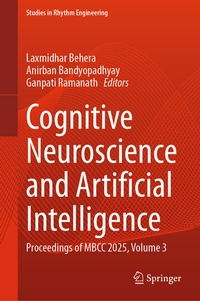
Cognitive Neuroscience and Artificial Intelligence
Description

This book brings together research on the neural and philosophical foundations of consciousness, the perceptual and cognitive mechanisms underlying experience, and the transformative impact of artificial intelligence. Cognitive Neuroscience and Artificial Intelligence explores the evolving interface between human cognition and emerging technologies. It also delves into the role of music as a unique conduit for altered and heightened states of awareness. Through thematic sections, AI and Consciousness, Cognition and Perception, and Music and Consciousness, this book highlights how diverse disciplines converge to illuminate the processes underlying awareness, perception, and intelligent behavior across human and artificial systems.
More details
Other editions
Additional editions
Persons
Prof. Laxmidhar Behera is the director of IIT Mandi and a senior professor in the Department of Electrical Engineering at IIT Kanpur. He earned his B.Sc. (Engg) and M.Sc. (Engg) from NIT Rourkela and completed his Ph.D. from IIT Delhi in 1996. With postdoctoral research at the German National Research Center for Information Technology, he has over 28 years of experience in teaching and research. His expertise spans intelligent systems, control, vision-based robotics, warehouse automation, brain-computer interfaces, drone technology, and consciousness studies. He has led projects worth over ?25 crores and collaborated with TCS, Renault Nissan, and BEL. Prof. Behera has supervised 31 Ph.D. students, 70+ master's theses, authored three textbooks, and published over 380 papers. His book Intelligent Control of Robotic Systems won the Best Engineering Book Award (2020-21). He has collaborated with ETH Zurich, University of Texas San Antonio, and others.
Dr. Anirban Bandyopadhyay is a principal research scientist at the National Institute for Materials Science (NIMS), Tsukuba, Japan. He did Ph.D. in IACS, Kolkata, 2005. From 2005 to 2008, he was an ICYS research fellow at NIMS, Japan. In 2008, he joined NIMS, built organic jelly-based artificial brain, quantum computer, molecular motor-based drugs, invented Dodecanogram for deep consciousness measurement, built Polyatomic time crystal-based Quantum cryptographic language, written a book "Nanobrain: The making of an artificial brain from a time crystal", 2020. From 2013 to 2014 he was a visiting scientist at the Massachusetts Institute of Technology (MIT), USA. He received the Hitachi Science and Technology award 2010, Inamori Foundation award 2011-2012, Kurata Foundation Award, and is a Sewa Society International member, Japan. He has published more than 100 papers, 23 patents, edited 17 books.
Prof. Ganpati Ramanath is the John Tod Horton professor at Rensselaer Polytechnic Institute. He received his Ph.D. in Materials Science and Engineering from the University of Illinois Urbana in 1997, following degrees from IIT Madras and the University of Cincinnati. His research focuses on structure-processing-property relationships in nanomaterials and interfaces for energy and electronics. He has published over 185 journal articles (h-index 53, ~12,000 citations), holds 9 US patents, and has delivered more than 235 invited talks globally. A co-founder of ThermoAura Inc., he served as the director of the NY State Center for Future Energy Systems and was an editor for IEEE Transactions on Nanotechnology. His honors include Fellowships of MRS, APS, and AVS, the NSF CAREER Award, and the Humboldt Bessel Award. He has held visiting positions at institutions in Germany, Japan, Sweden, Australia, and India, including IISc Bangalore and RWTH Aachen.
Content
Consciousness in Science: The Present and the Future.- AI Tongue Diagnosis: Expert System with LLMs for Abdominal Disease Detection through Mobile App.- Can AI and IoT-Integrated Mobile Health Apps Effectively Improve Cognitive Health and Caregiver Support for Dementia?.- AI-Powered Strategies to Mitigate Cognitive Dissonance: Enhancing Emotional Well-Being and Critical Thinking on Social Media.- Person Perception: Unveiling Confidence in Judgment.- The Unfinished Race: Bridging the Gap Between AI Vision Models and Human Motion Perception.- FOCUS - Facilitating low-resolution OCR Confirmation with Unsupervised Systems.- EAGER: An Exploratory Analysis of LLMs in GuEssing bilingual woRd translation.- Nadanusandhana: A Conceptual Overview and Review of Experimental Studies.- Sanative Concomitants of Bharatiya Sangeet.- RituScape: Automatic Season-Based Virtual Environment Generation from Indian Classical Ragas.- Consciousness: an emergent property of the brain or a fundamental property of the missing evolved atom?.
