

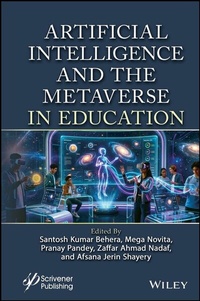
Artificial Intelligence and Metaverse in Education
Description

Secure your place at the forefront of the academic revolution by mastering the expert-led frameworks for integrating AI and the metaverse into immersive, ethical, and inclusive learning ecosystems that transcend physical boundaries.
In the rapidly evolving landscape of education, the convergence of artificial intelligence and the metaverse presents a transformative paradigm shift. This book explores the intersection of these cutting edge technologies, exploring their profound impact on academia in the coming years. As traditional educational models adapt to meet the demands of a digital age, AI and the metaverse offer unprecedented opportunities to enhance learning experiences, redefine collaboration, and reimagine the very concept of campus and classroom. AI, with its ability to analyze vast datasets and personalize learning pathways, promises to revolutionize curriculum design and student engagement. Meanwhile, in the metaverse, a collective virtual shared space that blurs the lines between physical and digital realms, opens new avenues for immersive learning environments and global connectivity. Together, these technologies herald a future where education is not confined by physical boundaries but enriched by limitless virtual possibilities. Yet, alongside these opportunities lie significant challenges: ethical considerations of AI algorithms in educational decision-making, ensuring equitable access to virtual learning environments, and safeguarding data privacy in an increasingly interconnected world. This book navigates these complexities, offering insights into how institutions can harness AI and the metaverse responsibly while fostering inclusive, innovative learning ecosystems. Through case studies, expert analyses, and visionary perspectives, it equips educators, policymakers, and stakeholders with the knowledge needed to navigate and thrive in this dynamic era of next-generation academia.
More details
Other editions
Additional editions
Persons
Santosh Kumar Behera, PhD is an Associate Professor in the Department of Education at Kazi Nazrul University with more than 14 years of teaching experience. He has contributed a number of articles and edited volumes in the educational field. His research interests include educational technology, philosophy of education, peace education, and measurement and evaluation in education.
Mega Novita, PhD is an Associate Professor and the Head of Foreign Cooperation at Universitas PGRI Semarang. Her study focuses on first-principles calculations of transition metal and rare earth ions using the discrete variational multi-electron method. Establishing standards for new red phosphor materials is the main goal of her research.
Pranay Pandey, PhD is an Assistant Professor at the Department of Education at Bhatter College. He has authored many books and published more than 70 research articles and book chapters in various esteemed journals and edited volumes. Additionally, he holds copyrights for eight literary works and has developed ten psychological scales, further cementing his impact in the field of education.
Zaffar Ahmad Nadaf, PhD is an Assistant Professor in the School of Education at the Central University of Kashmir. He is the author of three books and has contributed extensively to internationally recognized journals. He is also a board member and editor for several prestigious international journals.
Afsana Jerin Shayery is a Lecturer in the Department of English at Daffodil International University. She has published her research works in reputed journals and presented at international conferences. She is an expert in institutional internationalization by profession, and a social activist working for social business, three zeros, and digital equity for all ages.
