

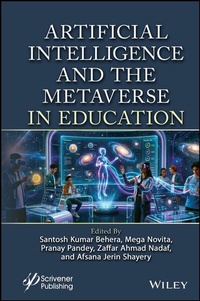
Artificial Intelligence and Metaverse in Education
Description

Secure your place at the forefront of the academic revolution by mastering the expert-led frameworks for integrating AI and the metaverse into immersive, ethical, and inclusive learning ecosystems that transcend physical boundaries.
In the rapidly evolving landscape of education, the convergence of artificial intelligence and the metaverse presents a transformative paradigm shift. This book explores the intersection of these cutting edge technologies, exploring their profound impact on academia in the coming years. As traditional educational models adapt to meet the demands of a digital age, AI and the metaverse offer unprecedented opportunities to enhance learning experiences, redefine collaboration, and reimagine the very concept of campus and classroom. AI, with its ability to analyze vast datasets and personalize learning pathways, promises to revolutionize curriculum design and student engagement. Meanwhile, in the metaverse, a collective virtual shared space that blurs the lines between physical and digital realms, opens new avenues for immersive learning environments and global connectivity. Together, these technologies herald a future where education is not confined by physical boundaries but enriched by limitless virtual possibilities. Yet, alongside these opportunities lie significant challenges: ethical considerations of AI algorithms in educational decision-making, ensuring equitable access to virtual learning environments, and safeguarding data privacy in an increasingly interconnected world. This book navigates these complexities, offering insights into how institutions can harness AI and the metaverse responsibly while fostering inclusive, innovative learning ecosystems. Through case studies, expert analyses, and visionary perspectives, it equips educators, policymakers, and stakeholders with the knowledge needed to navigate and thrive in this dynamic era of next-generation academia.
More details
Other editions
Additional editions
Persons
Santosh Kumar Behera, PhD is an Associate Professor in the Department of Education at Kazi Nazrul University with more than 14 years of teaching experience. He has contributed a number of articles and edited volumes in the educational field. His research interests include educational technology, philosophy of education, peace education, and measurement and evaluation in education.
Mega Novita, PhD is an Associate Professor and the Head of Foreign Cooperation at Universitas PGRI Semarang. Her study focuses on first-principles calculations of transition metal and rare earth ions using the discrete variational multi-electron method. Establishing standards for new red phosphor materials is the main goal of her research.
Pranay Pandey, PhD is an Assistant Professor at the Department of Education at Bhatter College. He has authored many books and published more than 70 research articles and book chapters in various esteemed journals and edited volumes. Additionally, he holds copyrights for eight literary works and has developed ten psychological scales, further cementing his impact in the field of education.
Zaffar Ahmad Nadaf, PhD is an Assistant Professor in the School of Education at the Central University of Kashmir. He is the author of three books and has contributed extensively to internationally recognized journals. He is also a board member and editor for several prestigious international journals.
Afsana Jerin Shayery is a Lecturer in the Department of English at Daffodil International University. She has published her research works in reputed journals and presented at international conferences. She is an expert in institutional internationalization by profession, and a social activist working for social business, three zeros, and digital equity for all ages.
Content
1
Artificial Intelligence: An Educational Frontier
Mohamed Saud Mira
Faculty of Management, Multimedia University, Cyberjaya, Selangor, Malaysia
Abstract
The path to prosperity, together with personal advancement, starts through education. AI introduction modernizes the educational framework and instructional methods to assist teachers and students. The educational landscape transforms with AI because it implements fresh methods to establish learning objectives as well as modern teaching techniques for different subjects. Teaching hours become more productive because AI-based tools operate grading processes automatically. The majority of AI student tools offer dual advantages for core subjects and deliver worthwhile feedback to students and teachers simultaneously. Personalized learning gains momentum through AI-powered apps that allow students to pursue subjects that match their interests and preferences. Through AI-enabled visual representations, schools achieve better data understanding, which results in permanent improvements to student learning attitudes. Through AI technology, educational institutions can distribute information by utilizing simulated models as well as virtual educational spaces, together with visual representation methods. AI maintains accurate content that educators can modify, which helps in building effective instructional materials. AI-powered language translation platforms expand educational resources by granting students access to materials through their preferred language while eliminating language barriers. Educational institutions benefit from AI utilities in every department because institutions continue to implement AI systems at a fast pace.
Keywords: AI, education, edtech, education, innovation
1.1 Introduction
Education stands as the fundamental pillar of progress for both human advancement and empowerment because it powerfully drives modern inventiveness, intellectual sharpness, and enlightened choice creation. A globalizing world relies on education because it drives economic development, social advancement, and human advancement to create better societies [1]. National education policies demonstrate the level of intellectual growth priority that drives holistic societal progress [2]. Efforts to enhance the quality of the education system for students involve constant changes and adaptations to improve the teaching methodologies and curriculum upgradation [3]. AI modernizes education by delivering customized learning solutions while improving administrative automation and maximizing student achievement with data analysis. Artificial intelligence (AI) has played a significant role in every field of life, including educational domains [4].
In education, AI is revolutionized by pioneering solutions for teaching practices and learning outcomes across various educational fields. Presently, to enhance pedagogical practices, AI technologies are being used worldwide [5]. Integrating AI with education provides a lens through which learning practices are more reliable. In addition, it provides a foundation in the educational landscape and assistance to educators, students, parents, and institutions [6]. On the other hand, there is a misconception that AI robotics is replacing human teachers, so it is critical to know the role of AI as it only assists educational practices [7]. Soon, the education system will use several AI tools to overcome human error gaps and achieve the desired outcomes.
Further, to understand better, it is essential to know about artificial intelligence [8]. AI involves simulating human intelligence within a computer system, enabling it to perform in a humanistic manner. Artificial intelligence's rapid spread throughout human life demands both wise and moral implementation of technology, which safeguards human fundamental values and social well-being and individual autonomy [9]. AI systems require a complete framework that promotes fairness and transparency alongside accountability to enhance human abilities over replacing them [10]. Similarly, AI's role is to act like human behavior within a computer machine [11]. AI has been performing integral roles in different fields of life, including the educational sector [12].
Scholars studied AI integration in education for more than 30 years [13]. The integration of AI discusses educational methods within learning spaces to enhance basic and supplementary educational systems and real-world training programs [14]. The main goal behind AI integration is to create personalized learning environments that are flexible and engaging for students [15]. Through artificial intelligence solutions in education, we acquire significant growth that develops modern personalized education platforms to accommodate both instructors and students [16]. This integration helps teachers develop their abilities through automated systems that let them dedicate their efforts toward building strategic educational content alongside delivering personalized mentoring and teaching critical thinking [17].
1.2 Role of AI in Education
Current developments in artificial intelligence (AI) and machine learning enhance the potential for student learning and teacher capacities. The educational application of artificial intelligence (AI) includes both educational democratization and the elimination of resource and access gaps specifically for underserved groups. AI holds significant promise in education and the economy. It can accelerate tasks and bridge knowledge gaps [18]. Furthermore, it provides road maps to organize and improve. However, ethical concerns arise when students use data; by using AI evaluation tools, we can gain insights to enhance understanding and drive future development [19]. Artificial intelligence processes extensive datasets to reveal distinct learning patterns of students, which educators then use to deliver personalized educational content along with targeted intervention techniques. Hence, numerous roles of AI in the education field are discussed as follows [20].
1.2.1 Grading Solutions
Teachers spend significant amounts of their time grading tests and papers, so their attention is focused while they miss opportunities to work with students and stimulate new ideas [21]. AI-grade tools offer an effective solution through automation, which saves substantial time during the assessment process [22]. ChatGPT applications process assessment tasks effectively through their interface input models, which enhances the grading procedure. AI systems do not replace human decision-making in assignments but show ongoing progress at dealing with standard grading responsibilities. AI applications enable teachers to allocate their instructional time toward supervision of classes, along with personalized teaching and developing creative knowledge-building abilities among students. When AI grading systems merge with education, the result is increased efficiency, which enables professors to dedicate more time toward enriching student learning [23].
1.2.2 Tutoring Solutions
The educational possibilities offered by artificial intelligence reach a broad scale because of its advanced power to deliver tailored tutoring services. AI-powered tutoring systems deliver personalized learning experiences adapted to individual student requirements, producing probable enhancements in student learning results [24]. Tutors in educational sectors have fixed schedules, engage with extracurricular activities, and are less available to students when they need assistance [25]. Additionally, not every student can grasp all concepts immediately and acquire extra support to understand their lectures better. An AI tutor can step in [26].
There are several AI-generated computer programs to help students in basic conceptual studies, such as Mathematics and writing [27]. However, these programs cannot address deep understanding, so students still need a tutor for better understanding. Nevertheless, in the future, AI can help solve these complex problems that require analytical and reasoning thinking [28].
1.2.3 Feedback Systems
AI feedback systems in education deliver customized, immediate feedback to students so they can detect weaknesses and monitor their academic advancement in real time. Two main functions of AI-based systems exist for both educational support during course studies and to assist teachers and students with beneficial feedback [29]. Certain AI-generated online courses enable tutors to view student progress reports together with performance-based concerns. The AI-assisted instruments provide students with customizable educational guidance for identifying instructional weak points for their teachers [30]. Students who get immediate feedback recognize their specific weaknesses for better learning improvement [31].
1.2.4 Bridging Learning Gaps
The educational setup faces significant difficulties when it comes to defining specific learning gaps [6]. The limited time available to teachers does not allow them to fully comprehend which subjects their students find difficult to understand or master [32]. The educational process benefits from AI-driven systems that identify pupil needs and create valuable additions to educational development [33]. The educational platform Coursera together with other learning sites currently provides AI-integrated curricula for students. The system notifies teachers about...
