

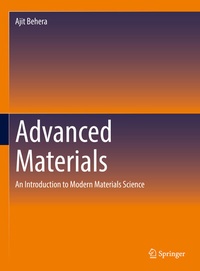
Advanced Materials
Description

This book provides a thorough introduction to the essential topics in modern materials science. It brings together the spectrum of materials science topics, spanning inorganic and organic materials, nanomaterials, biomaterials, and alloys within a single cohesive and comprehensive resource. Synthesis and processing techniques, structural and crystallographic configurations, properties, classifications, process mechanisms, applications, and related numerical problems are discussed in each chapter. End-of-chapter summaries and problems are included to deepen and reinforce the reader's comprehension.
- Provides a cohesive and comprehensive reference on a wide range of materials and processes in modern materials science;
- Presents material in an engaging manner to encourage innovative practices and perspectives;
- Includes chapter summaries and problems at the end of every chapter for reinforcement of concepts.
More details
Other editions
Additional editions
Person
Prof. Behera is an Assistant Professor in the Metallurgical and Materials Engineering Department at National Institute of Technology, Rourkela, India. He is working in the area of Smart materials, Nanotechnology, Characterization of materials, Cryo-treatment of materials, and Plasma surface Engineering. He has taught courses on 'Advanced Materials' and 'Materials Science and Engineering' for more than three years. He was awarded the 'Young Faculty Award' in 2017 and 'C.V. Raman National Award' in 2018. He is an active editorial board member and reviewer in many reputable journals. His collaborative and interdisciplinary research influences and enhances cutting-edge technologies on an international scale.
Content
Shape Memory Materials.- Piezoelectric Materials.- Nanomaterials.- Magnetostrictive Materials.- Chromogenic Materials.- Smart Fluid.- Super alloys.- High Entropy Alloys . - Bulk Metallic Glass.- Self-Healing materials.- Corrosion sensing and PH sensing materials.- Hydrophobic materials.- Ultra-light materials.- Biomaterials.- Advanced plastic materials.- Energy Harvesting Materials.- Advanced conductor/semiconductor materials.- Ultrafine-Grained Materials.- Alloys based on intermetallic compounds.- Metal-Organic Frameworks.
