

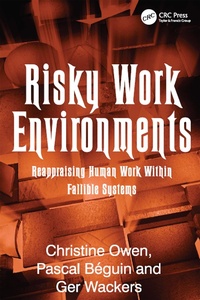
Risky Work Environments
Reappraising Human Work Within Fallible Systems
Published on 15. May 2017
226 pages
978-1-317-06253-0 (ISBN)
Description

Risky Work Environments provides new insights into the multiple and dynamic trajectories of both near misses and mistakes in complex work environments, based on actual case examples. It also studies the interactions between various activity systems or work practices (design, maintenance, incident investigation, regulation, operation) and their consequences for operational performance. The role of rules and regulations is explored, considering the consequences of deviations and the limitations of enforced compliance. Further, the book explains how to search for, think about and act on information about vulnerability, near misses and mistakes in a way that emphasizes accountability in ways that are not punitive but instead responsible, innovative and provide opportunities for learning. Writing from different disciplines and theoretical perspectives, the contributors analyse working in risky environments which include air traffic control, offshore mining, chemical plants, neo-natal intensive care units, ship piloting and emergency call dispatch centres. In each chapter the authors present rich empirical data and their analyses illustrate a variety of ways in which, despite imperfect systems, safety and resilience is created in human action. In the chapters where the focus is on error or mistakes, the analysis undertaken reveals the logic of actions undertaken at the time as well as their constraints. The contributors are all active researchers within their disciplines and come from Australia, Finland, France, Norway and the Netherlands. The book will be of direct interest to safety scientists, researchers and scientists, as well as human factors practitioners working in complex technological systems.
Reviews / Votes
'Amidst general theorizing regarding 'risk' as a condition of contemporary society, we are in urgent need of the kind of specific, historically and ethnographically based analyses offered to us in Risky Work Environments. The contributors to this collection bring the sensibilities and insights afforded by a range of current scholarship to a rich body of practical experience, both lived and observed. Rejecting the tired search for "human error", the authors ask instead: What are the dilemmas and contradictions built in to specific, complex sociotechnical systems, and how is it that persons living (with)in those systems come to know and help to mitigate their fallibility? The answers to those questions direct us to new understandings of safety, possible only through deepening and expanding practices of humility and care.' Lucy Suchman, Lancaster University, UK 'A well-managed collection of relevant and knowledgeable voices on a crucial topic in safety today: the human contribution to safety and resilience. This book takes the complexity and humanity of safety seriously, refusing to dumb it down to counting errors, and throws up examples from a whole range of domains to get through to the practitioner who actually needs to do this in real life. A book well worth your time.' Sidney Dekker, Lund University School of Aviation, Sweden 'In 1990, James Reason published his well-known book Human Error. In 2000, the US Institute of Medicine issued its report entitled To err is human?. This book proposes a different approach, focusing on the ways in which humans actively contribute to safety and system performance. A shift in perspective that was indeed needed.' Pierre Falzon, Cnam, Paris, past President of the International Ergonomics Association 'This book takes perfectly into account the multiplicity of ways by which risk analysis, diagnosis and prevention can be approached. The variety of authors' nationalities and specialities makes an original, enriching aMore details
Language
English
Place of publication
London
United Kingdom
Publishing group
Taylor & Francis Ltd
Target group
College/higher education
File size
35,53 MB
ISBN-13
978-1-317-06253-0 (9781317062530)
Copyright in bibliographic data and cover images is held by Nielsen Book Services Limited or by the publishers or by their respective licensors: all rights reserved.
Schweitzer Classification
Other editions
Additional editions
Pascal Beguin | Christine Owen
Risky Work Environments
Reappraising Human Work Within Fallible Systems
Book
10/2020
1st Edition
CRC Press
€94.27
The article will not be published
Pascal Beguin | Christine Owen
Risky Work Environments
Reappraising Human Work Within Fallible Systems
Book
03/2017
1st Edition
CRC Press
€83.90
Shipment within 10-20 days
Pascal Beguin | Christine Owen
Risky Work Environments
Reappraising Human Work Within Fallible Systems
Book
04/2009
1st Edition
Ashgate Publishing Limited
€231.60
Shipment within 10-20 days
Persons
Christine Owen is a senior researcher investigating communication, coordination and collaborative practices in high-technology, high-intensity, high-reliability environments. She is conducting research in aviation, and emergency medicine and emergency management environments. She has a particular interest in theories of activity and how learningful and developmental work environments may be enabled. She is currently Assistant Dean of the Faculty of Education at the University of Tasmania, Australia and national research program leader for Education, Training and Communication in the Australasian Bushfire Cooperative Research Centre. Pascal Beguin is Director of Research at the French National Institute for Agricultural Research (INRA). He has conducted researches in engineering companies, aviation, chemical industry and medicine (oncology). Pascal Beguin represents the French tradition of interventionist studies of design in work settings. He has a longstanding interest and experience in transformative approaches to participatory approaches in design. He has published extensively on the notion of instrumental genesis and its implications for the organization of design processes. Ger Wackers is assistant professor at the Department of Technology and Society Studies, Faculty of Arts and Culture, University of Maastricht. He was originally trained as a medical laboratory technician as a medical doctor. Subsequently he moved into science and technology studies. He holds a PhD in STS. He currently works on a research project on the vulnerability and reliability of complex technological systems, particularly in the offshore industry in the North Sea. He has an interest in transdisciplinary approaches in STS-research and has been writing with engineers on issues of reliability of complex technological systems.
Content
Contents: Introduction: shifting the focus to human work within complex socio-technical systems, Pascal Beguin, Christine Owen and Ger Wackers; Part I Identifying System Vulnerabilities within Incident and Accident Analysis: Learning from accidents: analysis of normal practices, Lenna Norros and Maaria Nuutinen; Derailed decisions: the evolution of vulnerability on a Norwegian railway line, Ragnar Rosness; Offshore vulnerability: the limits of design and the ubiquity of recursive process, Ger Wackers. Part II Accomplishing Reliability within Fallible Systems: Channelling erratic flows of action: life in the neonatal intensive care unit, Jessica Mesman; How do individual operators contribute to the reliability of collective activity? A French medical emergency centre, Jacques Marc and Janine Rogalski. Part III Enhancing Work Practices Within Risky Environments: When users and designers meet each other in the design process, Pascal Beguin; Near misses and mistakes in risky-work: an exploration of work practices in high-3 environments, Christine Owen; Conclusion: towards developmental work within complex and fallible systems, Christine Owen; Index.
