

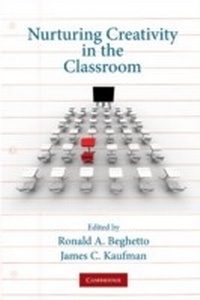
Nurturing Creativity in the Classroom
1st Edition
Published on 6. February 2012
978-1-139-20032-5 (ISBN)
Description

Nurturing Creativity in the Classroom is a groundbreaking collection of essays by leading scholars, who examine and respond to the tension that many educators face in valuing student creativity but believing that they cannot support it given the curricular constraints of the classroom. Is it possible for teachers to nurture creative development and expression without drifting into curricular chaos? Do curricular constraints necessarily lead to choosing conformity over creativity? This book combines the perspectives of top educators and psychologists to generate practical advice for considering and addressing the challenges of supporting creativity within the classroom. It is unique in its balance of practical recommendations for nurturing creativity and thoughtful appreciation of curricular constraints. This approach helps ensure that the insights and advice found in this collection will take root in educators' practice, rather than being construed as yet another demand placed on their overflowing plate of responsibilities.
Reviews / Votes
"What do leading scholars and researchers in the field of creativity think about developing creativity in the classroom? This fascinating book offers practical advice and concrete suggestions from many different perspectives and addresses a number of important questions. How does brainstorming in the classroom increase content knowledge? What are 'ideal acts' of learning? How do you combine creative and critical thinking in the curriculum? Beghetto and Kaufman in their excellent synthesis offer twenty key points about nurturing creativity in the classroom. This book is a very valuable addition to the field of creativity and education."- Sandra Russ, Case Western Reserve University "Nurturing Creativity in the Classroom is an essential addition to the library of anyone involved in education who cares about fostering student creativity. The chapters present the most current views of the foremost scholars in creativity and learning, with clear and readable syntheses of potential problems and pitfalls, contrasted with pointers and good practices to ensure that classrooms are vibrant homes to creativity. Own it, read it, and embrace the twenty key points listed in the Creativity in the Classroom Coda."
- Lisa F. Smith, University of Otago - College of Education, New Zealand "Ronald Beghetto and James Kaufman invited a diverse group of scholars to discuss in writing their most rigorous and cutting-edge ideas on the topic of classroom creativity. The results are refreshingly counter-intuitive. The book's recurring themes emphasize that developing student creative thinking requires expert guidance and role modeling in disciplined thought processes, persistence, deep content knowledge and risk taking within realistic constraints. By way of engaging language rich with examples, these chapters offer evidence-based advice on experiences that elicit creativity on the part of children, including suggestions for optimal timing, conditions, and purposes for these activities."
- Rena F. Subotnik, Director, Center for Psychology in Schools and Education, American Psychological Association "....Nurturing Creativity in the Classroom provides an important service through chapters that challenge long-standing, assumed dichotomies in American education.... Nurturing Creativity in the Classroom also includes two well-written articles about education for gifted students.... presents a broad view of the state of creativity research...."
- Michael Hanson, Teachers College Record "....Nurturing Creativity in the Classroom is a creative landmark in its unique and revolutionary way of reconceptualizing creativity in its relation to academic learning and in creative learning strategies that may be incorporated with standard methods of learning in the classroom. Its purpose to initiate change in how creativity is perceived, received, and implemented in the classroom setting is lofty, given the predominant emphasis on basic academic learning standards.... the scientist-practitioner approach to content should enhance the value of the book for educators, school psychologists, educational psychologists, and other professionals (practitioners and researchers) interested in creativity and the learning process.... academic and creative brothers can finally embrace."
- Giselle B. Esquivel, PsycCRITIQUES
More details
Language
English
Place of publication
Cambridge
United Kingdom
Publishing group
Cambridge University Press
Target group
Professional and scholarly
College/higher education
Illustrations
20 Tables, unspecified; 18 Line drawings, unspecified
File size
3560,35 MB
ISBN-13
978-1-139-20032-5 (9781139200325)
Copyright in bibliographic data and cover images is held by Nielsen Book Services Limited or by the publishers or by their respective licensors: all rights reserved.
Schweitzer Classification
Other editions
Additional editions
Ronald A. Beghetto | James C. Kaufman
Nurturing Creativity in the Classroom
Book
06/2010
Cambridge University Press
€38.37
Article exhausted; check for reprint
Ronald A. Beghetto | James C. Kaufman
Nurturing Creativity in the Classroom
Book
06/2010
Cambridge University Press
€82.94
Article exhausted; check for reprint
Persons
Ronald A. Beghetto, Ph.D., is an Associate Professor of Education Studies at the University of Oregon. His scholarship focuses on promoting creativity in K-12 classrooms and the influence of past schooling experience on K-12 teacher development. His recent publications on creativity and teacher development appear in a wide variety of scholarly journals - including the Creativity Research Journal, the Journal of Creative Behavior, Creativity and Thinking Skills, Educational Psychologist, the Journal of Advanced Academics, the Journal of Research in Science Teaching, and the Journal of Educational Research - and edited volumes: Creativity and Reason in Cognitive Development, Creativity: From Potential to Realization, Creativity: A Handbook for Teachers, Critical Issues and Practices in Gifted Education, and Rethinking Gifted Education. He serves on the editorial boards of Psychology of Aesthetics, Creativity, and the Arts; the Journal of Creative Behavior; and the Journal of Educational Research and is an Associate Editor for the International Journal of Creativity and Problem Solving. He is the 2008 recipient of the Daniel E. Berlyne Award from the American Psychological Association's Division 10. He has also received awards for excellence in teaching, including the 2005-2006 Crystal Apple Ersted Award for Outstanding Teaching from the University of Oregon. James C. Kaufman, Ph.D., is an Associate Professor of Psychology at the California State University at San Bernardino, where he directs the Learning Research Institute. His research broadly focuses on nurturing and encouraging creativity. He is specifically interested in creativity's role in fairness, everyday creativity, increasing creativity in the classroom, and the structure and assessment of creativity. He is also interested in related topics such as intelligence, personality, motivation, and thinking styles. Kaufman is the author or editor of 16 books, either published or in press, including Creativity 101, Essentials of Creativity Assessment (with Jonathan Plucker and John Baer), the International Handbook of Creativity (with Robert Sternberg), and Applied Intelligence (with Robert Sternberg and Elena Grigorenko). His research has been featured and discussed in the articles or broadcasts of CNN, NPR, New York Times, Los Angeles Times, New Yorker, and the BBC. Kaufman is a founding co-editor of the official journal for the APA's Division 10, Psychology of Aesthetics, Creativity, and the Arts and edits the International Journal for Creativity and Problem Solving. He is also the Associate Editor of Psychological Assessment and the Journal of Creative Behavior. He received the 2003 Daniel E. Berlyne Award from APA's Division 10, the 2008 E. Paul Torrance Award from the National Association of Gifted Children, and the 2009 Early Career Research Award from the Western Psychological Association.
Content
1. How to discourage creative thinking in the classroom Raymond S. Nickerson; 2. Teaching for creativity in an era of content standards and accountability John Baer and Tracey Garrett; 3. Developing creative productivity in young people through the pursuit of ideal acts of learning Joseph S. Renzulli and Catharina F. de Wet; 4. Creativity: a look outside the box in classrooms Alexinia Young Baldwin; 5. Using constraints to develop creativity in the classroom Patricia D. Stokes; 6. Infusing creative and critical thinking into the curriculum together Elizabeth Fairweather and Bonnie Cramond; 7. The five core attitudes, seven I's, and general concepts of the creative process Jane Piirto; 8. Learning for creativity R. Keith Sawyer; 9. Broadening conceptions of creativity in the classroom Ronald A. Beghetto and James C. Kaufman; 10. Everyday creativity in the classroom: a trip through time with seven suggestions Ruth Richards; 11. Education based on a parsimonious theory of creativity Mark A. Runco; 12. Roads not taken, new roads to take: looking for creativity in the classroom Thomas Skiba, Mei Tan, Robert J. Sternberg and Elena L. Grigorenko; 13. Creativity in mathematics teaching: a Chinese perspective Weihua Niu and Zheng Zhou; 14. Possibility thinking and wise creativity: educational futures in England Anna Craft; 15. When intensity goes to school: overexcitabilities, creativity, and the gifted child Susan Daniels and Michael M. Piechowski; 16. Intrinsic motivation and creativity in the classroom: have we come full circle? Beth A. Hennessey; 17. Attitude change as the precursor to creativity enhancement Jonathan A. Plucker and Gayle T. Dow; 18. Creativity in college classrooms Diane F. Halpern; 19. Teaching for creativity Robert J. Sternberg; 20. Creativity in the classroom coda: 20 key points and other insights James C. Kaufman and Ronald A. Beghetto.
