

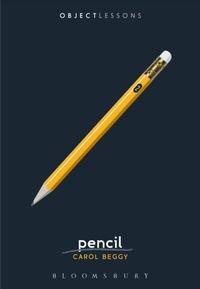
Pencil
1st Edition
Published on 8. February 2024
152 pages
978-1-5013-9222-1 (ISBN)
Description

Object Lessons is a series of short, beautifully designed books about the hidden lives of ordinary things.
A cylinder of baked graphite and clay in a wood case, the pencil creates as it is being destroyed. To love a pencil is to use it, to sharpen it, and to essentially destroy it.
Pencils were used to sketch civilization's greatest works of art. Pencils were there marking the choices in the earliest democratic elections. Even when used haphazardly to mark out where a saw's blade should make a cut, a pencil is creating. Pencil offers a deep look at this common, almost ubiquitous, object.
Pencils are a simple device that are deceptively difficult to manufacture. At a time when many use cellphones as banking branches and instructors reach students online throughout the world, pencil use has not waned, with tens of millions being made and used annually. Carol Beggy sketches out how the lowly pencil is still a mighty useful tool.
Object Lessons is published in partnership with an essay series in The Atlantic.
A cylinder of baked graphite and clay in a wood case, the pencil creates as it is being destroyed. To love a pencil is to use it, to sharpen it, and to essentially destroy it.
Pencils were used to sketch civilization's greatest works of art. Pencils were there marking the choices in the earliest democratic elections. Even when used haphazardly to mark out where a saw's blade should make a cut, a pencil is creating. Pencil offers a deep look at this common, almost ubiquitous, object.
Pencils are a simple device that are deceptively difficult to manufacture. At a time when many use cellphones as banking branches and instructors reach students online throughout the world, pencil use has not waned, with tens of millions being made and used annually. Carol Beggy sketches out how the lowly pencil is still a mighty useful tool.
Object Lessons is published in partnership with an essay series in The Atlantic.
Reviews / Votes
A fascinating voyage of discovery demonstrating why, in an age of electronic everything, the pencil still grips us. * Daniel Rosenberg, Professor of History, University of Oregon, USA, and author of Cartographies of Time: A History of the Timeline * This tribute to the lowly pencil is a celebration of the life of the mind and hand. Born in the sixteenth century, this familiar writing instrument lives on in our digital age as a tool of thought, indispensable for some, an object of nostalgia for others, collectible or disposable, a bond of community or a companion in solitude. Carol Beggy captures the presence of pencils in our lives with enthusiasm and wit. Her book is an object lesson in how to see and appreciate the humblest elements of existence and not to take anything for granted. * Robert A. Gross, author of The Transcendentalists and Their World (2021) * Pencil is a quick read (113 pages in 10 chapters), and an interesting exploration of where and how pencils are made, what sets them apart from each other, and how they maintain their usefulness and appeal in a world inundated with technology. After all, there's a reason that an estimated two billion pencils are made worldwide every year. * Society for Technical Communication *More details
Series
Edition
1. Auflage
Language
English
Place of publication
New York
United States
Publishing group
Bloomsbury Publishing PLC (Digital)
Target group
Professional and scholarly
ISBN-13
978-1-5013-9222-1 (9781501392221)
Copyright in bibliographic data and cover images is held by Nielsen Book Services Limited or by the publishers or by their respective licensors: all rights reserved.
Schweitzer Classification
Other editions
Additional editions
Person
Carol Beggy is an award-winning writer and editor, who worked for many years as a print journalist, including 15 years with The Boston Globe. She has worked as a public relations consultant, a television producer, an editor for blogs and newsletters, a producer and talent booker for podcasts, and speechwriter. She is the author or co-author of 10 books, including six with renowned Boston photographer Bill Brett. She is a graduate of Northeastern University.
Content
Introduction
1. Variations on a Theme
2. Making Their Mark
3. Tools of the Trade
4. People and Their Pencils
5. To Boldly Go
6. Collectors Versus Users
7. Pencils in the Wild
8. A Thoreau Job
9. Pencils Up
10. #FindYourPeople
Afterword
Notes
Acknowledgments
Selected Bibliography and Suggested Further Reading
Index
1. Variations on a Theme
2. Making Their Mark
3. Tools of the Trade
4. People and Their Pencils
5. To Boldly Go
6. Collectors Versus Users
7. Pencils in the Wild
8. A Thoreau Job
9. Pencils Up
10. #FindYourPeople
Afterword
Notes
Acknowledgments
Selected Bibliography and Suggested Further Reading
Index
